In 1986, a young hacker writing as The Mentor published The Conscience of a Hacker after his arrest. “My crime is that of curiosity” does not ask for leniency; it turns the accusation around. Who decides that opening a box, understanding a protocol or sharing knowledge is a crime? I follow that question through a history of hacking as counter-power.
Before the pirate: an ethics of access
Long before the mythology of cybercrime, “hacker” circulated through the Tech Model Railroad Club and MIT laboratories. It named practical intelligence: dismantling, understanding, improving, repurposing. Steven Levy described this culture in Hackers (1984): access to machines, circulation of information, suspicion of hierarchy, and the possibility of beauty in code. Phone phreaking revealed the hidden rules of telephone networks; the blue boxes built by Steve Wozniak and Steve Jobs already show how closely technical counterculture and industry could share their inventors.
The Mentor’s text, published in Phrack in September 1986, turned a practice into a collective voice. It did not prove that hackers are always right. It argued that a society which locks down its machines also creates people determined to read the locks.
Organising curiosity
Founded in 1981, the Chaos Computer Club made this inquiry public. In 1984 its demonstration against Germany’s BTX videotex system exposed a vulnerability, diverted a large sum and returned it: a way of making visible what an institution preferred to ignore. To me, this strategy matters more than the lone-genius myth. It creates a public capable of discussing the infrastructures around it.
Richard Stallman’s GNU project, launched in 1983, politicised code differently: free software means the freedom to study, modify and share, not simply a zero price. Cypherpunks made encryption a response to surveillance. These paths produced lasting conflicts: who can inspect a system, copy it, and control its traces?
Two manifestos, two scales
I met McKenzie Wark in the 2000s, while I was making alternative, open media. In A Hacker Manifesto (2004), the hacker is not simply someone entering a computer. A hacker produces a new abstraction: code, but also a formula, image, concept, protocol or collective form of life. Wark calls the class that owns the channels and stores of information, and captures the value of such inventions, the “vectoralist class”.
The book’s force lies in its account of ownership. We should look beyond individual exploits to the path of an idea: who invents it, carries it, makes it visible, encloses it and profits from it? That is why the manifesto concerns me as an artist. A work can hack a language, an institution or a distribution chain without touching a line of code.

Teleweb and tv-art: rerouting the channel
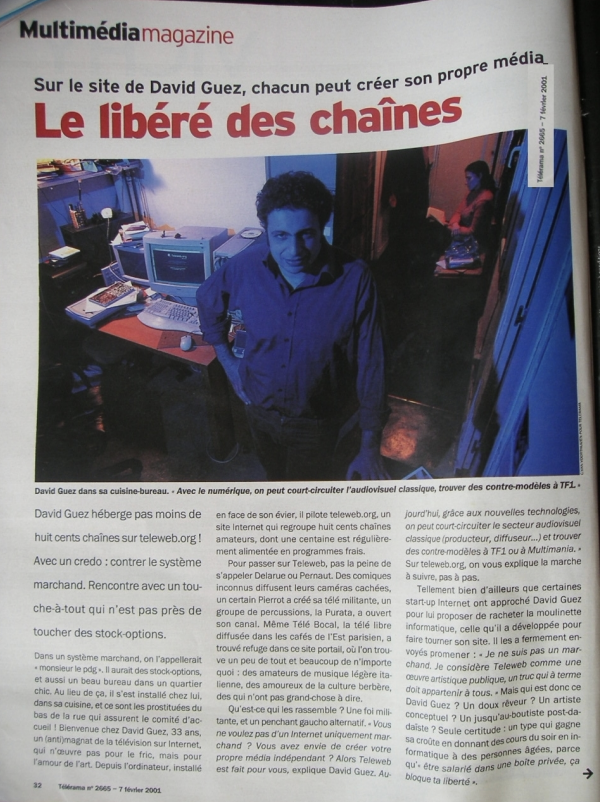
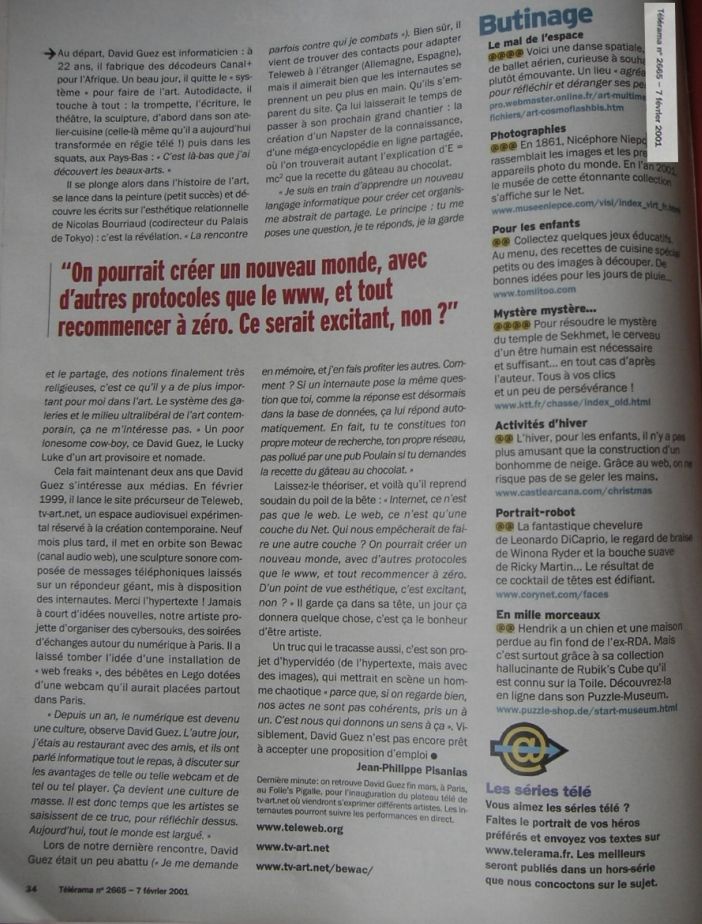
With Teleweb.org and tv-art.net around the turn of the millennium, I tried to bypass conventional audiovisual distribution. The question was not merely to make different images. I wanted to change their route: let others create their own media, circulate video art on the Web, and shift the boundary between broadcaster and spectator. In a 2001 Télérama interview I imagined “a new world, with protocols other than the Web”. Today I hear both an artistic hypothesis and a political desire in that sentence.
The two press pages reproduced from my archive document a moment when hacking a medium meant opening its infrastructure to other authors, before giant platforms recentralised distribution and income.
When repurposing becomes art
The history also runs through net.art. JODI made the apparent bug and unpredictable behaviour of a website into artistic material. etoy confronted eToys over names and trademarks in the late 1990s: network ownership became the stage of the work. The Electronic Disturbance Theater turned the sit-in into networked action with FloodNet in solidarity with the Zapatistas. Critical Art Ensemble and The Yes Men shifted the logic towards fake sites, borrowed corporate identities and institutional critique.
More recently, !Mediengruppe Bitnik mailed a camera to Julian Assange, Forensic Architecture reconstructed violence from scattered traces, and Trevor Paglen made surveillance infrastructure visible. Hacking becomes a method of inquiry and staging: not merely attacking a device, but exposing the political rules it presents as natural.
The boundary: disobedience and accountability
Aaron Swartz embodies a tragic side of this question: making knowledge accessible can collide with the ownership regime of scientific archives. By contrast, the disruptive actions of Anonymous or LulzSec remind us that theatricality and the capacity to cause harm do not automatically confer nobility. I use that word to name a demand, not a status: make systems legible, enlarge freedom, and accept public scrutiny of the consequences.
With AI, who owns the gesture?
Artificial intelligence makes Wark’s analysis suddenly contemporary. Our gestures, images and writing feed models, while a few companies own the computation, organised data, interfaces and distribution channels. Creation circulates; its value concentrates. The hacker’s question is not only “can a model be repurposed?” but “who may inspect its rules, challenge its categories and choose what it extracts?”
Artists already work at this boundary. Adam Harvey’s CV Dazzle tests appearances that interfere with face detection; Zach Blas builds collective masks resisting biometric reduction; James Bridle explores the limits of autonomous cars. More recently, Glaze and Nightshade have sought to give creators leverage over the use of their images in model training. None is a universal recipe against facial recognition or AI: these are situated experiments whose effects depend on the system and context.
Project: a machine for elucidating rules
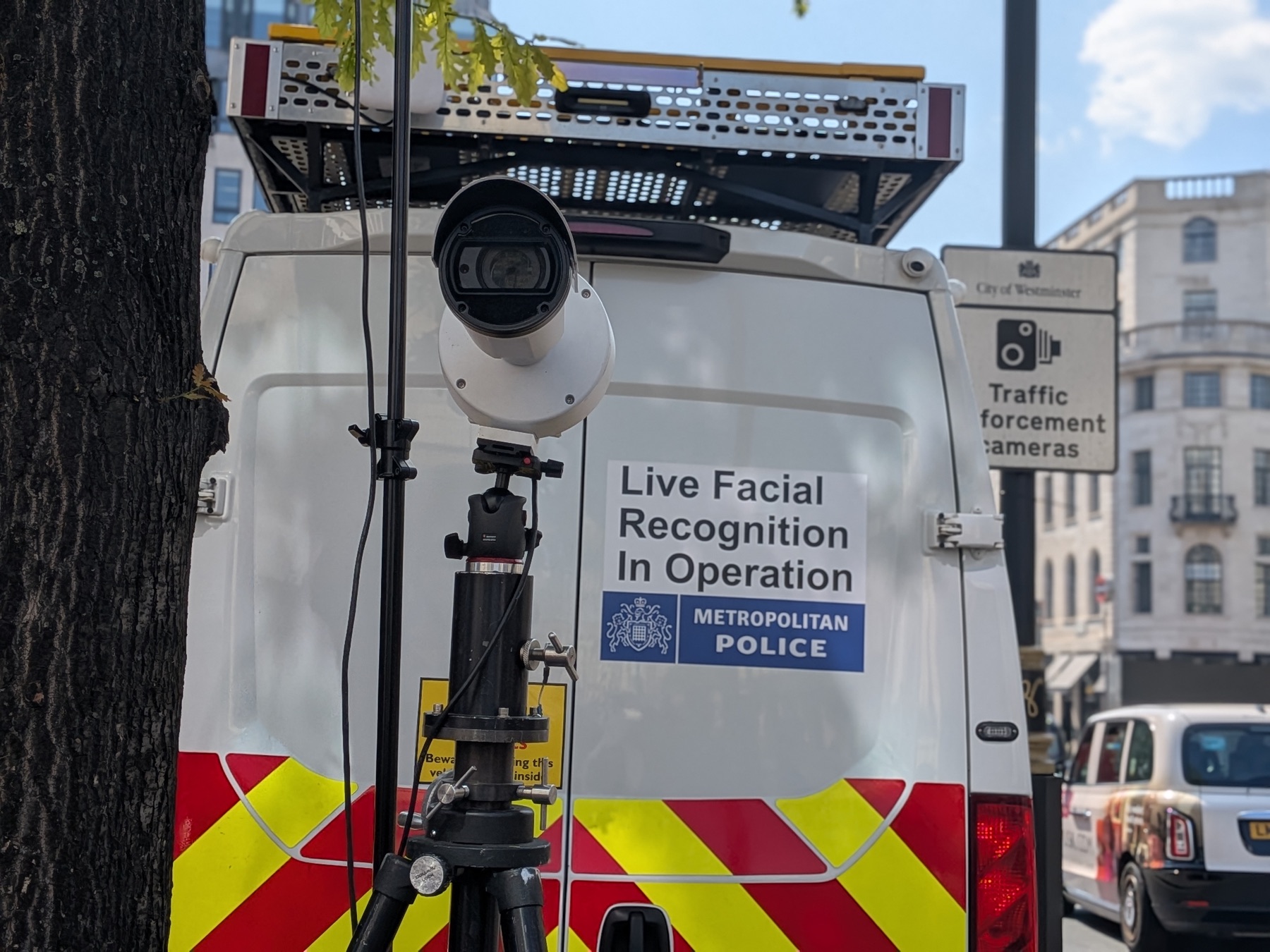
I want to extend this history with an AI-driven tool. A person submits a concrete situation — facial recognition in public space, for instance. The tool first maps its rules: technical standards, data, actors, contracts, laws, habits, economic interests, control points and opaque areas. Every assertion is tied to a source and an uncertainty level. It then suggests where intervention might change the situation.
For facial recognition, three paths might emerge: test visual, lighting or movement strategies with volunteers and within the law, measuring their actual effects; make system biases and errors publicly contestable; and design an institutional protocol limiting deployment or granting an effective right to challenge it. The decisive hack might be a mask. It might instead be an audit, a procurement rule, or evidence that the system must be withdrawn.
The tool would preserve discarded hypotheses as well as promising ideas. It would show how a problem changes when viewed by an artist, a user, an engineer, a lawyer, a public employee or a person under surveillance. It would provide neither automated intrusion nor a magical guarantee of invisibility. Its task is to open the black box of constraints and make other arrangements thinkable.
“My crime is that of curiosity” could then become a creative method: refusing to accept rules as a landscape, and learning to see them precisely enough to invent different ones.