Creating for a world in which we will no longer be here
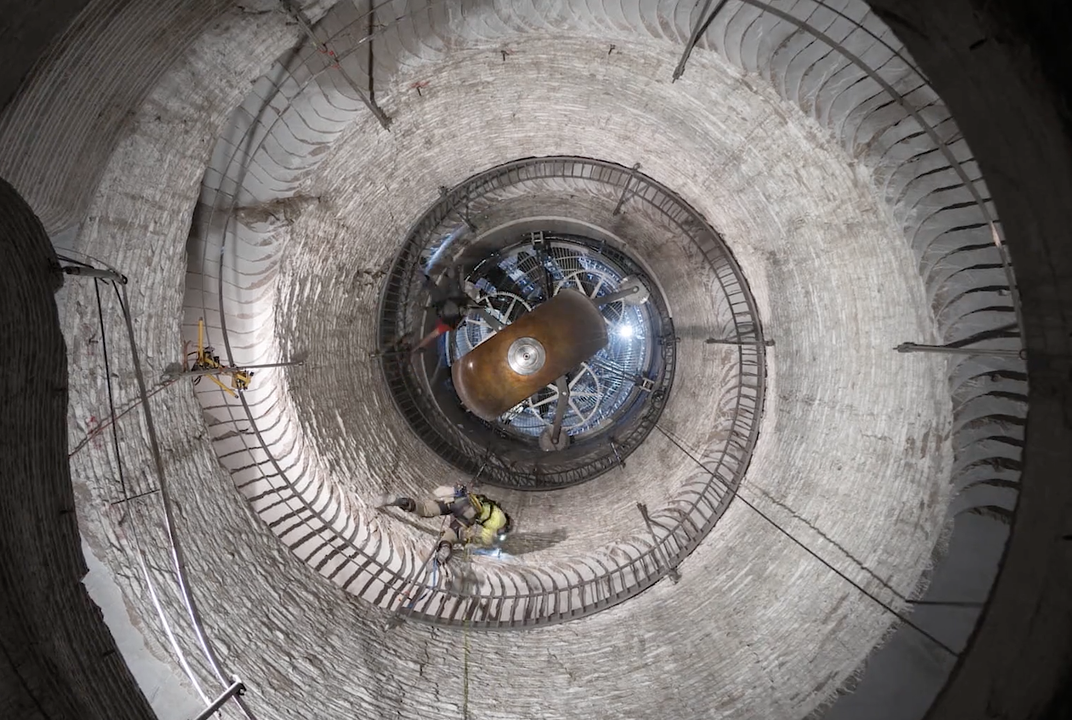
Somewhere inside a mountain in West Texas, a clock is being built that may still be running after almost everything we know has disappeared. It does not really measure our time. It measures our absence.
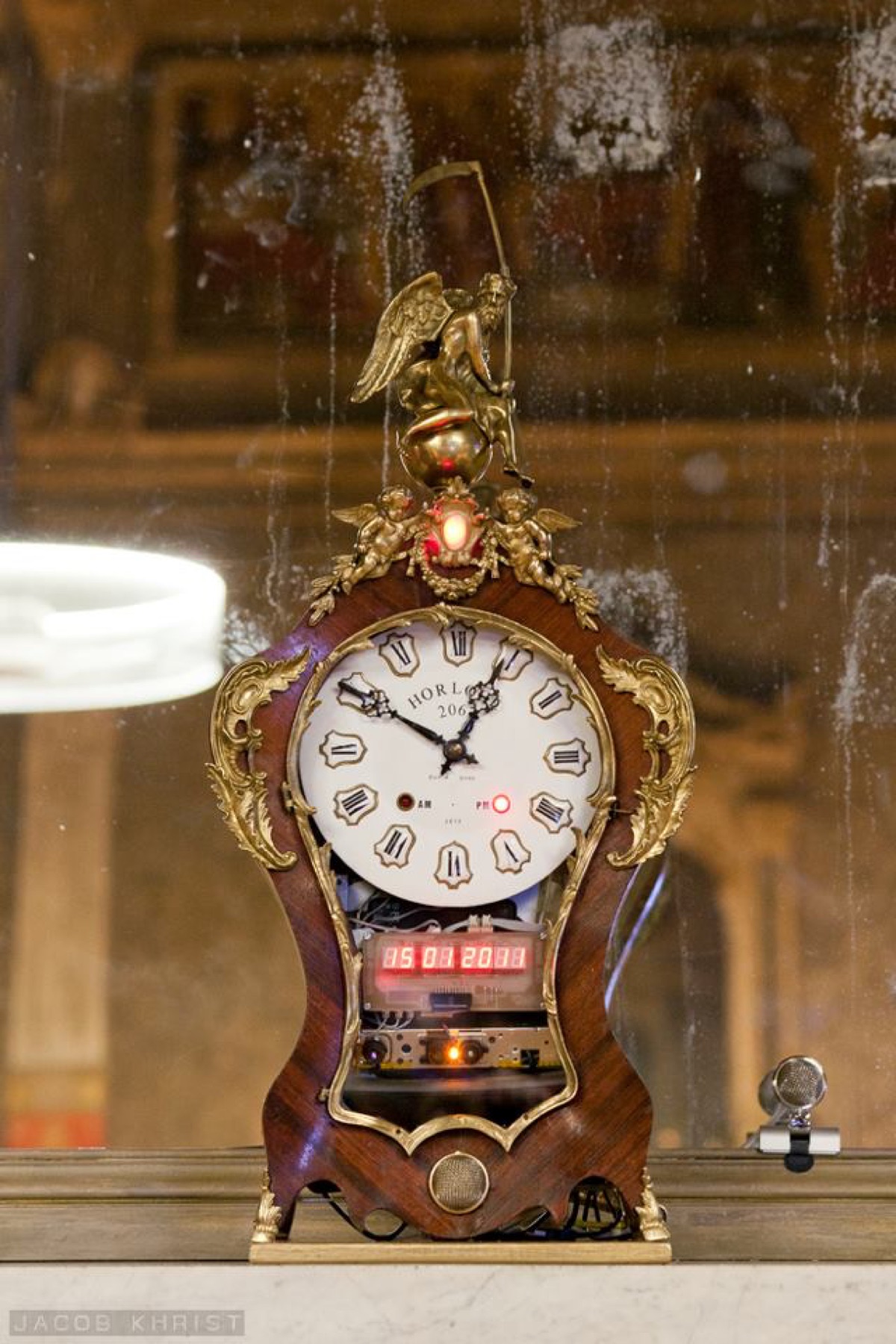
The Clock of the Long Now, imagined by computer scientist Danny Hillis, is designed to run for 10,000 years. It is mechanical, set inside a mountain, powered in part by day-to-night temperature changes and synchronised by sunlight. The Long Now Foundation presents it not simply as an engineering feat, but as a machine meant to alter our sense of time.
Ten thousand years. To grasp that distance, reverse the perspective. Ten thousand years ago, agriculture was transforming human societies. Writing did not yet exist. Neither did modern states, our present languages or religions, let alone the technologies with which we now record our lives. To imagine ten thousand years ahead is to project a distance comparable to the one separating us from that world—and to assume that someone will still be there to look at the clock.
A shrinking future
In 1995 Danny Hillis published “The Millennium Clock” in Wired. The paradox is striking: Hillis, a founder of Thinking Machines who worked on the massively parallel Connection Machine, turned from accelerating computation to imagining an extraordinarily slow machine.
His intuition was that our time horizon was shrinking. When he was a child, 1984 or 2001 still seemed like mythic futures. Those dates became the present, without being replaced by equally powerful horizons. His answer was a clock that would run for 10,000 years: a machine slow enough to force its visitor to change scale.
02026
Brian Eno gave this intuition a name: the Long Now. We usually think of the present in hours, weeks or years: a company plans for the next quarter, a government for the next election, a social network for the next few hours.
The Long Now stretches that present. The Foundation writes years with five digits: 2026 becomes 02026. The extra zero is almost useless, yet it changes the frame. It lets us write 12026 and stops our own era from occupying the privileged centre of history. We become one point on a much longer line.
Building something for 10,000 years
An idea about time becomes interesting when it meets matter. How do you build a machine for ten millennia? It must be durable, understandable and repairable. Ceramic bearings need no conventional lubrication and resist corrosion. The mechanism is meant to accept improvements from future caretakers.
This is almost the opposite of our digital objects. A file may remain intact while its medium, reader, operating system and software disappear. A clay tablet can be read directly after millennia; a digital file only decades old may already require a computer archaeologist.
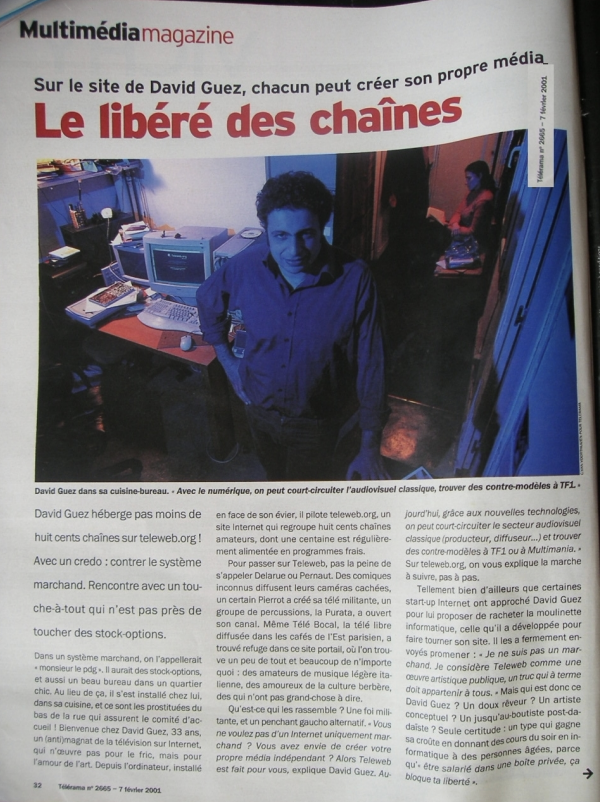
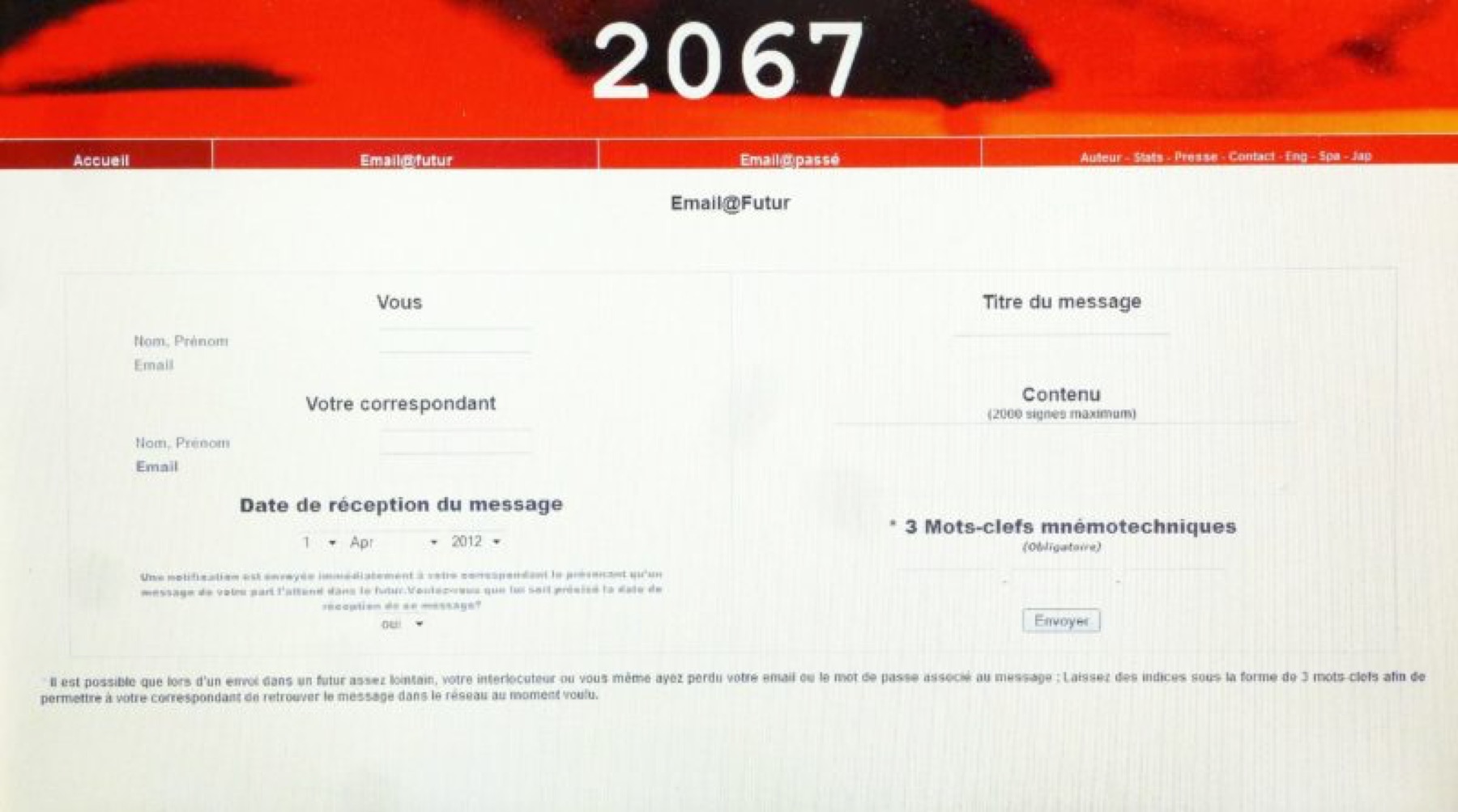
That is where the clock meets a question I had asked years earlier: how could an email be kept for fifty years? In 2067, Email to the Future, I made it possible to send a message that would be delivered in 2067. Behind this simple idea was a harder one: how do you preserve an email for half a century?
I turned the question around. Instead of asking which technology will still be available in fifty years, I asked which computing technology from fifty years ago remains understandable today. I came back to something elementary: a text file. An email is essentially text. Why lock it inside layers of databases and software, each adding another route to obsolescence?
Simplicity became a preservation strategy. A database must be interpreted; software must run; a proprietary format must be recognised. Plain text asks almost only to be read. This does not solve everything: media age, encodings evolve, data must be checked and recopied. Yet every dependency removed improves the chances of reconstruction. To send something into the future, perhaps we should first remove technology rather than add it.
The future has changed since 2067
I would ask the question again today—not because plain text has become a bad answer, but because new tools make other forms of transmission imaginable: optical storage in glass, synthetic DNA, distributed ledgers, new cryptography and quantum computing.
We should avoid looking for a definitive medium. It probably does not exist. The answer may be to let radically different technologies coexist.
Writing a message into glass
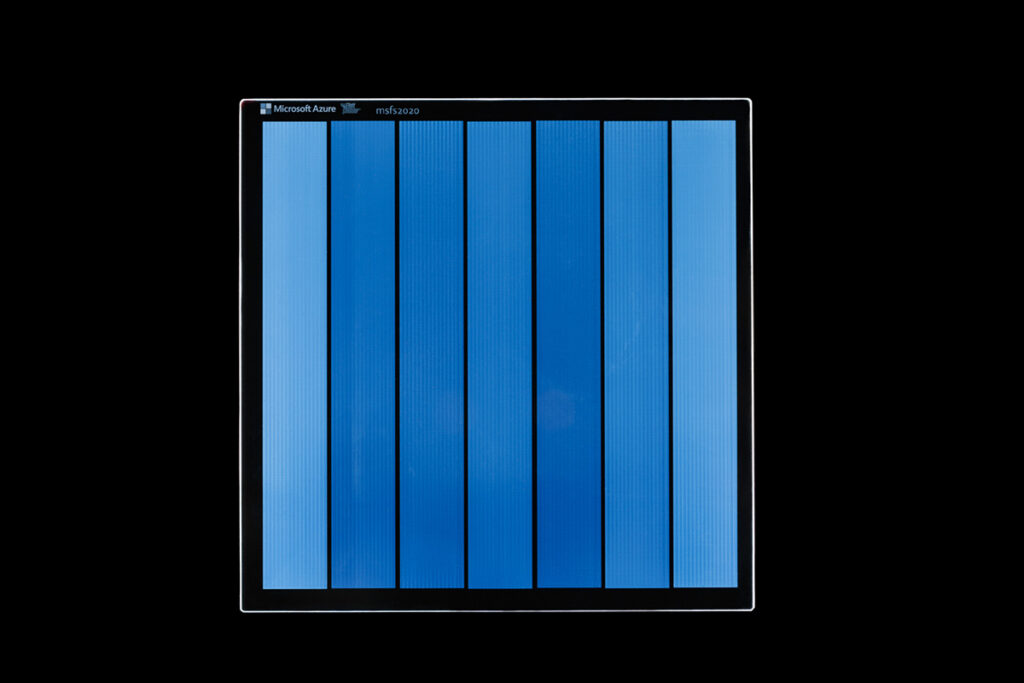
The idea sounds almost archaic: physically inscribe information into glass. Yet it is at the heart of current research. With Project Silica, Microsoft Research uses lasers to encode data in glass and read it optically. In February 2026, researchers announced a new generation using ordinary borosilicate glass and described a potential preservation horizon of 10,000 years, based on accelerated-aging research.
It is fascinating—but a glass plate full of data can also become incomprehensible without a reader, a description of the encoding and knowledge of how the information was written. A highly durable archive can become just a stone. Preserving information physically is not enough; we must preserve the possibility of understanding how to read it.
Writing in DNA
There is an even stranger possibility: use a technology that existed billions of years before computing—DNA. Molecular storage translates digital information into DNA sequences and synthesises the molecules. Experiments have encoded and retrieved text, images, sound and other data. DNA promises extraordinary density and archival stability, although cost, writing and reading speed, and access methods remain major obstacles.
The conceptual shift is immense. A message no longer sits on a disk; it is encoded in a molecule. One email could exist as plain text, in glass and in DNA: three material forms, one information. That multiplicity may matter more than the promise of any single eternal medium.
No original
We tend to imagine an archive as one object to protect. For a message intended for the future, that may be dangerous. A unique object can be destroyed; a unique technology can become obsolete; a unique place can disappear.
Perhaps a future-bound message should have no original. It could exist at once in different forms, places and technologies: plain text, a printed representation, ordinary digital storage, glass, perhaps DNA. Each version would contain enough information to reconstruct the others. Redundancy would no longer be a technical precaution; it would become the work’s very structure.
Blockchain: proving the past
A blockchain is not eternal. It depends on a protocol, a network, software and a community that keeps the whole system running. It does not magically solve the problem of time. But it introduces something useful for 2067: temporal proof.
The email itself need not be written into a distributed ledger. Its cryptographic fingerprint can be. The private message remains elsewhere, while its recipient can later verify that a matching message existed at the time of sending and was not changed. The future receives not only a message, but a message plus proof of its past.
The quantum problem
Quantum computing offers no obvious long-term storage solution; quantum states are notoriously delicate. It does, however, force us to consider how long cryptography will last. Data encrypted today may remain physically intact while its protection becomes inadequate.
This is no longer a problem we can ignore. In 2024, the US National Institute of Standards and Technology finalised its first three post-quantum cryptography standards and urged systems to begin migrating to algorithms designed to resist future quantum attacks.
A beautiful paradox appears: the message must be preserved well enough for the future to read it, yet protected well enough that the present cannot. Cryptography, too, becomes a technology of time.
The still message, the living machine
Today I would rethink 2067. I would not simply build a machine that stores messages for fifty years; I would build a system that maintains the possibility of their existence. Every ten or twenty years it would examine its technological environment. If a medium became fragile, the message would be copied. If a format became obsolete, it would be migrated. If cryptography weakened, protection would be renewed. A new storage technology would receive another copy once it became dependable enough.
One thing would never change: the message. The message would be still; the machine carrying it would keep evolving. This resembles life more than a safe. Genetic information crosses time while the organisms carrying it die and are replaced. 2067 could work the same way: not as a box, but as a lineage.
2067 would no longer be a date
Why stop at 2067? A sender could choose a temporal distance: ten, fifty, one hundred, five hundred, one thousand or ten thousand years. As the interval grows, the nature of the message changes. In ten years it is correspondence; in fifty, a time capsule; in five hundred, an archive; in ten thousand, an archaeological object we deliberately made.
At what point do we stop writing to a person and start writing to a civilisation?
Music for someone not yet born
The Clock of the Long Now contains an experiment of this kind. Brian Eno worked on its chime system. Ten bells can produce an enormous number of sequences, allowing the clock to play a different combination during its daily activations across millennia. Some sequences will never be heard by their designer. Music composed today may play when no one involved in its making is alive; some combinations may never be heard at all.
The score contains less a single piece of music than a field of possible futures. At this point the clock stops being, for me, merely a machine. It becomes an artwork.
Who do we make art for?
Art is usually made for a contemporary horizon: an exhibition in six months, a book next year, a video published today. Even when an artwork is intended to last, its first reception generally belongs to the present.
Imagine a work made in 02026 whose first public presentation is planned for 02226. No one who made it will be there—not the artist, not the curator, probably no one who knew the artist personally. The work stops being only an object. It becomes a transmission protocol, with a new actor between artist and viewer: time.
ARTIST → WORK → TIME → UNKNOWN RECIPIENT. Time is no longer the context of the work. It is its medium.
The unknown recipient
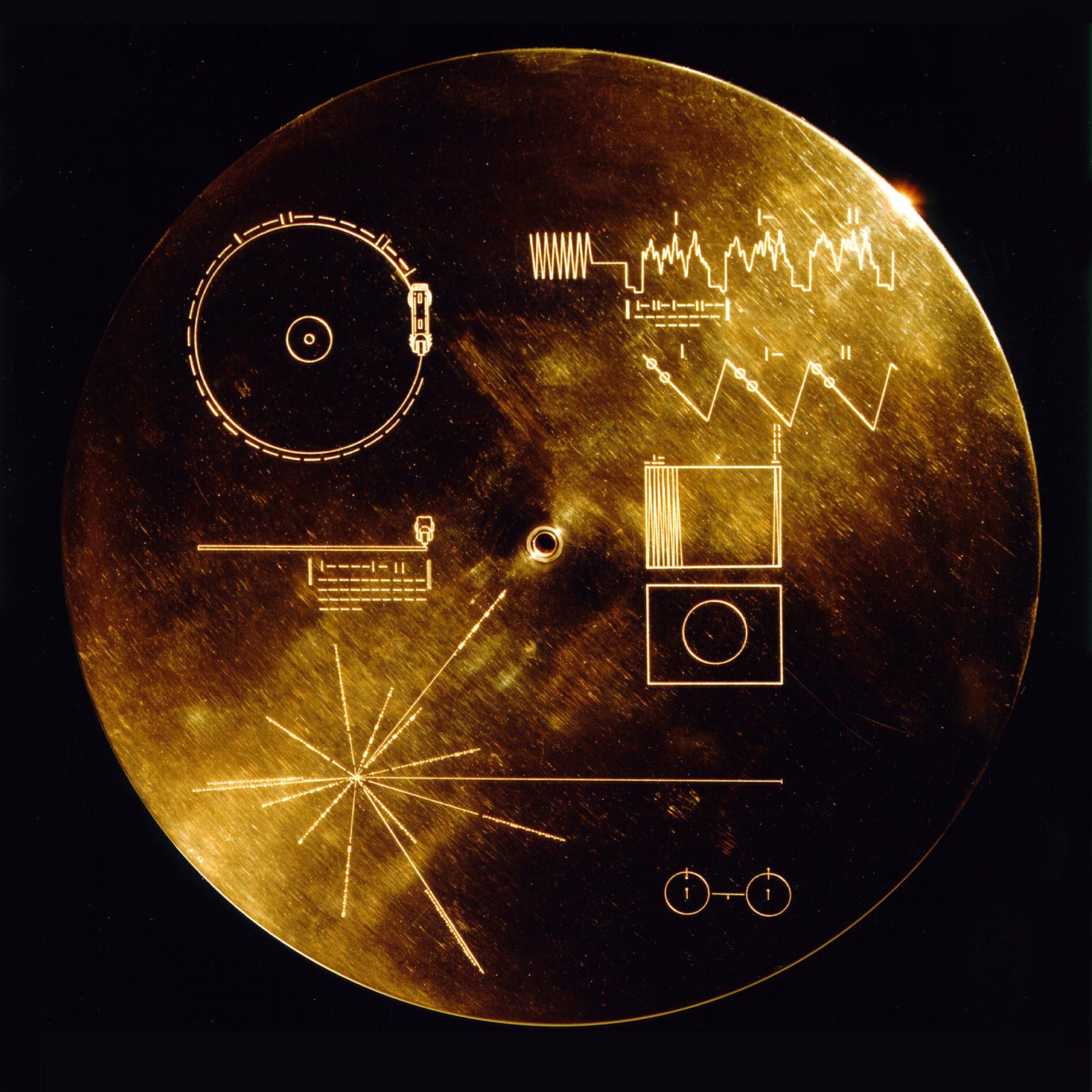
We already know this problem. Launched in 1977, the Voyager spacecraft carry their Golden Records: images, sounds, music and messages intended for a hypothetical extraterrestrial recipient. How do you explain to someone who knows no human language how to read a record? The message must carry part of its own instruction manual.
The same question faces us when we try to warn future humans about radioactive waste. How do we write DANGER for someone living thousands of years from now? A language disappears; a pictogram changes meaning; a threatening monument becomes fascinating; a prohibition becomes an invitation. The future shares one quality with the extraterrestrial: we do not know our recipient’s language.
From 2067 to 12026
I can imagine a radical extension of 2067. In 02026, someone writes a message addressed to 12026. It exists simultaneously across several media. One rule governs the project: each generation may change the medium, but never the message. Every fifty years, someone must find a way to carry it through the next fifty.
Glass may replace a disk; molecular technology may replace glass; a technology we cannot imagine may replace DNA. The true medium would be none of these supports. It would be transmission itself. For ten thousand years, people who never meet would collaborate to preserve the same message. The sender would not know the recipient; the final recipient would know none of the intermediate keepers. Yet all would belong to the same correspondence.
Are we good ancestors?
The Long Now Foundation often returns to a question associated with biologist Jonas Salk: “Are we being good ancestors?” It produces a strange shift. We think of ourselves as descendants—with parents, grandparents and ancestors. But we are simultaneously ancestors to people who do not yet exist. They cannot speak to us or ask us to preserve anything. And yet we are already leaving them carbon, plastic, nuclear waste, buildings, extinct species, artworks and billions upon billions of files.
Our era probably produces more digital traces than any other human era. But making more traces does not necessarily mean making more memory.
The paradox of simplicity
I return to my text file. After glass, DNA, blockchain, post-quantum cryptography and all the technologies still to come, it remains here: a few characters. Perhaps I asked the right question with 2067, but over too short a time span.
The technology best suited to the future may be neither the oldest nor the newest. It may be the one whose workings we can explain simply enough for someone else to rebuild. What matters may not be an eternal medium, but information capable of leaving its medium.
A machine that would never be finished
Danny Hillis says something essential about his clock: he does not know whether it will ever truly be “finished”. It was designed to be changed and improved by those who care for it after us. Perhaps this is where the Clock of the Long Now and 2067 become the same project.
The clock does not only try to survive ten thousand years. It asks successive generations to keep wanting it to survive. A message addressed to 12026 should probably do the same. We should not build a machine that runs for ten thousand years; we should build a machine someone will want to care for during ten thousand years. The difference is immense. The real preservation technology may be neither glass, DNA, diamond nor blockchain. It may be transmission.
12026
The Clock of the Long Now may never reach 12026. It could be destroyed, dismantled or forgotten. The mountain could become inaccessible; a future civilisation might no longer understand what we meant to do. But its first effect has already happened: we have just imagined 12026. For a few moments, our present grew larger. We thought about someone who might live millennia after we have disappeared.
When I imagined 2067, Email to the Future, I asked how to get a message to someone living fifty years from now. Today I would ask it differently: how far are we capable of accompanying a message? Perhaps the real project would no longer be 2067. It would have no date. It would be a machine that, generation after generation, asks one question: how can we carry this message a little farther than us?