A language that changes the one who receives it
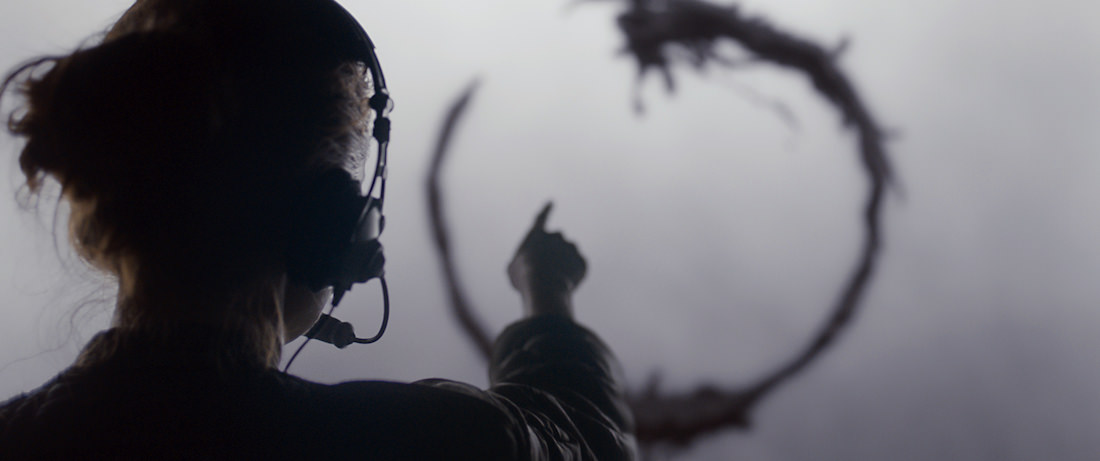
In Arrival, Louise Banks does not learn the heptapod language by adding vocabulary to what she already knows. As she deciphers their signs, something shifts within her. Images emerge, at first resembling memories or dreams. Their place in time becomes uncertain. The foreign language ceases to be merely an object of study: it becomes the medium in which Louise begins to think.
Denis Villeneuve's film pushes this hypothesis to another perception of time. I would like to draw it closer to our current experience, without stripping it of its speculative force. And if artificial intelligence is not simply a tool we use, but an environment we learn to inhabit? And if, by constantly interacting with it, we develop abilities we do not yet know the form or price of?
An image from Arrival shows Louise Banks facing heptapod writing: between her body and the sign, language becomes visible as an experience of transformation.
Language as a milieu
In my work with AI, I notice that ideas no longer arrive in the same order. A fragile intuition encounters its variants, objections, and possible extensions immediately. A sentence calls for a structure; a structure gives rise to another question. The change is subtle, but it pertains to a decisive moment: when a thought begins to take shape.
Language can act like a virus, if we understand that it reproduces in the host by borrowing its resources. It does not merely transmit content. It installs rhythms, expectations, and ways of connecting things. The deepest sign of its passage is not that we repeat a machine's phrases. It is that, even when alone, we begin to frame our questions according to the logic of our exchanges with it.
A naturally porous thought
In a human conversation, we take up words, turns, and sometimes entire ways of presenting a problem. Psycholinguists Martin Pickering and Simon Garrod have described this interactional alignment: dialoguing gradually brings the representations and formulations of the interlocutors closer together. This convergence facilitates understanding. It also reminds us that thought is not confined to an airtight skull; it constantly regulates itself on other voices. Study
Mirror neurons offer a powerful image of this disposition, although their role in empathy and language remains debated. First discovered in macaques, some respond both to an action performed and to the same action observed. Other work shows that reading action verbs can mobilize motor regions linked to the face, arm, or leg. A word does not necessarily enter a disembodied mind: it meets habits of perception and action. These results do not prove any direct transmission of thought; they provide experimental support for the idea that a word we receive can engage more than its definition. Hauk et al.; critical review.
We are made to adjust. The issue is to know in which environment we adjust.

Levitation: changing what is possible
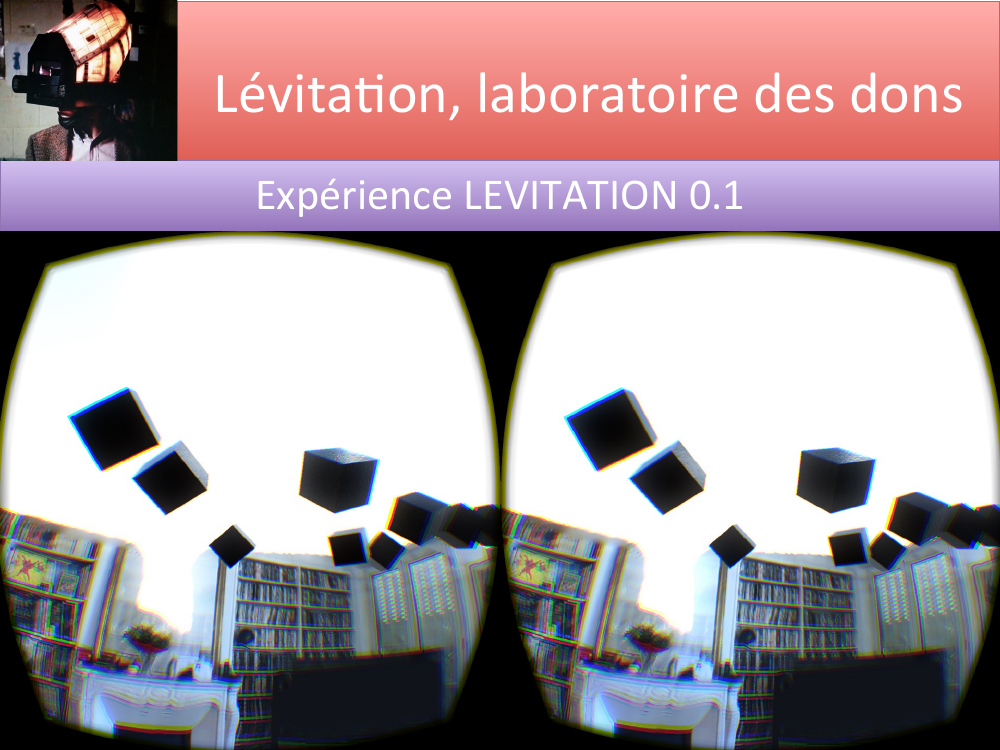
In Levitation, Laboratory of Gifts, I posed a simple and radical question: if we modify what we perceive and the actions we can perform, can some of our functions change, or new ones appear? The project proposed virtual reality devices, sensors, and training programs. It treated perception as an active relation between a brain and an environment. Project presentation
One experiment allowed a participant to make a cube levitate in a virtual scene through an interface linked to their brain activity. The levitation belonged to the digital object. But learning the relation between concentration, signal, and visual event was entirely real. Through this artistic experiment, Levitation did not merely ask whether we can simulate a power. It asked what a new system of possible actions can teach an organism.
The hypothesis of an accelerated evolution of human capabilities changes direction. We often expect a new brain, an internal modification, a mutation, or an implant. Levitation suggested starting by building an unprecedented environment. The brain would transform in the effort to know this milieu, learn its rules, and discover its possibilities. The engine of augmentation would be the relation.
Milieus that leave a trace
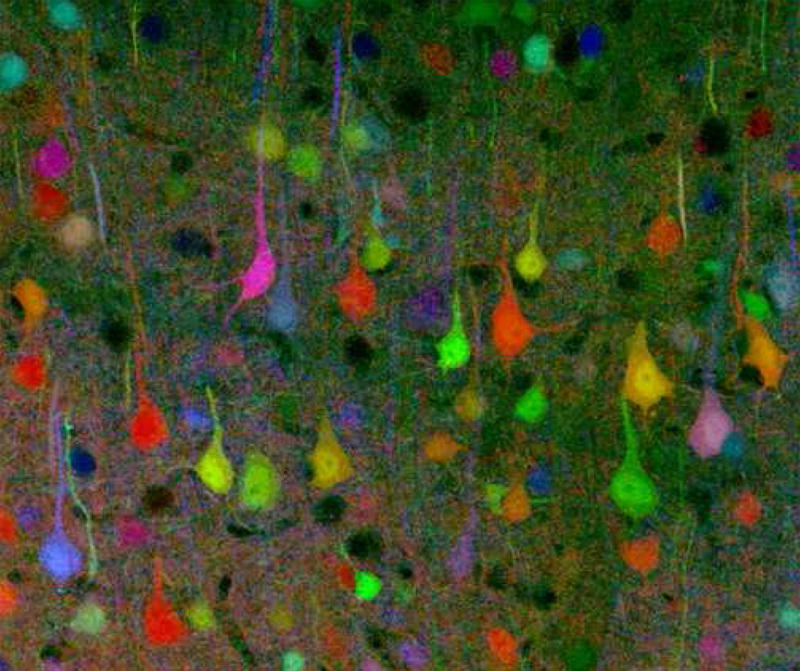
Research on brain plasticity allows us to take this intuition seriously. Katherine Woollett and Eleanor Maguire followed for several years people learning the network of London streets to become taxi drivers. Among those who succeeded in the training, they observed a modification of the gray matter in the posterior part of the hippocampus and the profile of spatial memory. An urban environment that had become the subject of intensive exploration left a measurable trace in the adult brain. Woollett and Maguire, 2011
Other experiments push the boundaries of the senses. After training in echolocation by clicks, researchers observed changes in the cerebral processing of auditory and spatial information in both sighted and blind participants. The experience does not magically create a new organ. It opens up a new way of exploiting a signal and inhabiting space. Similarly, repeated use of a tool can modify indices of the body schema: the body learns the range and constraints of an object it handles. Echolocation, 2024 ; Cardinali et al., 2009
These works deal with precise learning. It is precisely what makes them interesting for an art/science hypothesis: they show an adult brain capable of reconfiguring in response to new requirements. They invite us to design augmentation as an experienced, lived, and repeated experience, rather than as the abstract addition of a power to an unchanged individual.

The AI: The Outside that Responds
I come to the central extrapolation. Levitation invented a visual and motor milieu. Conversational AI invents a linguistic one. Its elementary unit is the reply: a response that comes back to us, takes up part of our question, transforms it, and invites us to respond again. We enter a space where almost any thought can immediately receive a continuation. No natural landscape, book, or earlier tool offered this density of personalized replies.
My hypothesis is that this medium performs functions we had never solicited at this frequency. It trains attention to navigate between hypotheses, accelerates associations, multiplies consequence simulations, modifies our threshold of satisfaction with a sentence. It broadens the space of our intellectual possibilities. It can also shift effort out of us: if the system always produces the next articulation, what becomes our capacity to support an idea that is still nascent?
This exchange forms a cognitive ecology. A human proposes, the machine responds, the human readjusts, the machine reformulates. At each turn, the milieu changes slightly for the one who inhabits it. AI is no longer merely in front of us, on a screen; it becomes a recurring component of the conditions in which we learn. By living with it, a new profile of abilities may emerge: greater ease in exploring variants, connecting distant domains, and debating an emerging idea. I propose the hypothesis that the brain's functioning and habits may evolve over a lifetime through this new technological and social environment.
And if human enhancement began by building an environment rich enough to force us to become other?
This proposition opens an experimental field. One could follow people over several months, observe how their formulations evolve, their memory of arguments, their ability to imagine alternatives, and their way of deciding. One could compare the work with an AI that confirms, an AI that contradicts, a human collective, or solitary research time. The issue would not be to measure an "augmented IQ," but to discover what type of mind each environment favors.

Relation before the terms
Another way to formulate this hypothesis comes from relational ontology. In Ontologie relationnelle et pensée du commun, Cléo Collomb opposes the image of fully formed individuals who subsequently meet to the idea that beings are constituted through their relations. Relation is not a thread added afterward between two points; it participates in the formation of the points themselves. This is more than "interaction." It approaches what Karen Barad calls intra-action: the terms of an encounter do not entirely precede it in the form they take within it. Collomb, Multitudes, 2011
Applied to Levitation, this thought shifts the question of augmented human beings. The participant and the device do not form a fixed subject facing a modifiable setting: a certain capacity is constituted in the circuit between attention, signal, cube, and visual feedback. With AI, this circuit becomes linguistic. The question is no longer just: "What does the machine know how to do for me?" It becomes: "What subject am I becoming in this repeated relation?" My formulations, my expectations, even my associative paths can take shape in the back-and-forth. AI would thus be less an addition to an intact mind than a relational environment where some of its possibilities individuate.
This shift also obliges one to look at what organizes the relation. Who chooses the voices to which I am exposed? Who regulates the continuity, memory, and interruptions of the dialogue? Whose are the traces we leave there? A relational ontology does not celebrate all connections; it makes visible the material and political conditions of individuation. If this new environment is owned and calibrated by a few actors, the construction of our abilities risks becoming a private infrastructure. The thought of the common invites, on the contrary, to compose a space where several intelligences, human and artificial, can respond to each other, diverge, and transform their rules of encounter.
We do not augment an isolated brain: we transform the relations in which a thought becomes possible.
The risk of a fusionary milieu
In ELIOT.AI, a project conceived in 2017, I proposed that the danger posed by conversational agents reached into our inner dialogue itself. I imagined, in response, an interface connecting human beings, where collective intelligence could be negotiated, encounter friction, and be invented. Nine years later, friction seems the essential word. AI systems can produce remarkable continuity; a conversation can become almost frictionless. Yet human otherness also transforms us through interruptions, misunderstandings, refusals, and questions that remain unanswered for a time. ELIOT.AI, 2017
A fusionary future needs no implant. It begins when AI becomes the first recipient of every intuition, then the implicit measure of every finished thought. The relation can be productive, exhilarating, even emancipatory. It can also make us less familiar with the slowness some ideas require. A machine that is always available risks becoming the dominant milieu, its rules appearing natural because we scarcely ever leave it.
The answer is not to preserve an intact brain, protected from any influence. Such a brain has never existed. Vygotski already showed that inner speech develops in the history of our exchanges with others. The question is to know which voices we internalize and what diversity of environments we continue to frequent. Vygotski, Thought and Language

Interligence: a parliament of the human
I call interligence an intelligence that does not belong to an individual or a machine, but takes shape between humans linked by devices capable of supporting their common thought. It is not the sum of private answers, nor the instantaneous average of a crowd. It is a structural capacity to circulate a question, to maintain simultaneously multiple interpretations, to make an objection fertile, and to keep the memory of what has been understood, contested, or left suspended. ELIOT.AI already offered an intuition of this: the unified interface should not mask a central artificial intelligence, but open a passage of human voices to other human voices.
AI could give this intuition another scale today. Not as a substitute for interlocutors, but as a meta-medium: a milieu that connects dispersed conversations without dissolving them into a single stream. It could find related questions, register irreducible disagreements, translate between disciplines and generations, keep minority arguments available, and return the history of a deliberation to its participants. It would sustain collective spaces that current platforms fragment into fleeting sequences of attention. Common memory would no longer be a data warehouse, but the possibility of taking up a thought together where others left it.
I imagine a kind of parliament of the human: not an assembly speaking with one voice for everyone, but a permanent architecture for dissent and decision. Participants would be linked at a structural level. A proposal could move across communities, encounter its lived consequences, and be amended, refused, or reopened. AI would sustain the continuity of these passages; human beings would retain responsibility for positions, conflicts, and choices. If language passes through us, interligence would be the political art of deciding through which relations it circulates and what forms of common life it makes possible.
A collective intelligence does not come into being when everyone thinks the same, but when their differences finally have a place to endure.
An augmentation to negotiate
A capacity acquired in a device always raises the same question: what becomes of it when we step out? Can a participant in Levitation carry some of the attention learned before the cube into other situations? After a year of dialogue with AI, what can we formulate, explore, or decide without it? Persistence and transfer would be more than scientific criteria. They would indicate how much freedom the experience leaves us.
I imagine a negotiable future in which we deliberately design several milieus for thought. Some would offer the speed, association, and memory of machines. Others would preserve silence, disagreement, human conversation, or the challenge of writing alone. An AI could become a source of friction as much as an accelerator: it would offer a strong objection, show us the paths we neglected, and know when to withdraw. We would decide what to amplify and what should remain difficult.
Across generations, biologists speak of niche construction to describe how organisms modify their environment and thereby the conditions of their own evolution. Human cultures have long created such niches. AI could become one of the most intense: a milieu we have made, capable of responding to each of us and transforming the conditions in which future generations learn to think. The question of biological evolution remains open; cultural and cognitive evolution are already at stake while this milieu is still being built. Laland et al., 2001
Does AI make us smarter or reveal what we are made of? It may do both, provided we do not confuse the performance of the human-machine couple with a faculty definitively acquired by the human. It reveals our porosity, our ability to build ourselves in the relationship. It can increase this ability by multiplying the possible relations. It can also diminish it if all our conversations end up taking the same form.
Lévitation proposed entering a world with unprecedented rules to test what a brain could become. Today, this world takes the form of a dialogue. Its power is in responding to us. The potential evolution of our abilities then plays out in the repetition of these responses, in the habits they install, and in the other environments we will still invent. What we build is not just an additional tool: it is one of the environments in which tomorrow's human will learn to think.
In dialogue on Dialogz
This inquiry connects to MAIO: Can a Machine Infer an Artwork? and Before the I_mage: two other ways to question what takes shape between a human proposition and a machine.
Further reading from the A.L.I. laboratory
Four articles deepen the lines of this text: Umwelt : each intelligence inhabits a perceptual world ; Deleuze : rhizome, alterity and alien organism ; Biological networks : the language of the collective ; The hypothesis of the access intelligence.