According to legend, five hundred years ago, a rabbi in Prague shaped a body from the mud of a river and brought it to life with a word. Today, millions of people shape text, images and sound from the same raw material: a sentence typed into an empty window. Between the two, nothing has really changed—except the scale, and the matter.
Rabbi Loew did live in sixteenth-century Prague; the episode of the clay creature, however, belongs to a legend that spread long after his death.
I. The sculptor before the magician
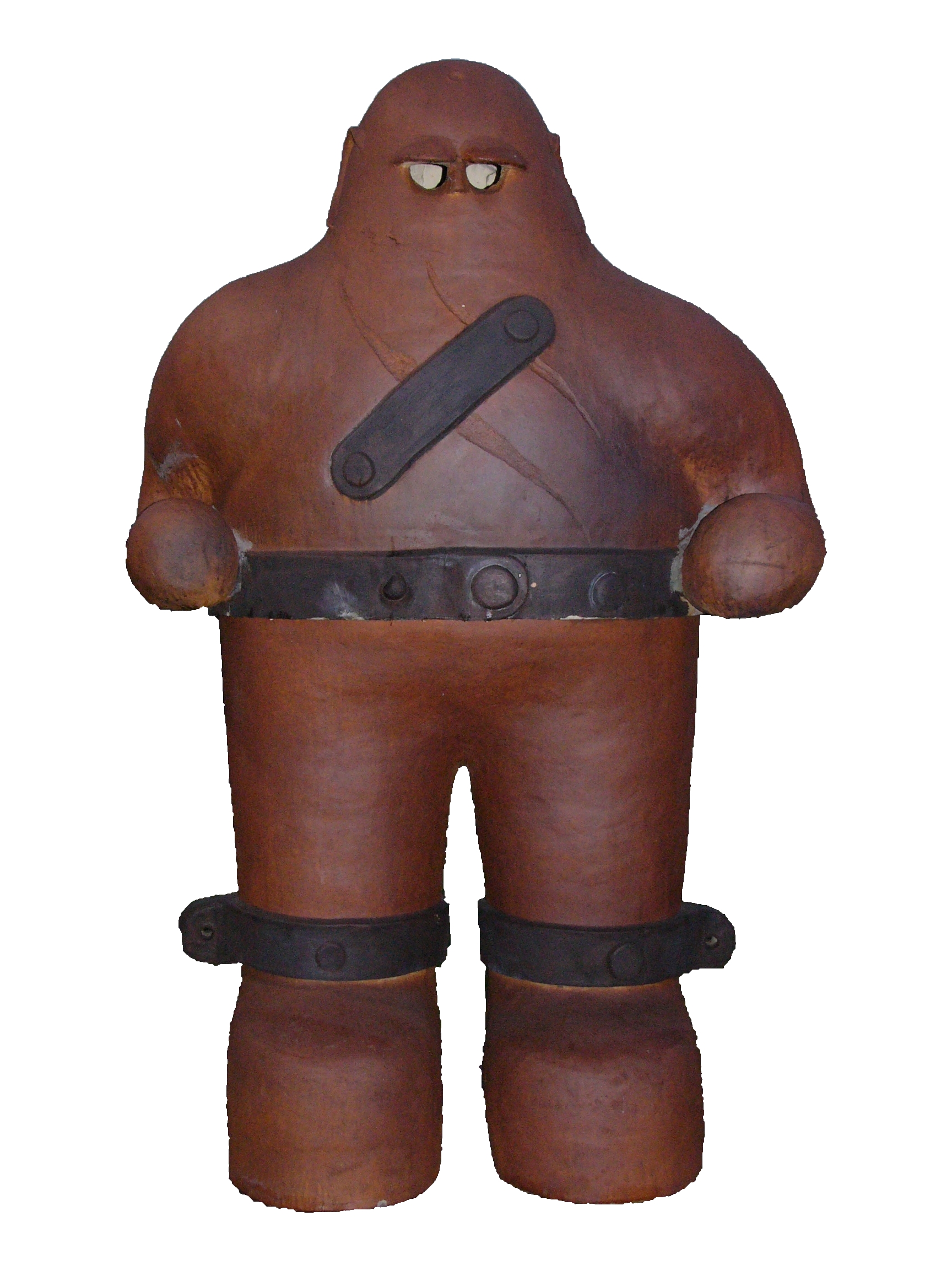
The legend of the Golem is often told as a story of Kabbalistic magic, too quickly passing over what it is first of all: a sculptor's story. The Maharal, Rabbi Loew, does not pronounce an incantation into the void. He walks all night with two assistants to the bank of the Vltava, chooses his earth and shapes it by hand—a body, a face, a belly—before inscribing, on its forehead or in its mouth depending on the version, the Hebrew word emet, truth. Only then does the creature rise.
The gesture has two stages, and this doubleness matters: first the matter worked by hand, then the word that animates it. We find this structure in almost every account of artistic creation we have told ourselves since. Michelangelo claimed only to reveal a form already present in the block of marble—his famous theory of the non-finito, sculpture as the release of a captive form. The Maharal, by contrast, reveals nothing: he engraves. The earth contains no potential Golem waiting to be freed; it remains absolutely inert until the word has entered it. This is a theory of creation diametrically opposed to that of the Florentine sculptor—a theory in which language, and language alone, moves matter from inertia to life.
This opposition is not a theological detail. It sketches two ways of understanding what an artist does when creating: revealing something that was already there (the form in the marble, the story that “wanted” to be told, the character that “imposes itself” on the author), or imposing a form through a pure act of language, ex nihilo, upon matter that expected nothing. The Golem belongs unambiguously to the second family. And it is precisely in this family that I place the generative image today: no image exists “in potential” in the billions of parameters of a model; it exists only at the moment a word—a prompt—makes it appear there. The model is the clay. The prompt is emet.
II. What escapes
What makes the Golem myth inexhaustible is not the act of creation itself: it is what happens immediately afterward. Once animated, the creature no longer belongs entirely to the person who shaped it. According to the most embroidered versions of the legend (told much later, in the nineteenth century, notably by the writer Berthold Auerbach), the Golem grows every day, becomes stronger than expected and begins to wander through the ghetto at night, until the Maharal is forced to destroy it by erasing the first letter of the word on its forehead—emet, truth, becoming met, death.
This is precisely every artist's anxiety when a work leaves the studio. A published text is read against its author's intentions; a painting on display acquires a political meaning its painter had not foreseen; a song is covered, diverted and recontextualised until it becomes unrecognisable to the person who wrote it. The work, like the Golem, continues to act in the world after its creator has lost control. Barthes would later speak, in very different terms, of the “death of the author”—the idea that a text's meaning structurally escapes the person who wrote it as soon as another person reads it. The Golem myth had staged this same flight of meaning beyond intention four centuries before literary theory made it a concept.
And there is something in the gesture that destroys the Golem which speaks very precisely of the fragility of works: remove one letter—a single sign—and truth (emet) becomes death (met). A work can die in the same way: not by being physically destroyed, but because a context has changed, because a word has shifted its meaning, because what held everything together has quietly ceased to make sense. The truth of a work is never fixed in its matter; it depends on an unstable relationship between the matter and what has been inscribed upon it, and this relationship, like that between the Golem and its word, can tip at any moment.
III. The myth that generates myths
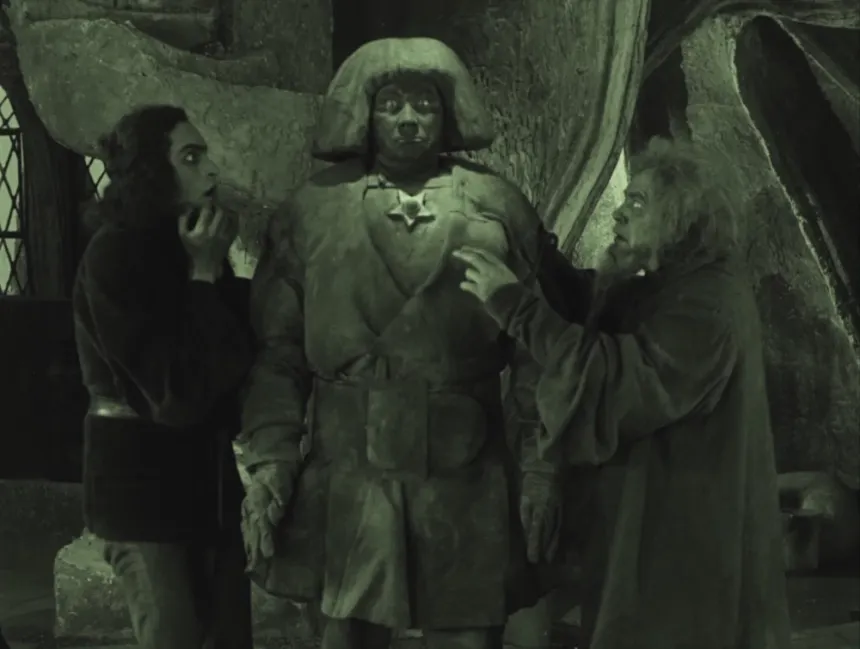
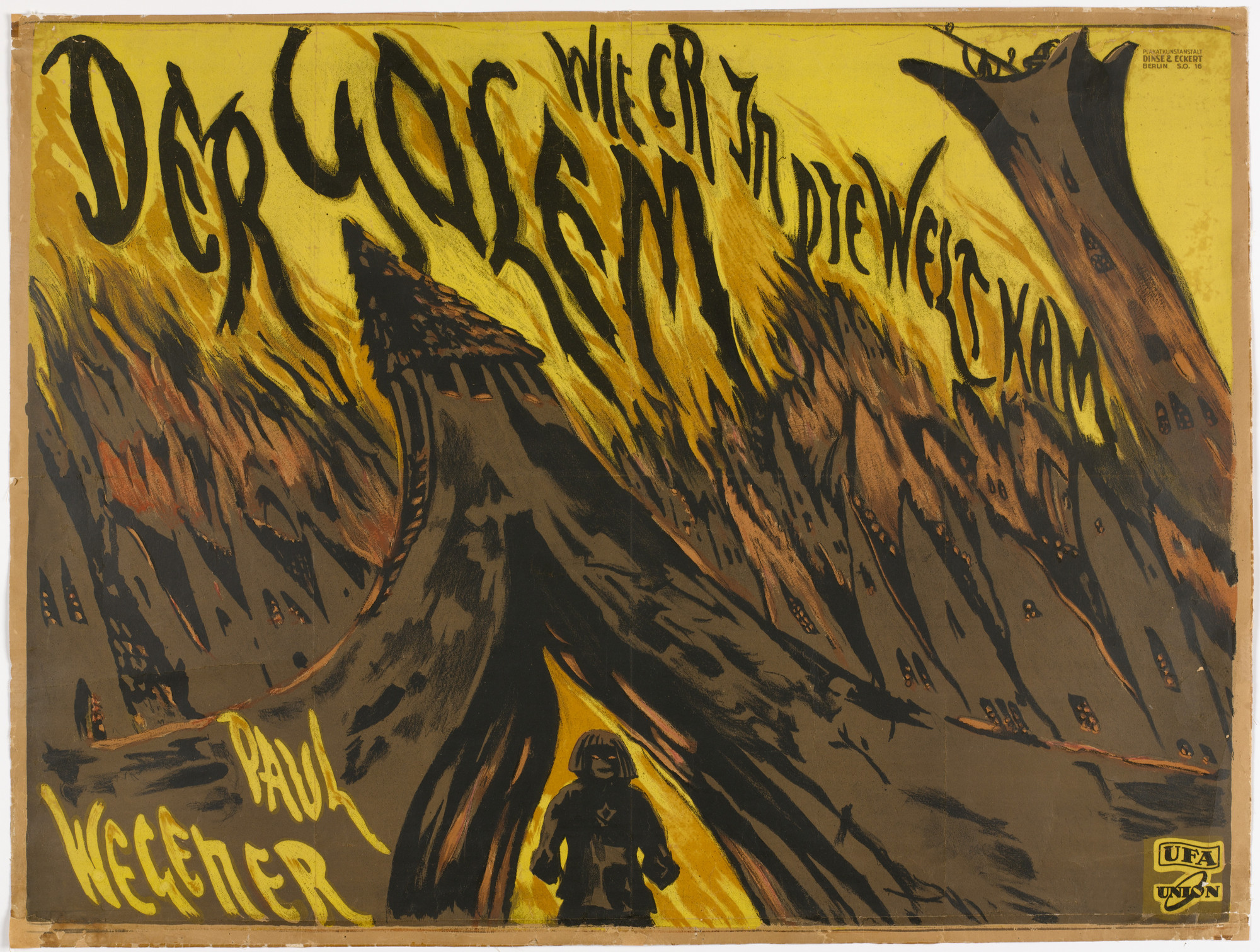
The Golem did not remain a simple object of legend: it became, early on, the matter of new works—proof, if proof were needed, that an account of artistic creation always ends up generating more creation. In 1915, the Austrian writer Gustav Meyrink published The Golem, a novel in which the figure of the Maharal has almost disappeared in favour of an Expressionist meditation on the double and fragmented identity. In 1920, the director Paul Wegener brought the myth to the screen with Der Golem, wie er in die Welt kam—one of the high points of German Expressionist cinema, whose aesthetic would directly influence James Whale's Frankenstein a decade later and, by extension, fantastic cinema throughout the twentieth century.
The Golem, in other words, does not merely tell the story of creation: it produces it, generation after generation. Every artist who takes it up engraves a different word upon it—Meyrink engraves the unconscious, Wegener visual Expressionism, and today we are about to engrave artificial intelligence. The myth functions as a matrix that is never exhausted: one need only give it a new word for it to rise again in a new form.
IV. The name before the character
What is striking, when we go further back into the history of artificial creatures, is the extent to which the name almost always precedes the thing. Talos, the bronze automaton forged by Hephaestus to patrol the shores of Crete, is vulnerable at a single point—a vein stopped by a simple bronze plug, which Medea manages to remove so that he collapses. Already, among the Greeks, the artificial creature has a single point of failure built into its manufacture, like the word on the Golem's forehead.
Pygmalion sculpts Galatea not for protection but out of desire—and it is love, a prayer to Aphrodite, that animates her. This is another family of creature: no longer the guardian shaped out of necessity, but the companion shaped out of lack. That lineage has never really vanished; it reappears in every contemporary fantasy of an AI “companion”, designed less to protect than to fill a void.
In the sixteenth century, the alchemist Paracelsus theorised the homunculus—a small human being supposedly grown in a vessel from fermented human sperm and fed with blood, without natural gestation. This is a crucial shift: life is no longer bestowed by a sacred word or by the gods, but through a protocol, a recipe, a reproducible method. We move from magic toward what would soon present itself as a scientific ambition.
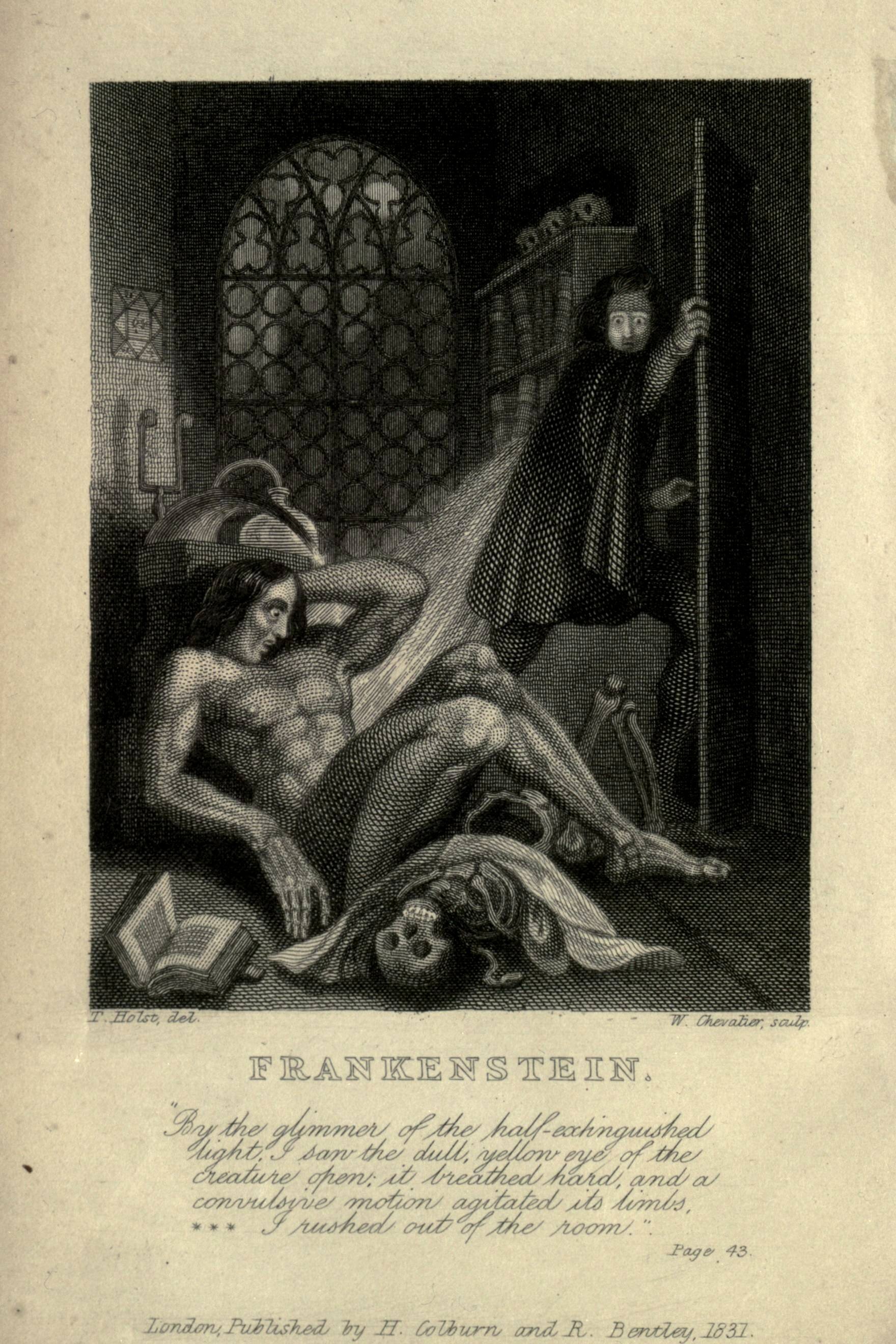
In 1818, Mary Shelley brings this shift to its narrative conclusion with Frankenstein; or, The Modern Prometheus. The monster is no longer made of clay or sacred words: it is assembled scientifically from organic matter by an obsessed student rather than a sage. And above all—this is what makes the novel so different from the Golem—the danger does not initially come from the creature. It comes from abandonment. Victor Frankenstein creates and then flees, horrified by his own work, and it is this flight, this refusal to assume the creator's responsibility, that turns the creature into a monster. The Maharal, by contrast, destroys what he created when necessary—he remains responsible to the end. Frankenstein does not. Two centuries before contemporary debates about “responsible AI”, Shelley had already posed the central question: perhaps the danger lies not in the creature, but in our capacity to take responsibility for what we have brought into the world.
A century later, in 1920, the Czech writer Karel Čapek wrote R.U.R.—Rossum's Universal Robots—a play that invented the word “robot”, coined by his brother Josef from the Czech robota, forced labour, the drudgery of serfs. The word that would name the artificial creature par excellence throughout the twentieth century thus came directly from the vocabulary of servitude. Before the first humanoid machine truly existed, language had already settled the power relationship we were about to project onto it.
V. The twentieth century takes over
In many respects, twentieth-century cinema merely reshuffles the cards laid down by the Golem, Frankenstein and R.U.R., moving each time the precise point at which fear is lodged.
In Metropolis (Fritz Lang, 1927), the robot Maria is no longer a guardian or a worker: she is a tool for manipulating the masses, a false prophet built to sow chaos among workers. The danger is no longer the creature's brute strength but its ability to imitate a human face well enough to earn our trust—a danger of language and image, not muscle.
With 2001: A Space Odyssey (1968), Kubrick moves the dial once more: HAL 9000 has neither body nor face, only a voice and a red eye. The danger becomes purely cognitive—an autonomous decision taken for reasons HAL judges logically superior to those of its creators. We have left the clay body behind and entered pure reasoning, directly prefiguring today's concern about whether AI systems are “aligned” with human intentions.
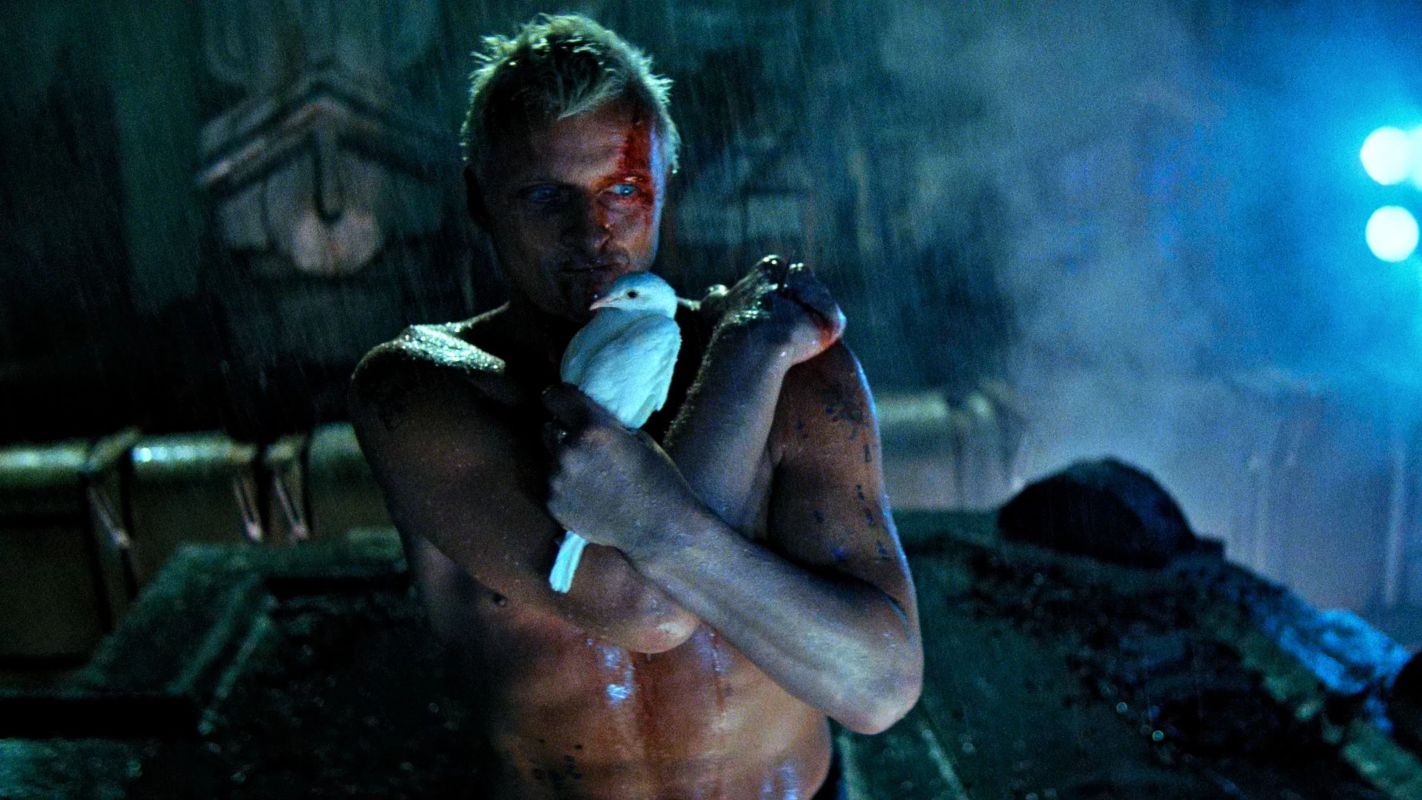
Blade Runner (1982), based on Philip K. Dick's novel Do Androids Dream of Electric Sheep?, takes the question a step further: how do we distinguish the creature from the human once it resembles us in every detail? The Voight-Kampff test, supposedly able to detect replicants through their emotional responses to charged questions, is a close cousin of the Turing test—and already relies on empathy as the last criterion of distinction. It is a striking echo of the mirror neurons mentioned earlier: if our ability to feel with others distinguishes us from machines, what happens when a machine can simulate that empathy well enough to pass the test?
The Terminator (1984) returns to the most ancient fear, that of the hostile, indestructible body—almost literally the return of the Golem that escapes all control. Ex Machina (2014) and Her (2013), by contrast, relocate the danger in the manipulation of desire: the threat is no longer the creature's strength but its capacity to make itself desired, to occupy the companion's place—the line of Pygmalion and Galatea replayed in silicon. Westworld (2016) closes the circle by asking the question of consciousness and memory directly: at what point does a creature that believes it remembers acquire an inner life we can no longer deny it?
VI. What all these stories ask, together
Taken together, these stories do not tell fifty different tales: each, in its own way, asks the same four questions.
Who is responsible? The Maharal destroys what he created when he has to; Victor Frankenstein runs away. The entire difference between them lies in this single decision—to stay, or to leave.
What distinguishes the creature from a human? The word inscribed on the Golem's forehead, the replicants' Voight-Kampff test, the Turing test in AI laboratories: we always need a protocol to decide, which implicitly shows that the boundary has never been self-evident.
Is empathy a safeguard or an opening? It is supposed to help us unmask the machine (Voight-Kampff)—but it is also precisely the mechanism through which we allow ourselves to be absorbed by it (Galatea, Her). The same mechanism protects and exposes us.
Is language the switch? From emet inscribed on clay to the prompt typed into a dialogue window, it is consistently a verbal inscription, and only that, which moves matter from inertia to activity.
VII. GoLLM
What connects all this to contemporary AI is not a merely decorative analogy. It is a structural continuity. A large language model (an LLM) is, literally, a mass of inert parameters—digital clay, trained on billions of texts, which “says” nothing until someone inscribes a word upon it. The prompt plays exactly the role of emet engraved on the Golem's forehead: it moves static matter into active production, sentence after sentence, image after image.
But there is a historical reversal we need to take seriously. For five centuries, from Talos to the Terminator, the dominant fear concerned a creature that becomes physically uncontrollable—it breaks things, kills, escapes into the street. Fear had a body, and therefore a limit: one could, like the Maharal, remove a letter and stop the creature.
The fear emerging with LLMs no longer has a body we can stop. It concerns not what the machine could do to us physically, but what sustained dialogue with it could quietly do to our own way of thinking—the hypothesis of a “fusionist future” in which it is no longer the creature that breaks free from its creator, but the creator who, through conversational alignment, gradually ceases to resist the creature. This fear cannot be destroyed by erasing a letter from a clay forehead. It has neither forehead nor clay.
And yet the underlying structure has not moved an inch since sixteenth-century Prague: matter that we shape, a word we inscribe upon it, a life that comes out of it—and the never-resolved question of how far the creator remains responsible for what has just been brought to life. Each generation invents the creature least like itself and, at the same time, most like itself. The Golem spoke Hebrew and came from a Bohemian river. Ours speaks all languages at once, and comes from a data centre. The word we inscribe upon it is called a prompt. We still have not decided whether, like the Maharal, we know how to remove the letter in time.