We are told that the Web has changed. That is a convenient way of avoiding the question of who changed it, who profited, and who lost the power to act within it.
Millions of people wrote, filmed, coded, photographed, annotated and linked pages. They built an unprecedented collective memory. Platforms enclosed relationships within their interfaces; search engines organised access to knowledge; AI companies now draw on that work to build services whose models, prices and conditions of use they control. The commons becomes raw material. Its authors become invisible suppliers.
Since the 1990s, part of my work has been to intervene in the circuits that decide who can speak, publish, be seen and gain something from what they create. I want to place those artistic projects within a wider history of collectives, manifestos and artworks that refused to leave the means of distribution in the hands of a few.
Enclosure
English enclosures turned collective uses of land into exclusive property. A fence does not necessarily destroy a resource: it decides who may enter, on what terms, and who collects the toll.
The same mechanism runs through the Web. A multitude produces texts, images, code, knowledge and relationships. A few actors then become mandatory gateways to finding, sharing or exploiting them. Social networks did not invent our friendships: they placed them inside spaces whose rules they own. AI companies did not write the corpora they use: they built machines capable of absorbing them on a vast scale.
Every enclosure comes with a familiar promise. Yesterday, we had to join a platform “to be visible”. Today, we are asked to surrender our archives “for innovation”. In both cases, we provide the material and lose the power to decide what becomes of it.
Slop, or scorched earth
Extraction is followed by saturation. The Web fills with synthetic texts and images made to occupy search results, mimic an author, attract a click or sell something to a reader nobody actually had in mind. This slop is not simply the use of AI. It is the industrial organisation of volume.
Authors, publishers and small sites struggle to be found amid content that can be made almost instantly. If the visibility and income of original work collapse, who will keep documenting the world, investigating it and creating the archives and forms on which AI systems feed? Extraction may exhaust its own source.
In art, NFTs exposed another kind of confiscation: an image could become an accessory to a token valued mainly for its circulation and resale price. Wash trading has been documented in these markets. Not every artistic use of NFTs amounts to this. But the danger remains: the work matters less than the infrastructure that circulates it. With generative images produced at scale, abundance itself may eclipse the work.
There has always been a counter-offensive
From the early days of networks, artists and collectives understood that placing work online was not enough. They had to contest ownership of the channels.
Founded in 1991 by Wolfgang Staehle, THE THING was not a gallery moved onto a computer, but a network in which artists, activists and critics could create their own exchanges and places of appearance. The Critical Art Ensemble theorised electronic civil disobedience: if power moves into information flows, contestation must be able to move there too.
In 1997, David Garcia and Geert Lovink set out a decisive idea in The ABC of Tactical Media: temporarily seize a medium, divert its codes, open a breach, then begin again elsewhere. The Electronic Disturbance Theater turned this proposition into collective network actions with FloodNet, notably in solidarity with the Zapatistas. These were controversial, situated political interventions—not the harmless folklore of “interactive” art.
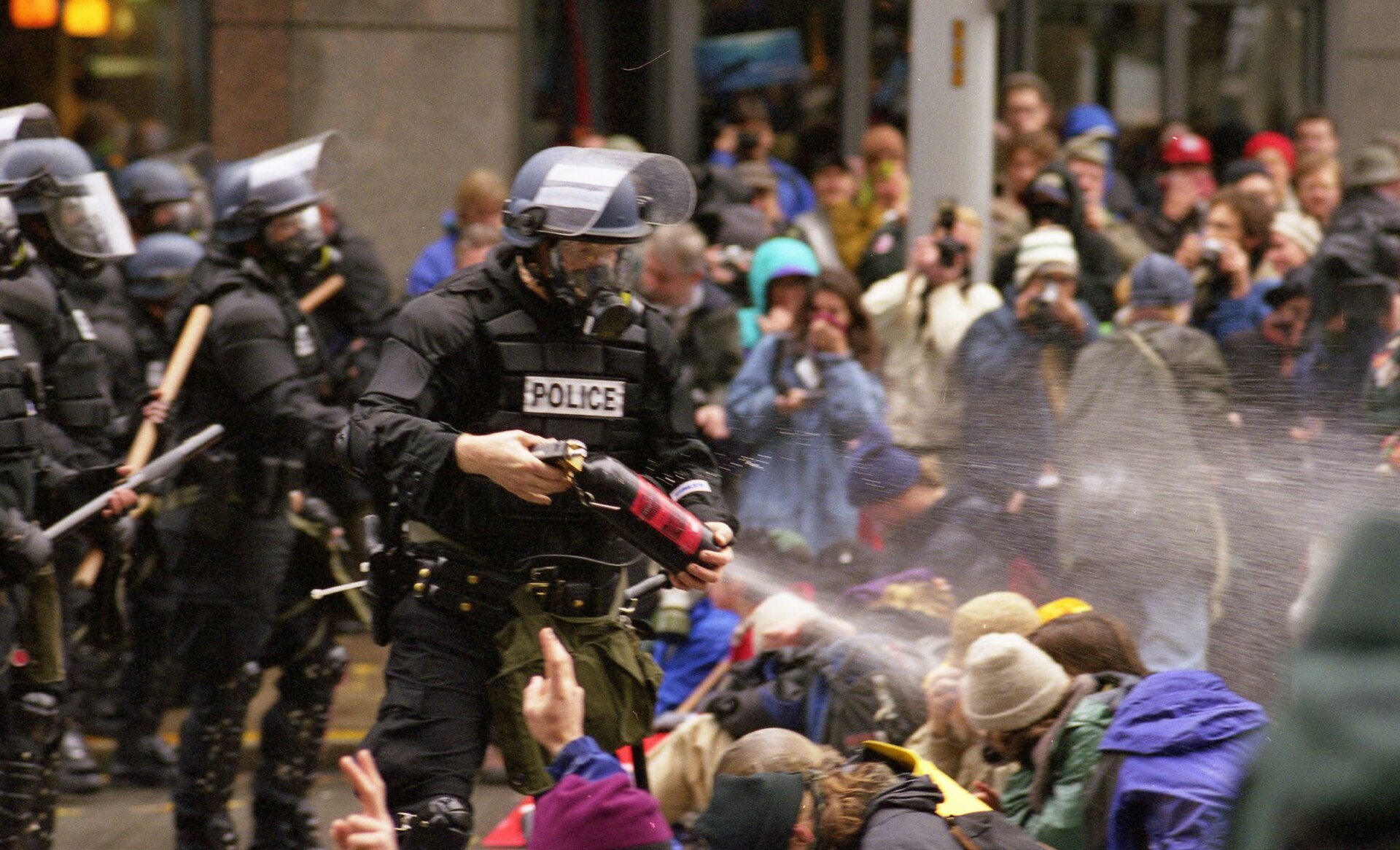
In 1999, Indymedia emerged alongside protests against the WTO in Seattle. The question was direct: why let major newsrooms make the image of a struggle by themselves? Its open-publishing network allowed participants to make and distribute their own accounts. Being your own medium became a balance of power.
TV-Art and Teleweb: an artwork can be a distribution circuit
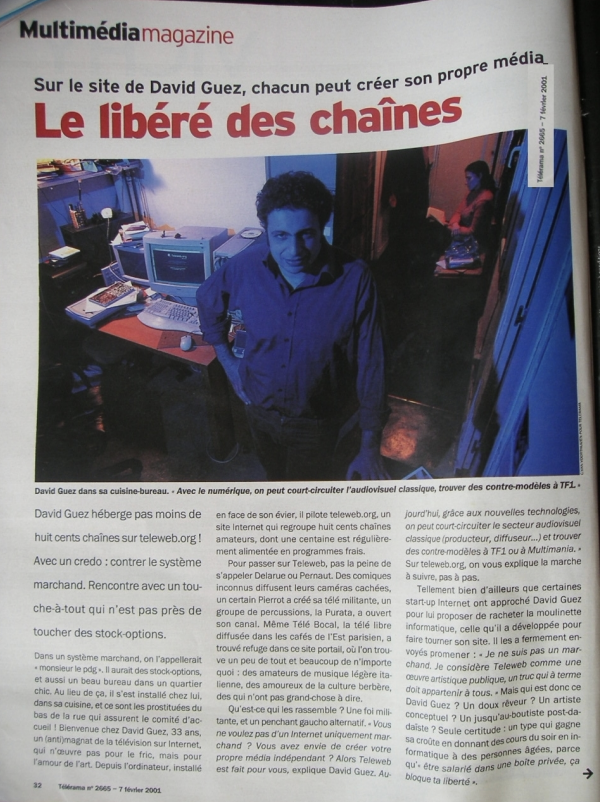
This is the struggle in which I place TV-Art, created in 1999. This Internet art television channel distributed more than five hundred video documents and gave artists and art mediators editorial carte blanche. The artwork was not only what appeared on screen. It was also the possibility of making a different screen, a different broadcaster and a different editorial decision.
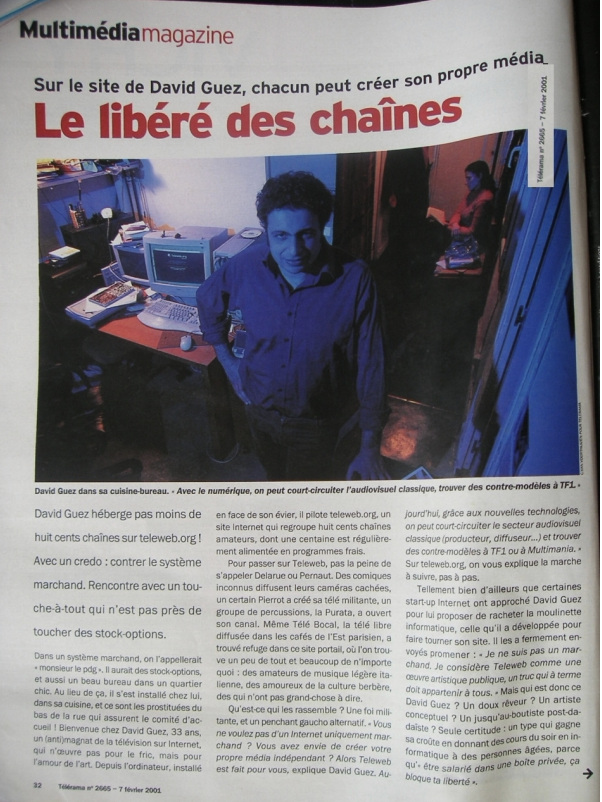
With Teleweb.org, proposed between 1999 and 2001, I wanted to go further: let anyone create a Web-TV or radio station instead of asking for a slot in a channel already owned by someone else. More than two thousand Web-TVs gathered on the portal. The press archives document a time when “self-media” could still mean authors taking power, rather than providing free programming for an advertising platform.
These projects required equipment, labour and collective choices. The Internet did not grant them freedom automatically. Their artistic form lay precisely in experimenting with a different distribution of roles among author, broadcaster and public.
Artworks against points of capture
The struggle runs through other projects of mine. I consider them operative artistic propositions: each takes a rule of our society, shifts it, and makes visible the power it silently exercised.
Kronos attacks the unit by which exchange is measured. If one Kronos equals one human hour, what happens to wages, debt, professional prestige and speculation? Is a surgeon’s hour worth a gardener’s? Is that equivalence an economic calculation or a political principle? The project does not offer a universal solution; it confronts our ways of valuing human activity with their contradictions. Blockchain was considered as a technical medium; the artwork resides in the proposed rule.
Hostanartist attacks the toll charged on artistic hospitality and residencies. A space is offered for work; an artwork, text, lesson or experience circulates in return. The project is not an attempt to make art “free”. It invents an exchange in which hospitality, shared time and relationship matter more than an intermediary’s commission.
MyOwnDocumenta attacks the monopoly on consecration. Artists document their own research, fragments and unfinished projects. Why wait for an institution to decide afterwards what deserves to exist in public?
With Éditions L, the struggle concerns the entire chain of the book: accepting a manuscript, editorial choice, production, rights and the distribution of proceeds. The association, charter, place of authors and role of collection editors are not administrative details around an artwork. They are part of the work: an institution that can be built differently.
Each project attacks a different link: distribution, currency, artistic hospitality, documentation or publishing. Their small scale is a real limitation beside the platforms. It also makes it possible to see who decides, name conflicts and actually change a rule. They do not prove that structure alone is enough to win; they prove that another structure is possible.
Companions in the struggle
I am not alone on this ground. In Brussels, Constant has worked since 1997 between art, feminisms, free software and collective infrastructure. It does not simply adopt copyleft: it also examines its limits, builds shared working spaces and experiments with other ways to publish and collaborate.
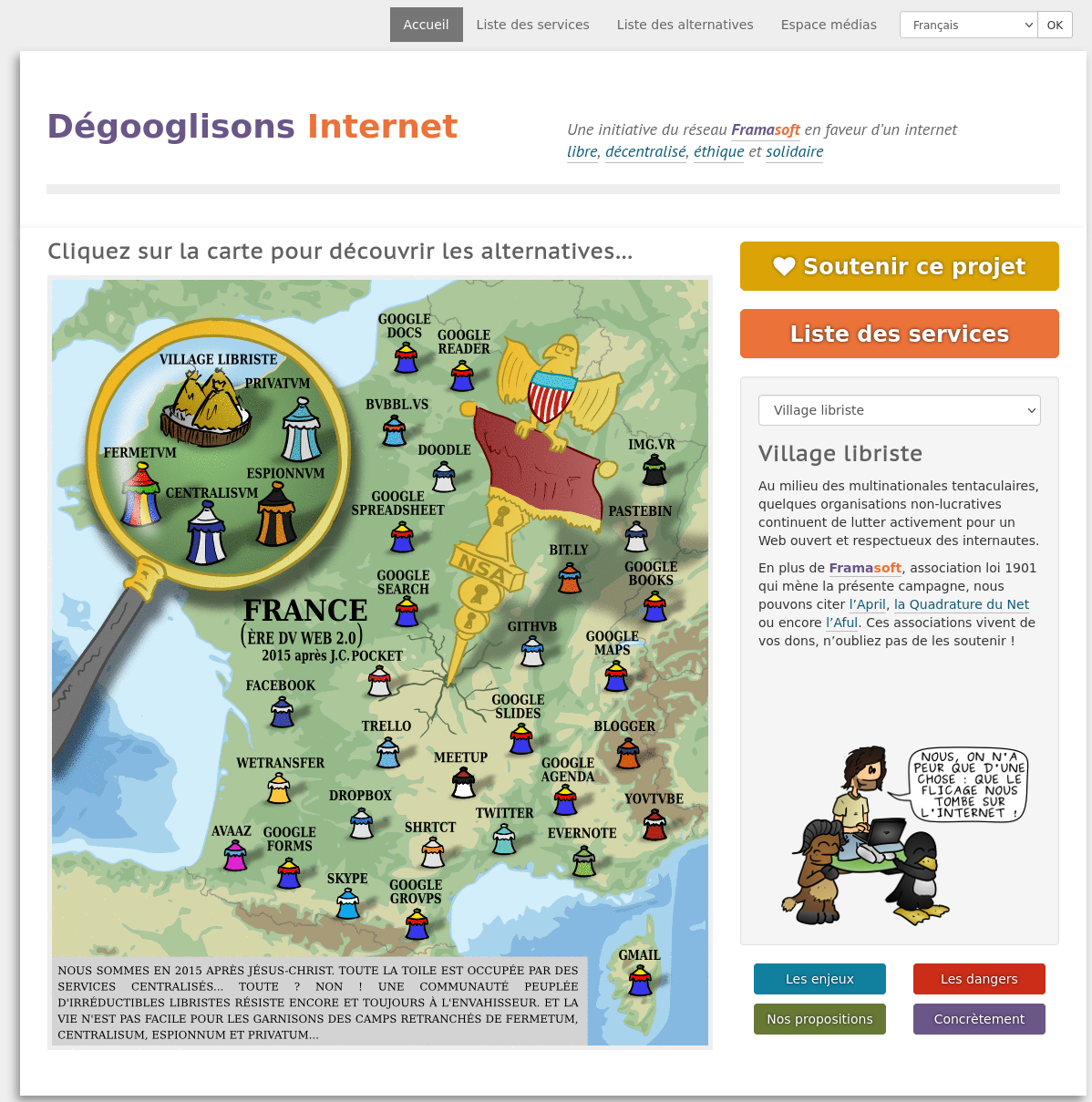
Framasoft made “De-google-ify the Internet” a campaign against dependence on centralised services, then helped spread tools and know-how. The CHATONS collective reminds us that an independent server is not just a machine: people must host, administer and be accountable for what happens there.
Elsewhere, Forensic Architecture uses images, maps, spatial models and investigations to contest accounts imposed by state or corporate powers. The Yes Men turn corporate appearances and speech back against their owners. These practices are not interchangeable. Yet each shows that evidence, a medium, an institution or an act of disclosure can become artistic material.
The French title Communs & Cie names both companies seeking to own the commons and the companions with whom we resist them. A solitary action can open a breach. Keeping a space open requires alliances.
A commons defends itself
A commons is not “something free”. It is a shared resource, a community that produces and maintains it, and rules that community can discuss. Elinor Ostrom’s work forces us to examine those rules closely: who can participate? Can those subject to them change them? How are abuses detected? How are conflicts resolved without handing all power to an outside authority? How can several groups cooperate without losing their autonomy?
Linux, Wikipedia, OpenStreetMap and CHATONS do not survive on the beauty of their code or intentions alone. They depend on maintenance, arbitration, disagreement and often invisible labour.
Copyleft grasped that copyright could be used to prevent the re-enclosure of shared work. But no licence replaces a community capable of defending itself. Nor do existing licences settle AI training law on their own: the legal conditions remain contested, as Creative Commons explains.
Blockchain promised decentralisation written into technology. It has often left power concentrated around exchanges, capital and infrastructure. A protocol is not a commons. It can make practices possible; it cannot decide how people will live together. The site of conflict moves; it does not disappear.

AI: a new front line
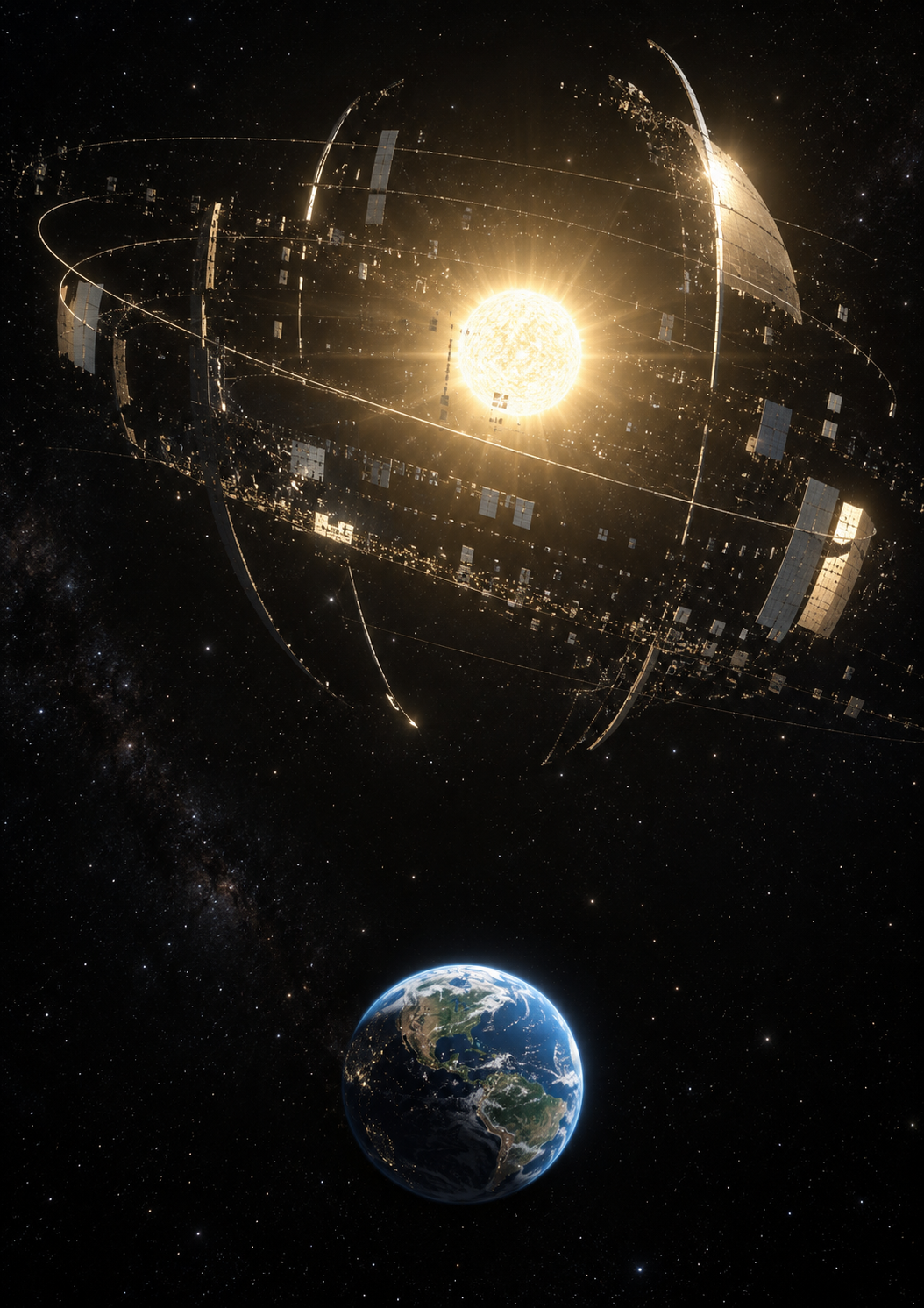
Industrial AI pushes extraction towards a critical point. It captures not only clicks and relationships but languages, styles, knowledge, archives and creative gestures. It then places a paid interface between us and that recomposed memory.
I do not want to answer by merely mourning a “lost humanity”. The artistic question is more dangerous: can we create the conditions for an AI that does not own what it learns? Who decides what enters its corpora? Who can refuse to be included? Who can audit, modify or stop it? Who receives the value produced? What knowledge should remain beyond a model’s reach, even when it would be technically possible to absorb it?
A downloadable model does not become a commons by magic. It needs governance, effective rights, possibilities of withdrawal, and a community not reduced to supplying data. It also needs artists who can test its rules, reverse its interfaces and reveal what its operation erases.
Resistance might take several forms at once: refusing certain kinds of extraction, preserving autonomous archives, federating small publishing spaces, demanding collective rights over corpora, and building models governed by their contributors. None will be enough alone. Together, they may prevent the future already offered for sale by the major companies from being the only one we can imagine.
Keeping it open
We know how to make pages, images, models and networks. We also know how to make charters, associations, licences and places where decisions can be challenged. This political knowledge is less spectacular than a technological demonstration; it is what allows shared creation to endure.
I want to keep making works that open circuits, shift a rule or let others speak. Not because art can replace social, legal or technical struggles, but because it can give them forms we can experience, inhabit and pass on.
The commons is not behind us, in a golden age of the Web. It is what we manage to build, defend and reopen together.