A catalogue for changing the world
In 1968, Stewart Brand, an American writer and editor and a figure in countercultural networks, launched the Whole Earth Catalog. It brought together books, tools, techniques and resources for learning, building, growing food and organising collective life. Circulating in alternative and artistic circles, it became a major work of the counterculture.
In this article, I explore Brand’s aims, the history and evolution of his project, and what such a catalogue could become today. In light of digital tools, collaborative practices and artificial intelligence, I propose a first mock-up: the Whole Earth Catalogue 2027.
The question feels particularly alive amid our abundance of means for acting. Search produces thousands of results; platforms organise choices; AI connects disciplines and proposes new forms. A catalogue can help select, connect and make those possibilities accessible. I imagine a book kept open on a table, helping an idea become a practice.
1968: an address could change a life
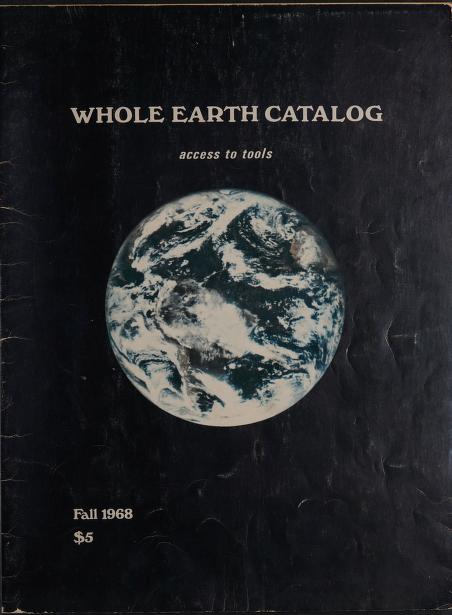
The Whole Earth Catalog first appeared in autumn 1968. It connected books, equipment and practices at a time when finding information often required correspondence, an encounter or a journey. Its ambition combined evaluation with access. Knowing that a tool exists does not yet tell us why it deserves attention or how we can use it. The first issue’s archive makes that practical function visible.
Its planetary cover established a vast horizon, while the inside continually returned to particular objects. MoMA describes the Catalog as an alternative information and distribution service. That seems more useful to me than treating it solely as a countercultural icon. It did not supply a finished world. It connected readers, communities, techniques and knowledge.
I like the disproportion between the cover and an individual entry. The entire Earth on one side; a particular resource on the other. The reader establishes the connection. A building technique becomes inseparable from a way of living. A book about systems changes how a community is understood. The printed object creates neighbourhoods of ideas: its thought also lies in what it places next to what.
What layout does to thought
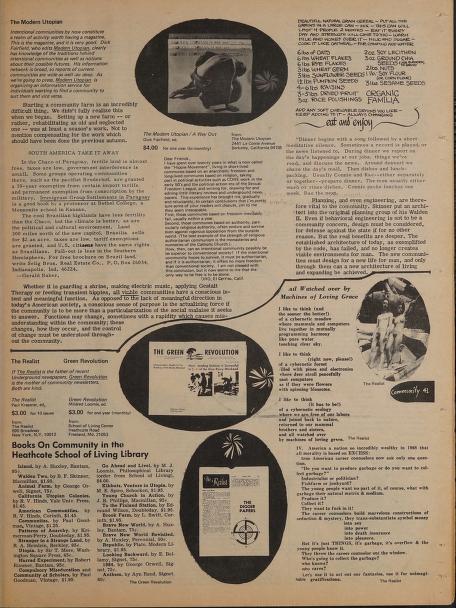
An original Catalog page is not a sequence of presentation slides. Columns, differently sized pictures, comments and addresses offer several points of entry. I can begin with a photograph, leave an entry unfinished and return through another reference. Discontinuous reading is not necessarily shallow reading: it gives the reader the work of making connections.
My mock-up develops this approach through three-column pages with independent entries: name, organisation, description, first step, access conditions, judgement and address. An index lets readers return to a resource and compose their own routes.
What interests me is the effectiveness of this form: the sense that each page makes a possibility more precise. A catalogue can be beautiful because it works, makes connections and helps somebody decide.
Humanpédia: an encyclopedia entrusted to the living
Before imagining this new catalogue, I had already explored this question through Humanpédia. The project proposes a universal memory outside any technological context: each person can become the custodian of one Wikipedia article or a major literary work, learning it, printing it, telling it and passing it on. This network of “Humanpédiens” could help reconstitute shared knowledge should its digital version disappear.
Humanpédia does not turn people into human hard drives. It changes our relationship to knowledge. A page is no longer only stored somewhere: it is carried by a voice, a memory, an interpretation and a responsibility. Knowledge becomes a relationship. It circulates by changing form, language, rhythm and context; it stays alive because somebody takes it up again.
The connection with the Whole Earth Catalog is profound. Brand sought to put tools and resources within reach of readers able to use them. Humanpédia asks the question that follows: what happens to knowledge when it leaves the servers? Who agrees to preserve it, update it, discuss it and transmit it? The catalogue organises access; Humanpédia imagines a community of keepers and transmitters.
At a time when AI systems create the impression that all knowledge is instantly available, this proposition has particular force. An answer generated on demand is not yet a shared memory. It does not replace learning, storytelling or the confrontation of interpretations. Humanpédia reminds us that knowing is not only being able to retrieve information: it is being able to let it circulate again between human beings.
Autonomy has always depended on other people
It would be easy to tell a reassuring story: counterculture opened the tools, computers democratised them, the internet distributed them, and AI now completes their accessibility. I do not believe in that straight line. In From Counterculture to Cyberculture, Fred Turner follows the networks linking those worlds. Their promises need to be considered alongside the structures that developed around them.
A free plan requires time to understand. An open machine requires parts, a workshop and practical skills. A participation platform requires an institution willing to respond. Autonomy becomes misleading when it erases these relationships. I prefer the capacity to recognise, negotiate and change dependencies: knowing who maintains a tool, being able to modify it, having an alternative.
One finding during this selection makes the issue concrete. L’Atelier Paysan’s website reports its cooperative’s judicial liquidation in April 2026 and collective efforts to preserve and continue the project. Its plans do not suddenly become worthless. But the organisation supporting them changes. A useful catalogue must record that situation rather than treating a familiar name as a timeless recommendation.
This is central, not incidental. Who pays for updating a drawing and helping a beginner? How is knowledge maintained when an organisation disappears? Access to tools must include an understanding of how they are sustained.
A tool can be an organised relationship
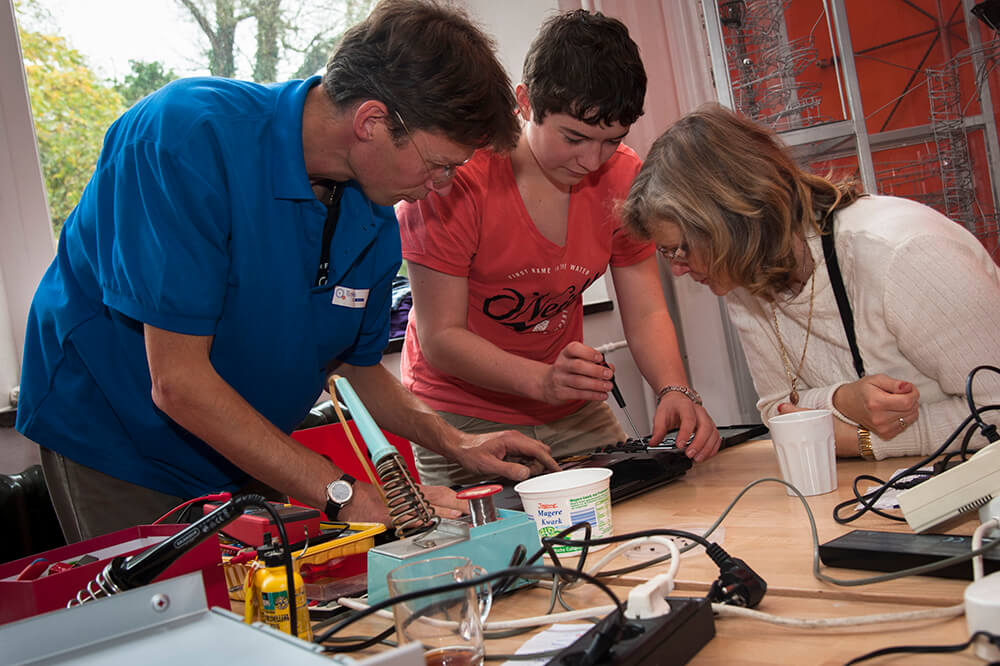
I have grouped Repair Café, iFixit and FreeCAD together. The first offers an encounter and skills; the second can make dismantling understandable; the third allows a simple part to be redrawn. Repair becomes a chain rather than the purchase of another device.
A similar relationship connects OpenStreetMap, QGIS and Sensor.Community. Describing a place, organising data and producing an observation are different operations. Together they can help residents formulate a question about their neighbourhood. They do not automatically turn a map into proof or a sensor into a public-health authority. They do change who can begin an inquiry.
The selection therefore includes material objects, software and forms of organisation. I am interested in the connections, not in pretending they are interchangeable. A screw, a licence and an assembly perform different functions. A technique may nevertheless become inaccessible because one of them is missing. The catalogue must show the relationship rather than only photographing the finished object.
DIY, preparedness, survivalism: whose survival?
Equipment circulates between different imaginaries. DIY describes making or repairing things oneself; it can be solitary, commercial or collective. Preparedness addresses the possibility of disruption. Survivalist cultures develop ways of anticipating deeper crises. These overlap without being identical. Research on survivalist preparedness helps avoid a simplistic contrast between virtuous sharing and selfish bunkers.
The same radio can serve a walk, a closed group or neighbourhood mutual aid. The same reserve can support a vulnerable person or establish a boundary against others. What changes is the social protocol: who can enter, who receives information, who may use supplies, and who decides when resources run short?
My preference is explicit: tools should be capable of increasing shared capacities. An offline library needs readers. A plan should be intelligible to someone other than its author. Preparedness must include people absent from the meeting. The catalogue therefore proposes a neighbourhood coordination exercise, without causing any actual outage, to identify who the arrangement leaves out.
The future I want is not one where everyone owns a miniature private civilisation. It is one where an interruption does not immediately destroy the relationships on which life depends. This does not replace public services with volunteers. It also reveals what those services provide and what a small collective cannot carry alone.
What role can AI play?
AI can participate in the design of the catalogue itself: comparing functions, identifying an overlooked dependency, connecting disciplines and unfolding several responses to a need. Starting from an agricultural technique, a library principle or a collective rule, it can help imagine arrangements that familiar categories kept apart.
I use it as a partner in exploration. Existing resources lead back to identifiable sources; new projects take the form of experiments. My task is to select, articulate a perspective and open these proposals to readers. The catalogue becomes a place of research where anyone can develop, challenge or transform an entry.
This extends the question behind MAIO: AI can participate in constructing relationships and processes, not just pictures. Here, however, a proposal must also encounter a situation and an objection. The catalogue’s openness is not measured by the number of objects it can generate, but by the possibility of correcting it.
Four proposals, four possible tests
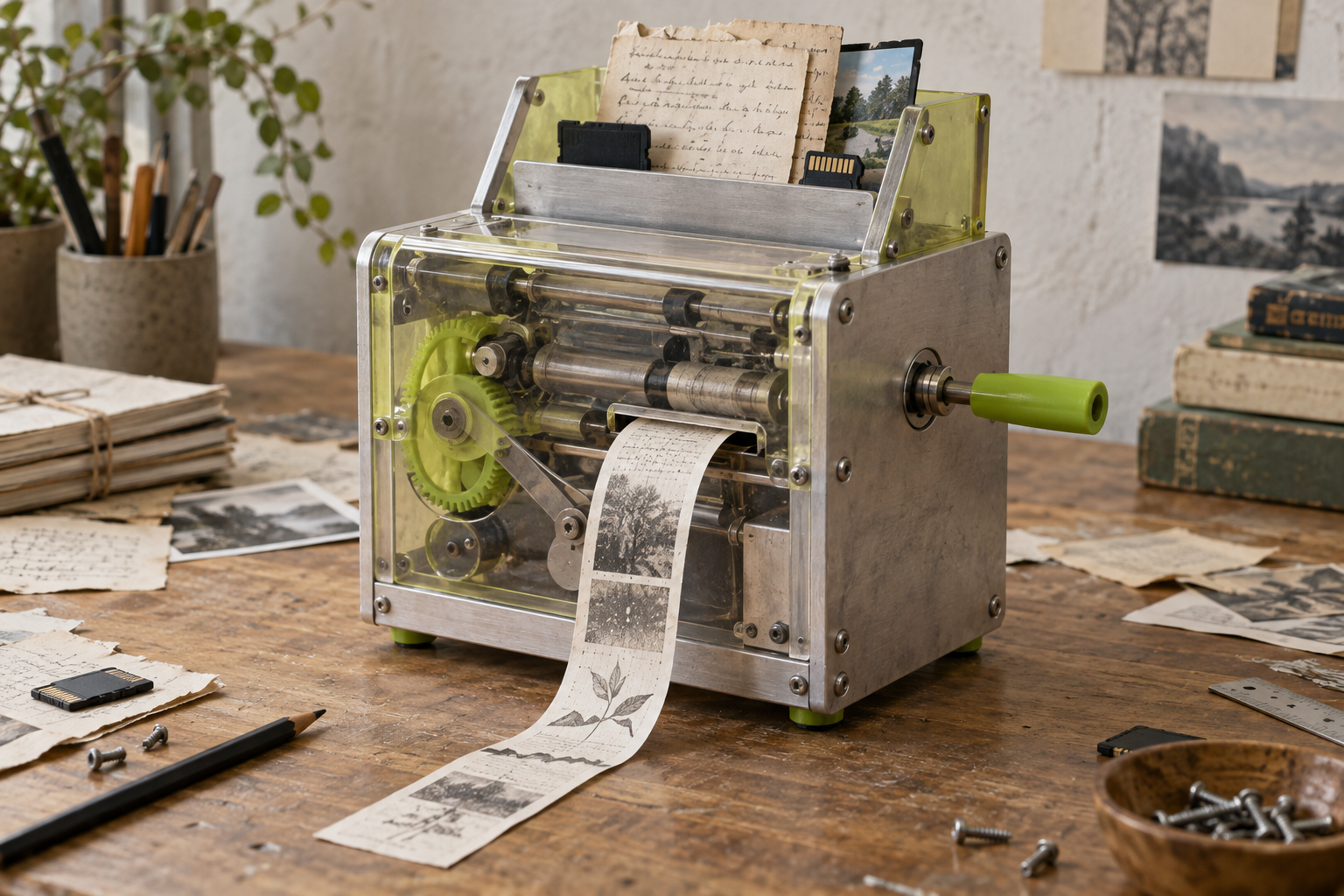
The Memory Composter becomes a workshop about deciding what to keep. A first session would compare human and automated classifications of twenty fictional documents and record disagreements. No personal original is deleted. The issue is not freeing disk space, but who gives our memories their form.
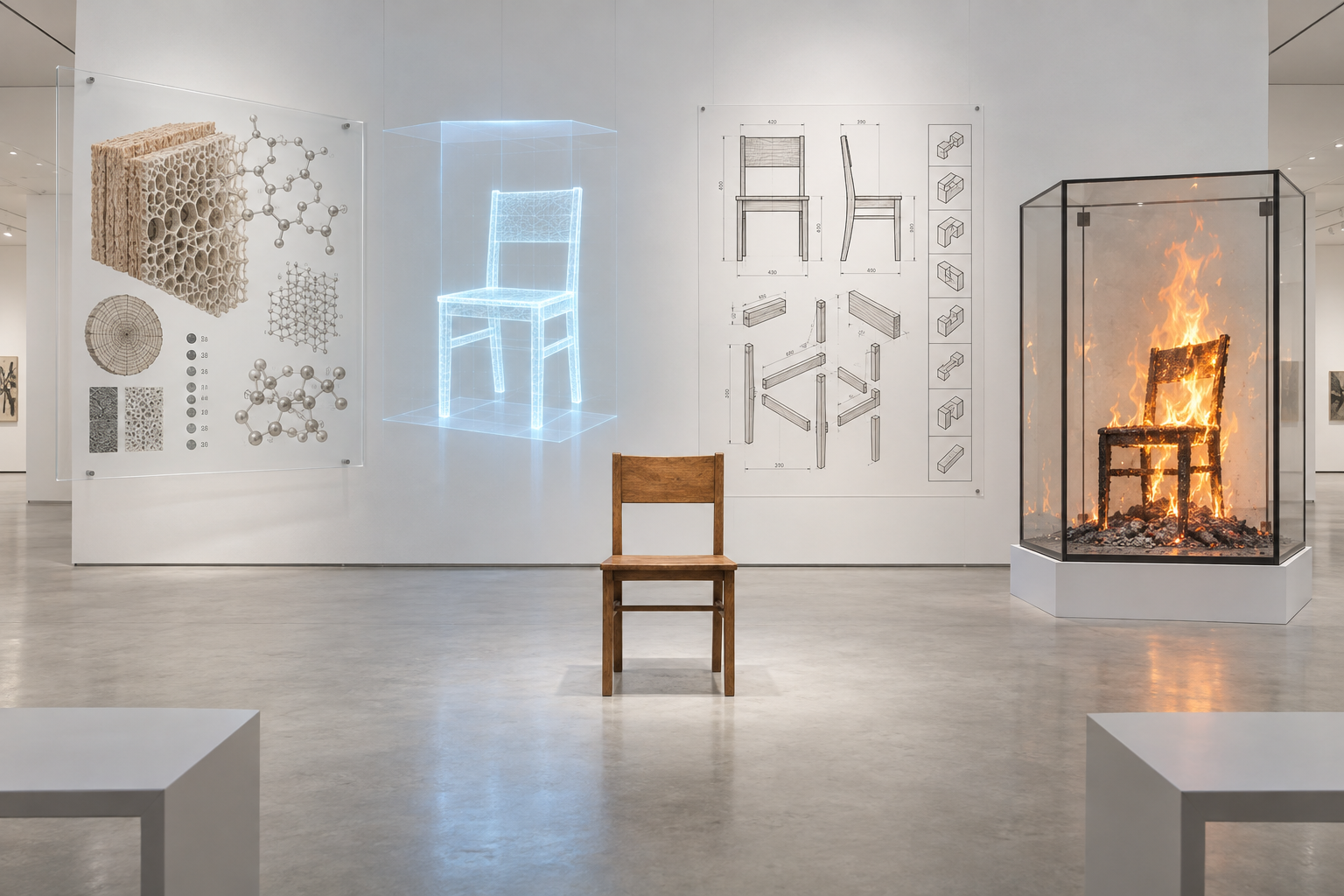
The Parliament of Objects can begin without electronics: five objects, maintenance needs, a fictional budget and spokespersons. What becomes important when participants defend a lifespan rather than a novelty? Sensors would only be added for a question that actually requires measurement. The absence of spectacular technology does not imply the absence of an artwork.
The Urban Ghost Cartographer starts with one street, three dates and attributed sources. Archives and testimony remain distinct from reconstructions. Hypotheses can occupy their own layer without masquerading as recovered history. One measure of the work would be its ability to accept correction from a resident.
The Manual of Algorithmic Disobedience proposes observing recommendations, changing one accessible setting and documenting differences. It does not claim to reveal an entire algorithm or make its user invisible. It aims to recover a degree of agency: understand an option, identify a dependency, decide what can be given up.
For each proposal, the catalogue specifies materials, a first session and questions to investigate. Together they form an open workshop and an invitation to make things together.
Why keep a Dyson sphere on the cover?
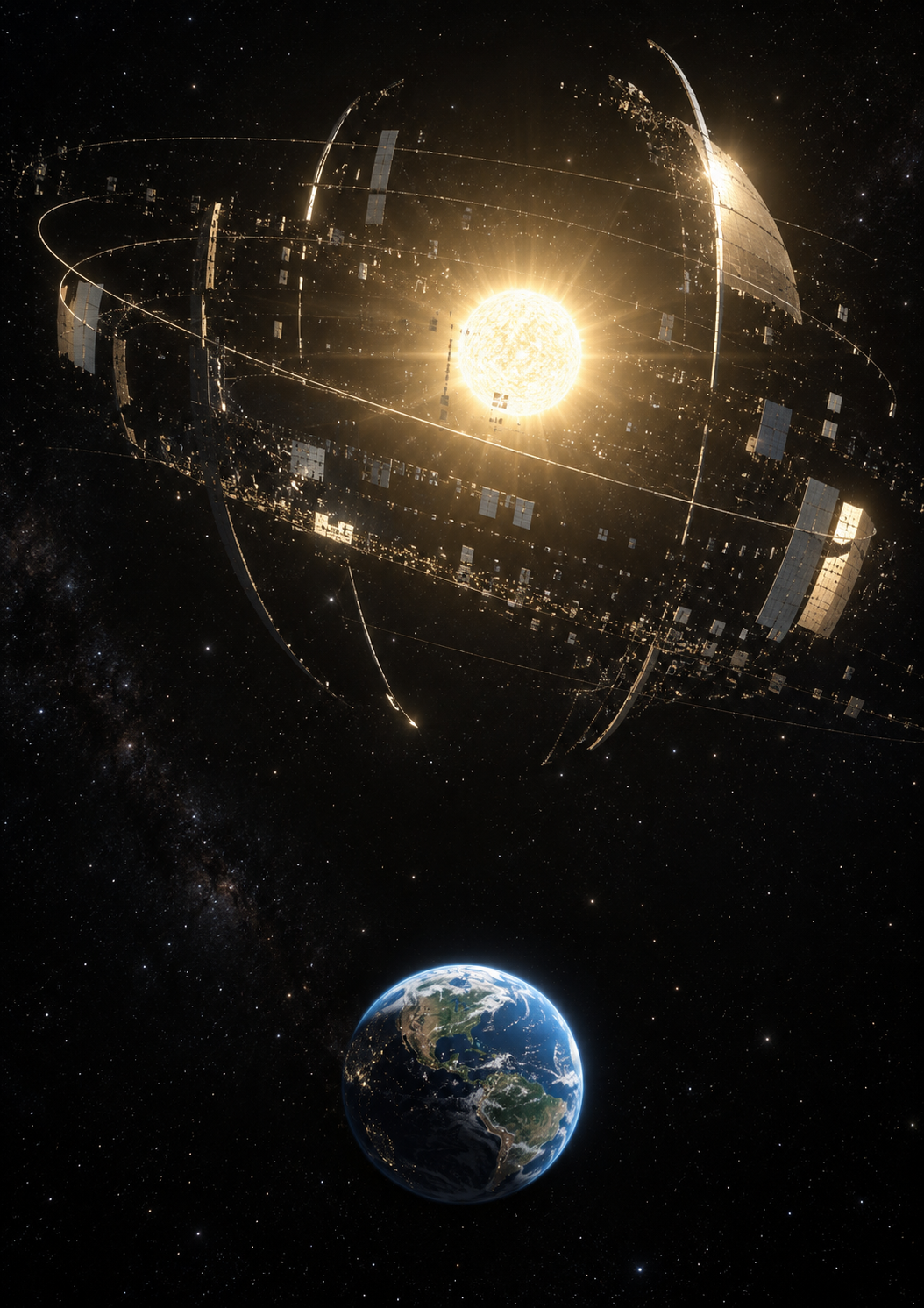
I do not want the future to shrink into an inventory of sensible objects. Freeman Dyson’s 1960 hypothesis proposed searching for infrared signatures of civilisations exploiting their stars’ energy. An image of a collector swarm represents a radical shift of scale. The collector swarm on the cover opens that horizon: after the whole Earth, the star as the territory of a technical organisation.
I set it against a question that technological power tends to postpone: what need would justify such infrastructure? A drawing of an equipped star tells us nothing, by itself, about the society that produced it. It might suggest shared abundance or vast appropriation. It could promise freedom while imposing maintenance that nobody can interrupt.
I am not proposing a material equivalence between a repaired part and a stellar swarm. I am looking for continuity in the questions: who acts, who depends, who maintains, who decides what follows? The cover opens the imagination; the entries ask it to account for its proposals. That movement can make this catalogue more than a directory or a fiction.
A guardian intelligence: knowledge off-grid
The question that closes this issue has become decisive. If AI is increasingly the interface through which we question knowledge — a manual, map, archive, recipe, repair guide, translation or history — how can that capacity avoid being locked inside the servers of a few companies? I am not describing a digital-bunker fantasy. I am describing an intelligence that can be kept, started, checked and passed on when a network, subscription, platform or institution stops answering.
A model on its own is not enough. Its weights are a statistical capability, not a library whose sources remain visible. A real knowledge reserve therefore brings together several layers: a repairable small computer, local models, an offline library, maps, chosen documents, a tool that retrieves useful passages, backup power and, crucially, a printed operating manual. One must be able to ask the machine for an answer, but also return to the page, guide, map or testimony from which it proceeds.
The pieces already exist
This infrastructure is no longer theoretical. Kiwix makes it possible to keep offline libraries on a computer or local hotspot: Wikipedia, Wikivoyage, WikiMed, Gutenberg, dictionaries and archives. Internet-in-a-Box already organises this principle for a school, clinic or household: a local network and free content that nearby people can consult without an external connection.
Alongside these libraries, tools such as Ollama and GPT4All run models on the computer that hosts them; GPT4All can index a folder of local documents. The llamafile project makes portability even more direct: model, inference engine and server can be combined in one executable file. Concrete kits are emerging as well, such as PortableMind, which places a ready-to-query local environment on a USB drive. These are not science-fiction ideas: they are early forms of continuity infrastructure.
What good use of AI means
The good use of AI is not only producing an answer faster. It is making a community less dependent on an answer that arrives from elsewhere. A local machine can guide a search through thousands of pages, rephrase a guide for a specific situation, translate an instruction, compare two procedures or reveal a gap. But it must be able to say: “here is the document”, “this is missing”, “this I do not know”. Sovereignty is not an answer that claims certainty about everything; it is the ability to recover the conditions of an answer and discuss it.
I see a direct continuation of Humanpédia here. An off-grid memory does not rest on a sacred black box. It associates people who know, a verifiable documentary collection and a machine that helps connect them. The model can become a guardian librarian, not an oracle replacing readers. In an outage, under censorship, during displacement or disaster, it does not save “all knowledge”; it preserves a collective capacity to search, understand and begin again.
Issue 02 could be a case for shared intelligence
I imagine a modest case: a low-power computer, an encrypted duplicated drive, a battery and small solar panel, a local Wi-Fi hotspot, a set of models chosen for their legibility and size, Kiwix archives, maps, repair manuals, legal texts, public medical resources and a paper booklet explaining how the whole thing is updated. The first question would not be: “which AI is most powerful?” It would be: “which knowledge do we need here, and who will be able to maintain it tomorrow?”
The Whole Earth Catalog gave addresses for obtaining tools. This new page should show how to keep tools and knowledge when no remote address is available. Autonomy does not mean isolation: it means retaining sources, gestures and relationships when the network goes quiet.
The next page should come from use
I imagine a publication fed by situated experiences: a tool, a place, a cost, time spent, a failure and a correction. I would also like to publish well-explained abandoned attempts. They can teach more than a successful demonstration. This first issue brings together twenty-four documented resources and four artistic proposals; readers’ practices can open its next chapter.
A real catalogue may be incomplete; it should not be indifferent to what happens after reading it. Its meaning emerges when an address becomes an encounter, a plan becomes a workshop question and a reader comes back to say: I tried it, and this is what is missing. That is the living publication I want to build.
Open Issue 01: 24 documented resources and 4 proposals to test, 16 pages. Catalogue in French.