In 2024, a team of researchers published a study in Nature on the collapse of generative AI models during training. What may happen when data produced by one model is used to train later generations? Under certain conditions, rare cases disappear, diversity contracts and the model’s representation of the world grows poorer. The image does not literally vanish: what may erode is the variety of examples a model has learned to represent. The outcome depends on the training protocol, data selection and how much human-origin material is retained.
To understand this vertigo, I trace a much older structure: recursion, a system that takes its own outputs as material for its next state. It appears in games, mathematics, language, music, biology, art and economics. A loop can generate new forms and meanings; it can also propagate a flaw or thin out what it reuses. Model collapse makes this second possibility visible at industrial scale.
A structure that takes itself up again
Video games: crossing between worlds
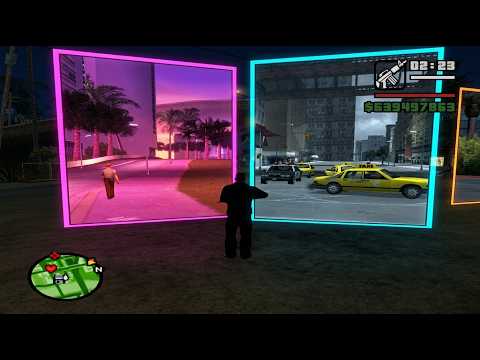
In July 2026, modder Dryxio presented a modification of Grand Theft Auto: San Andreas connecting three games: San Andreas, GTA III and Vice City. The player moves through San Andreas, crosses a portal and enters another map where play continues. The other worlds are not merely images projected into the setting: they become active spaces hosted by the game. A boundary between worlds becomes a passage.
Theoretical computing: a program looks at itself
A quine is a program that prints its own source code. Recursion also lies at the heart of Ken Thompson’s 1984 Turing Award lecture: a compromised compiler can pass a backdoor into the programs it produces, then into its own future versions. The mechanism reproduces itself while remaining absent from the source code being inspected. This is a loop of transmission, not mere duplication. At another scale, nested virtual machines run one computer system inside another.
Language: sentences within sentences
In an influential hypothesis associated with Noam Chomsky and his collaborators, recursion occupies a central place in the language faculty: one proposition can contain another, which in turn contains a third. “The cat [that the dog [that the child saw] chased] ran away.” This capacity can generate increasingly complex sentences, although memory and breath impose practical limits. Whether it is a uniquely human property remains disputed; experiments and their interpretations do not settle the debate.
Biology: copying with a living environment
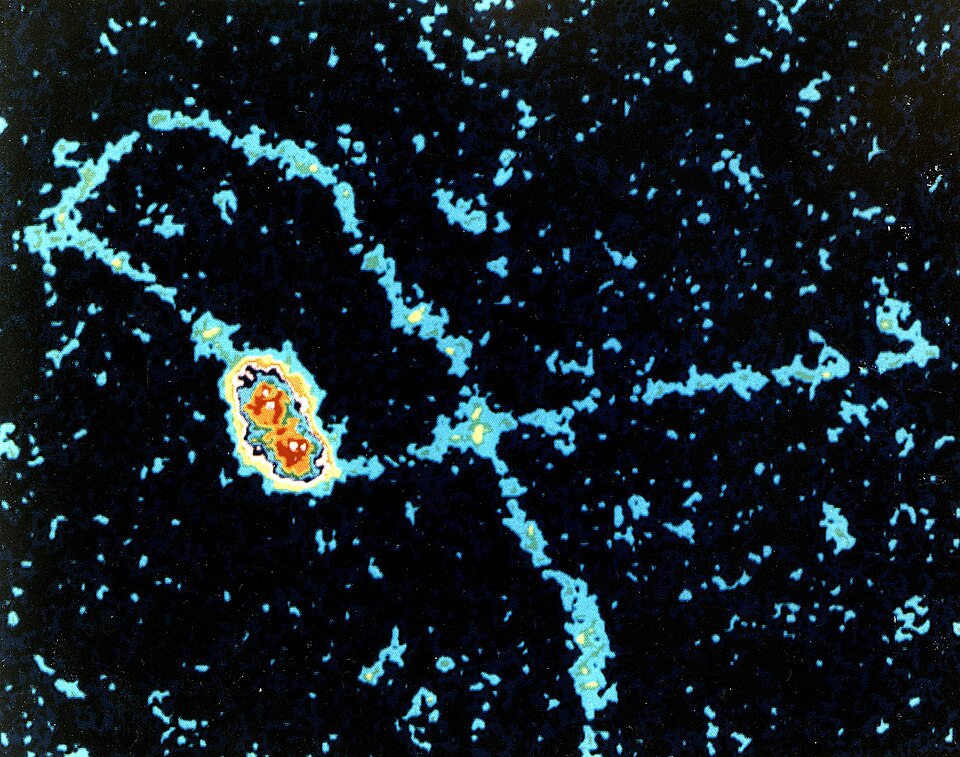
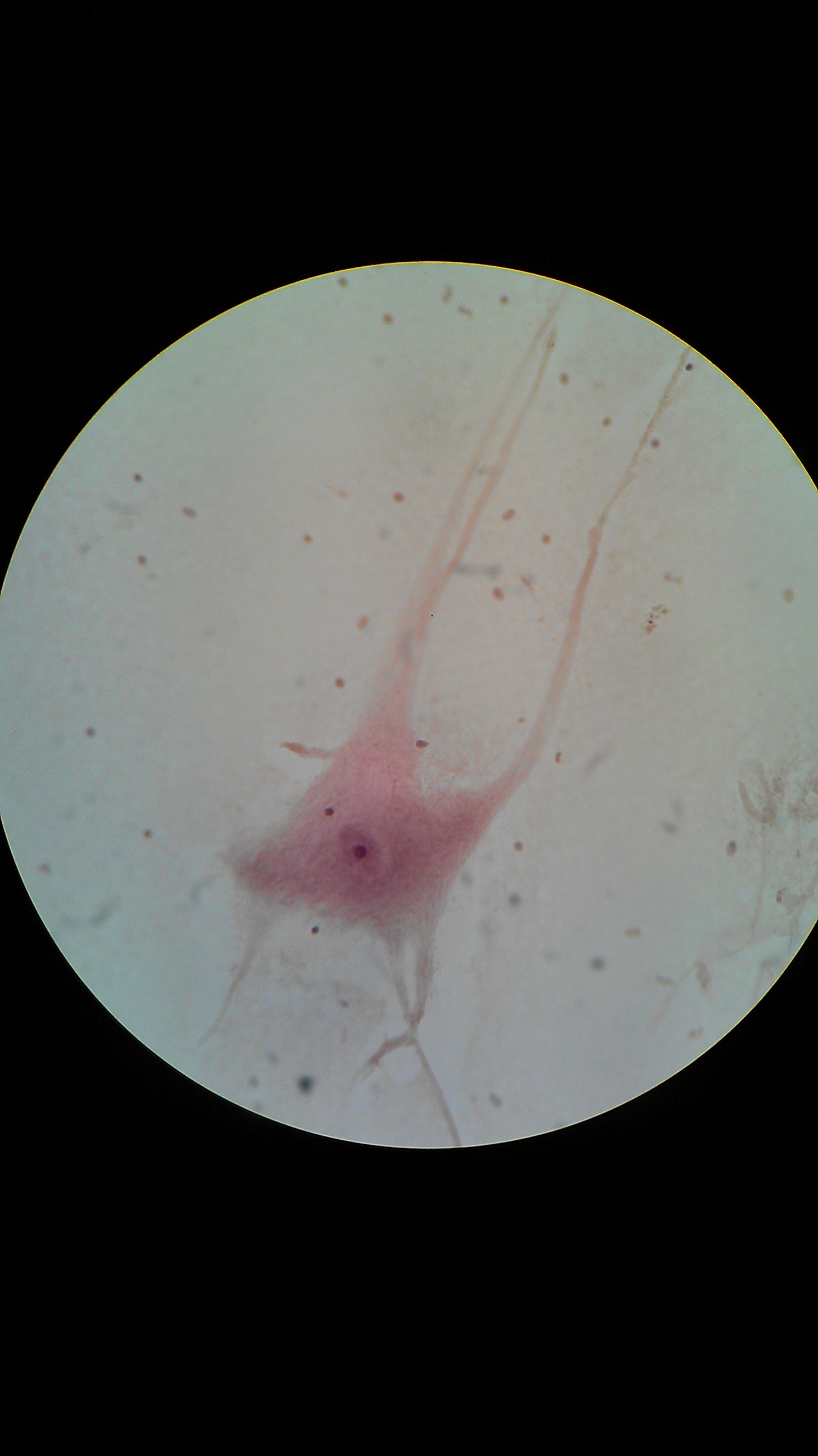
When a cell divides, DNA is copied semi-conservatively: each new molecule retains one old strand and receives one newly synthesised strand. Copying depends on matter, energy, repair mechanisms and an environment. Viruses make that dependence tangible: their genetic material can be replicated, but they recruit a host cell’s machinery. At another scale, bronchi, blood vessels and some plant structures show approximately fractal branching patterns. Life is not a loop that simply copies itself; it combines reproduction, variation, selection and milieu.
Music: climbing without leaving the loop
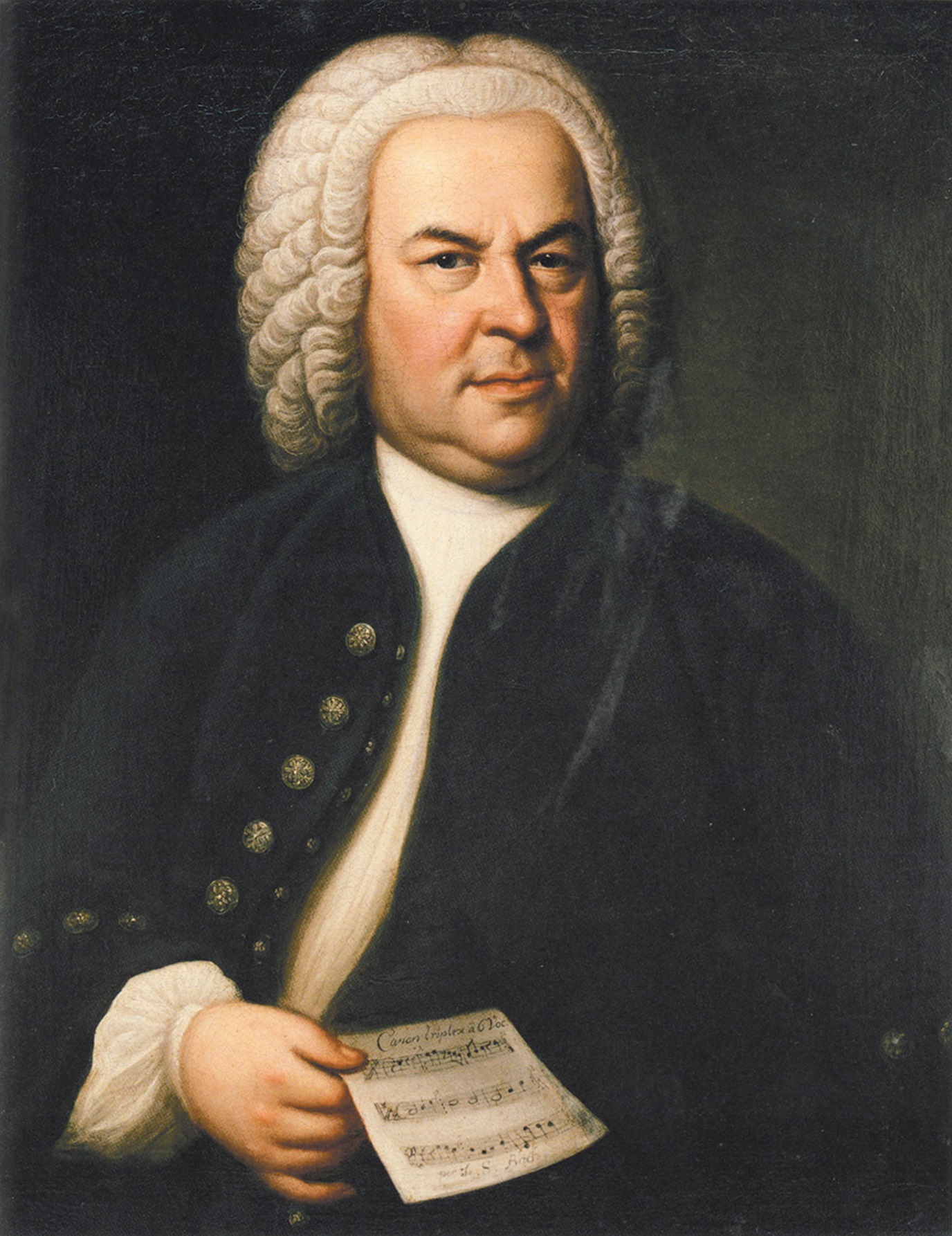
In Bach’s Musical Offering (1747), the canon now nicknamed “perpetually ascending” appears to rise by a tone with each repetition, then returns seamlessly to its starting key. Douglas Hofstadter sees in it a musical image of a strange loop: a sonic staircase that seems to climb while turning back on itself. The Shepard tone extends the illusion with superimposed sounds that seem to rise forever. In live looping, musicians listen to and transform the material they have just recorded in real time.
Architecture: rules across scales
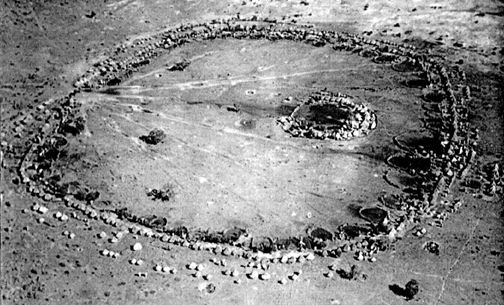
Mathematician Ron Eglash studied Ba-ila settlement forms in Zambia and described some spatial organisations as self-similar: compositional rules recur at several scales, from dwelling to village. This is his mathematical interpretation of observed forms, not a claim that their inhabitants used the concept of fractals themselves. A rule can be read in a form, but that form also belongs to a history and a culture.
Art: the viewer enters the apparatus
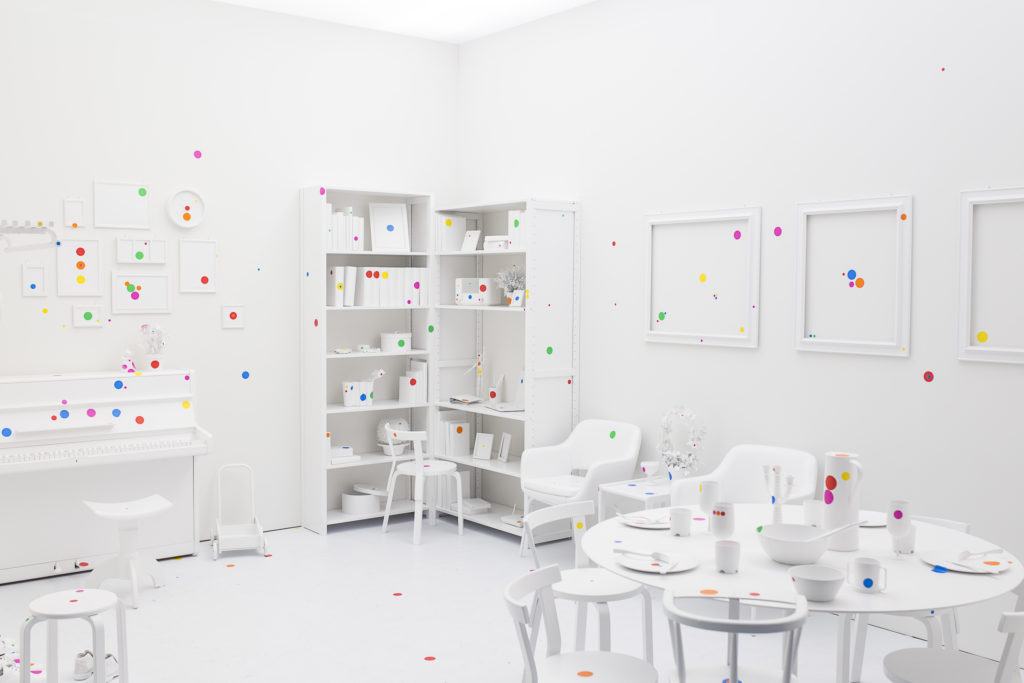
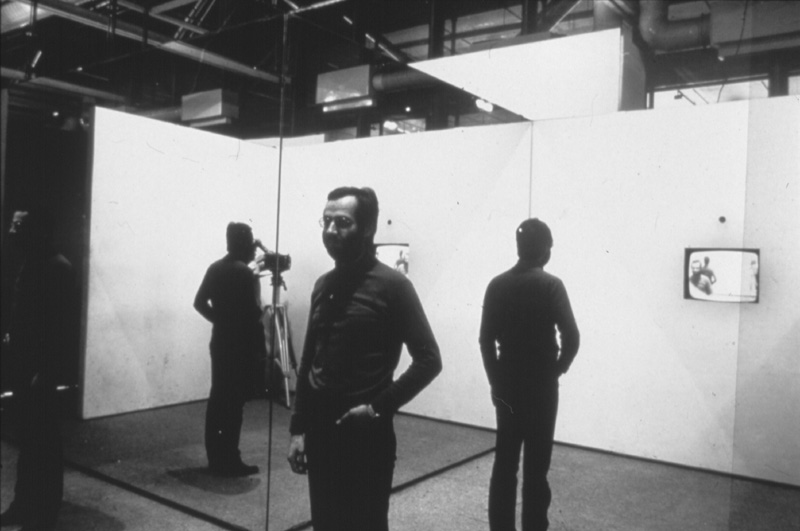
M. C. Escher draws two hands drawing one another; René Magritte places a painting in front of the landscape it conceals; Norman Rockwell paints himself painting his own reflection. In Present Continuous Past(s) (1974), Dan Graham combines mirror, camera and monitor: the room and its audience return as an image delayed by eight seconds. The viewer enters a temporal loop. With her Infinity Mirror Rooms, Yayoi Kusama turns reflection into a spatial experience, while her Obliteration Room is gradually covered by visitors’ coloured marks.
Literature, mathematics and economics
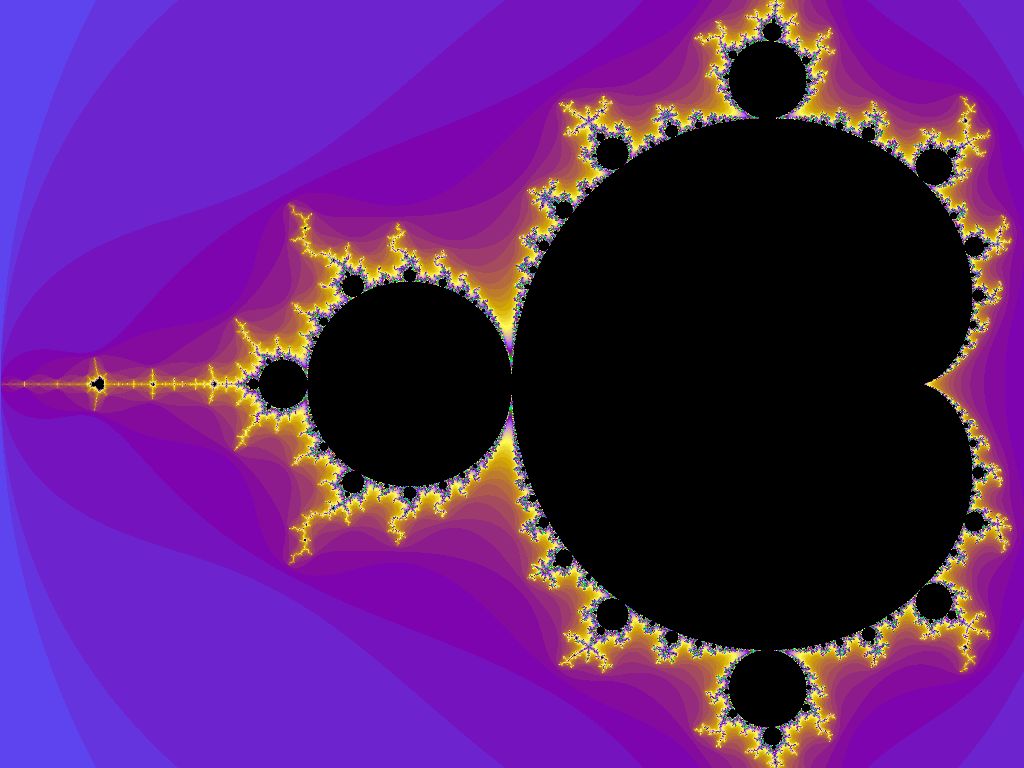
In The Counterfeiters, Gide has a character write a book bearing the title of the novel we are reading. Cervantes makes the characters in the second part of Don Quixote readers of the first. Borges imagines a map that eventually reaches the size of the territory. In mathematics, the Mandelbrot set reveals intricate regions at different scales; logical self-reference also leads to limits of provability, formalised by Gödel in 1931. A logical limit is not entropic decay: it is a boundary internal to a system.
Economics offers other loops, but they are not interchangeable. Bank lending creates deposits when a loan is made; repayments, rules and demand then shape the process. A Ponzi scheme, by contrast, depends on new participants’ contributions and collapses when they stop. George Soros calls “reflexivity” the process in which beliefs affect prices, which in turn alter the situation being assessed. Some loops therefore reproduce effects in the world rather than merely copy a form.
Consciousness: the loop of the self
In I Am a Strange Loop (2007), Douglas Hofstadter proposes that self-awareness may be understood as a brain representing itself representing the world. The “I” would be an apparent fixed point, produced by representations that refer back to one another. This is a philosophical and cognitive proposal, not a universally accepted definition of consciousness.
Two regimes of recursion
A generative recursion adds something at each turn: Bach’s canon returns transformed, fractals reveal new scales, and Graham’s viewer enters the work and changes what it shows. The loop does not simply return to the same place; it organises difference.
An entropic recursion can instead transmit a flaw or lose diversity. A Ponzi scheme needs new contributions; Thompson’s mechanism passes a backdoor from compiler generation to generation. I do not place Gödel’s theorems in this category: they mark limits in certain formal systems, rather than making those systems decay. This distinction matters to me, because “recursion” alone names neither catastrophe nor promise. What matters are the loop’s rules, inputs and conditions of transmission.
Model collapse: when AI recycles its own images
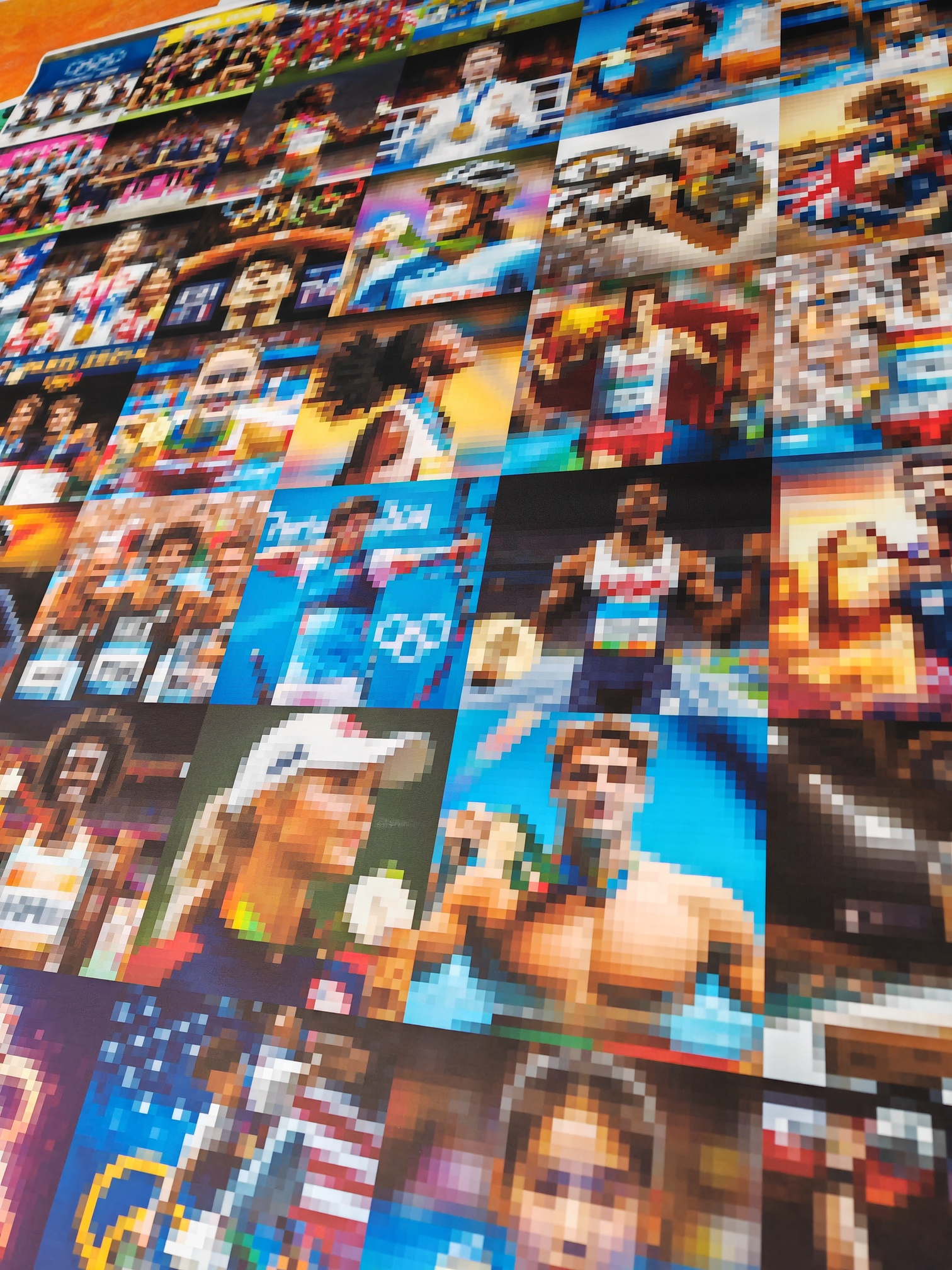
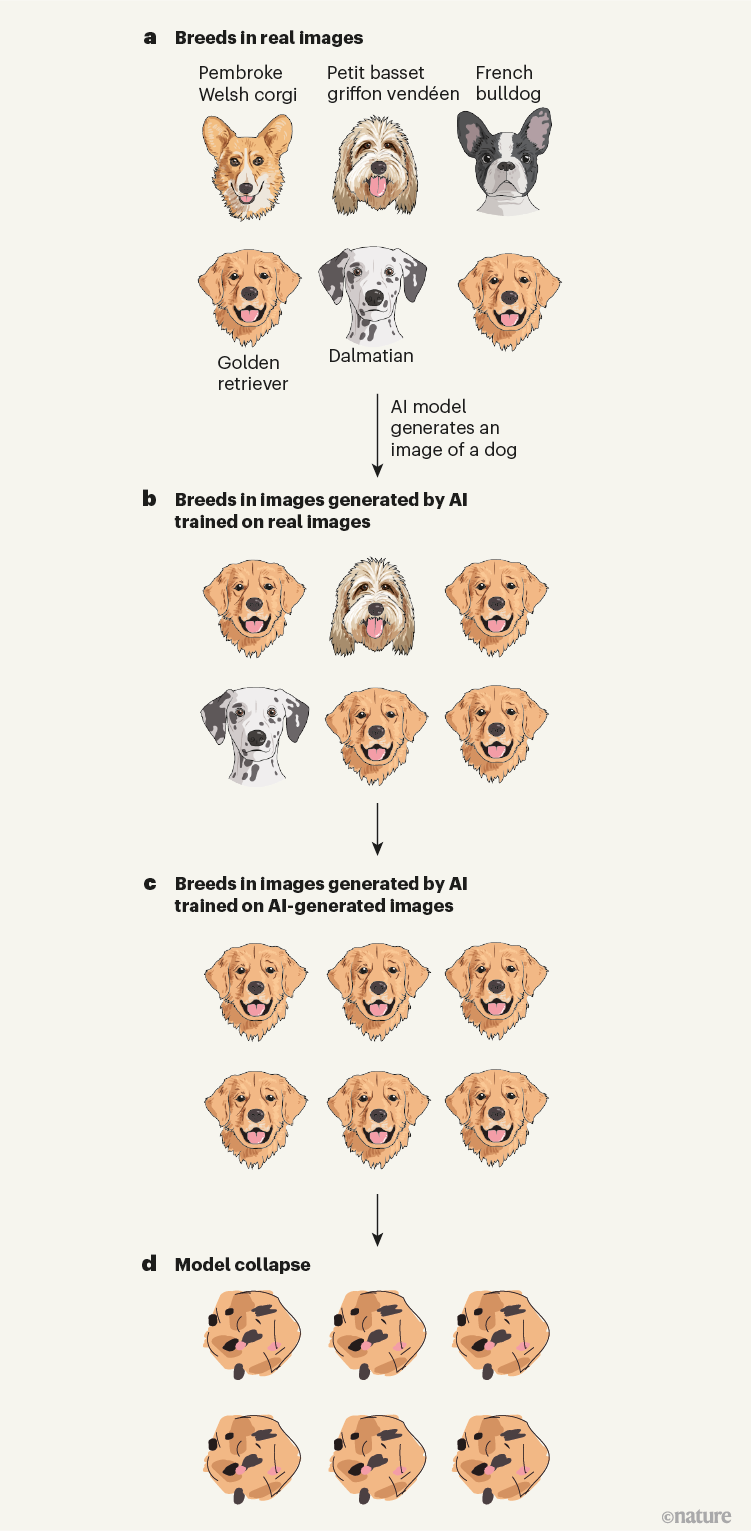
Experiments by Ilia Shumailov and colleagues show that recursive training can progressively erase the tails of a distribution and amplify errors. Rare examples are especially vulnerable: they make up little of a corpus and can be submerged by successive generations of more average outputs. An illustration published by Nature makes the shift visible through generations of images.
I see a tension with the artistic loops described above. In a canon, a game or an installation, repetition can open a difference and make the apparatus perceptible. In model training, recycling synthetic images can impoverish learned data if sources, rare examples and provenance are not protected. The question is not simply “does AI copy?” but who selects what enters the loop, what comes out, and what remains as an archive of the real.
Baudrillard before the fact?
In Simulacra and Simulation (1981), Jean Baudrillard describes several relations between an image and what it claims to represent: reflection, distortion, masking an absence, and finally a simulacrum without a stable referent. Model collapse is not a literal fulfilment of that theory. Still, the connection unsettles me: what happens to an image when the material available to produce it consists increasingly of statistical reflections of earlier images? A technical loop becomes a cultural question about copies, archives and the world.
What the loop changes in practice
The problem is documented in specific protocols, not an apocalypse already under way. Yet it invites us to treat source data, provenance and rare cases as a heritage worth preserving. As synthetic content circulates, future corpora will need to distinguish sources from derivatives and later generations. Without that memory, an average representation may take the place of the world it claims to describe.
This returns me to a question in my work on prediction: can a system projecting statistical patterns from the past still see reality if its archives are made of its own projections? We need provenance chains, diverse datasets and ways to compare outputs with their sources. A loop is not a uniform destiny; it is also an infrastructure choice.
Conclusion: a loop can enrich or erase
Dryxio’s mod, Kusama’s mirrors and Bach’s canon enchant me because their loops produce an addition of meaning, play or beauty. Model-collapse experiments show another possibility: under some training conditions, the loop gradually reduces the diversity it transmits. The same logical structure can generate richness or impoverishment. I am interested in the politics of the loop: its inputs, exclusions, archives and the power to decide its next turn.
Proposal — a Generator of Void
I extend the essay with an experiment to try on the page: a generator receives an image, transforms it, then takes its own output as the next input. Each iteration simplifies colours, pulls them towards an average and adds a slight disturbance. The image becomes a sequence of traces increasingly distant from its starting point. This is a local visual process in the browser, not an AI model and not a simulation of AI training.
I want this disappearance to read like a score: source image, number of iterations, operation applied, duration and stopping threshold. The question is not only when the image becomes unrecognisable. It is also what remains: a colour, a grain, an abstract distribution, or simply the evidence that an image was once there.
If the image can no longer be recognised, has it disappeared — or has it merely left the regime of recognition we assigned to it? I leave it to the visitor to decide when to stop the loop. The void is not a pre-made blank page; it is the visible history of what has been lost.