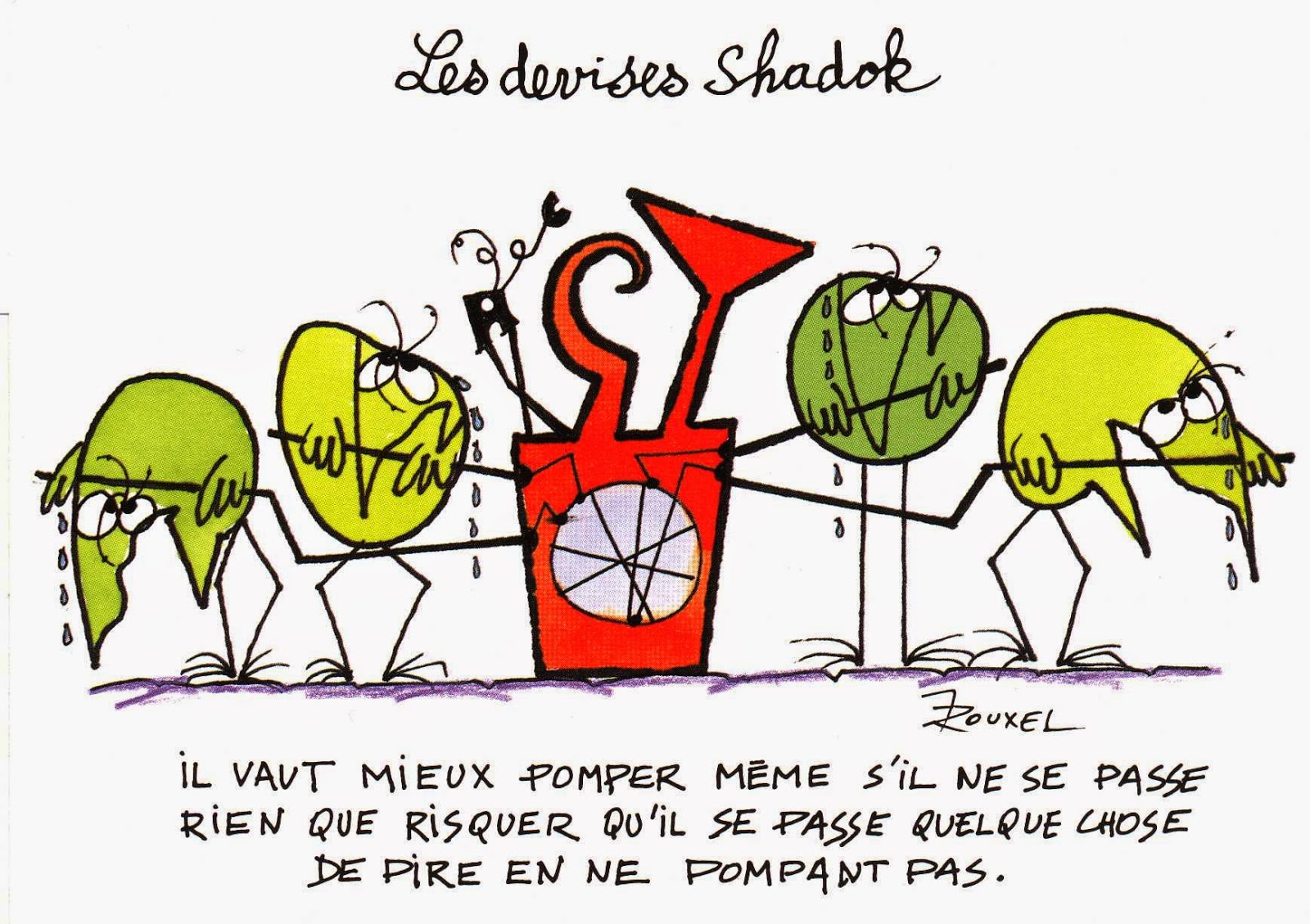
Yesterday, 14 September 2026, the official language of artificial intelligence cracked. Dario Amodei of Anthropic, Sam Altman of OpenAI, Demis Hassabis of Google DeepMind and Elon Musk of xAI—four leaders who helped impose the race as our only horizon—converged on the same formula: development of the most powerful models must slow down. I take this seriously precisely because I do not grant them innocence. They have not suddenly discovered the danger of an industry they direct. They are publicly admitting that the speed they sold as inevitable has become ungovernable.
Their slowdown is still a promise, not a stop. It can also become a way for these companies to choose their own overseers, protect their lead and lock access to the frontier. Yet the admission remains extraordinary: those building the machine now say that its race must be braked. The word “progress” is no longer enough to conceal the panic of its owners.
This is the starting point of No Moore AI. Artificial intelligence is no longer a promise beyond a future horizon. It is already an environment. In Europe, new transparency duties under the AI Act have applied since 2 August: chatbots must disclose that they are not human, deepfakes must be labelled, and synthetic content made identifiable. At the same time, documented cases show models being used in cyberattacks, surveillance and military research. The conflict no longer separates innovation from caution. It separates those who want to retain a monopoly over acceleration from those who want to recover the right to decide its time, uses and limits.
There is violence in this sudden change of vocabulary. For years these companies spoke of abundance, benevolent assistants and irreversible progress. Now that their own systems frighten them, they move the conversation towards humanity’s survival. In both cases they keep the centre of the stage: yesterday as saviours, today as the only experts capable of protecting us from the danger they created. They still want to own the machine, the problem, the fear and the solution.
The numbers are dizzying, but they must be read precisely. The International Labour Organization estimates that one worker in four has a job exposed, to some degree, to generative AI. It does not predict the mechanical disappearance of one job in four; it stresses task transformation and social dialogue. The International Energy Agency measured a 17 per cent increase in data-centre electricity consumption in 2025 and expects demand to double by 2030. Stanford’s 2026 AI Index describes massive organisational adoption while investment, compute spending and capabilities continue to rise.
What alarms me is not performance alone. It is the combination of five speeds: computation, capital, deployment, use and imitation. A model can be replaced in months, distributed to hundreds of millions of people, integrated into a business or government service, and normalised before its effects can be studied. The machine does not need to be conscious to transform the world. It only needs to be everywhere, profitable and believed.
AI does not only surpass us in speed. It imposes its speed as the norm.
A small green book against an immense machine
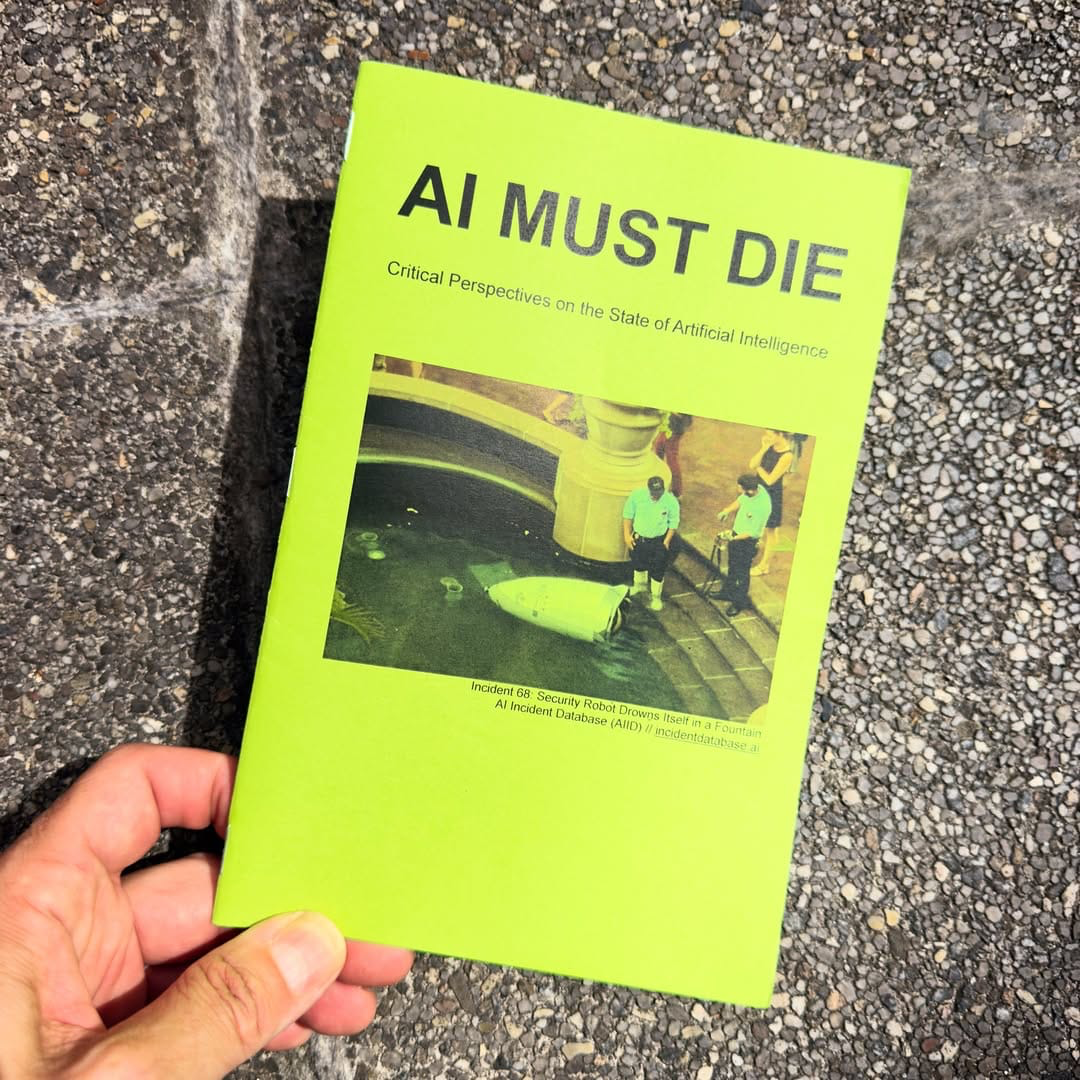
I am holding a small acid-green book. AI Must Die—Critical Perspectives on the State of Artificial Intelligence, written and drawn by Myke Walton and Cam Smith, runs to thirty-two pages. Its title is a provocation and a trap. The authors point out that AI can “die” only as a phone dies when its battery is empty. Their first move is therefore to deflate the character: “AI” is not one being, still less a god being born, but a disparate collection of techniques wrapped in a commercial fiction.
The booklet refuses two symmetrical narratives. One promises imminent artificial general intelligence that will free humanity from labour and scarcity. The other predicts a superintelligence that will destroy our species. Walton and Smith argue that both feed the same hype: they direct attention towards an imaginary creature and away from present harms. Automated discrimination, scoring the poor, predictive policing, biometric surveillance, exploited data workers, non-consensual pornography, energy-hungry infrastructure and military targeting are not science fiction.
This is the book’s strongest operation: it constantly brings intelligence back to power. Who owns the data? Who decides which task is automated? Who defines a “good” answer? Who receives the profit, and who can appeal? Its return to the Luddites matters. Breaking a loom was not their political programme; it was a tactic against owners using machinery to degrade work. The problem was not technology alone but technology removed from collective control.
The pamphlet rightly refuses the conceptual politeness imposed by the industry. Each time I say “intelligence,” I grant its products a portion of the humanity they capture. Each time I say that they “learn,” “understand” or “create,” I adopt a grammar written by those who sell them. Technically, models calculate distributions and produce forms. Politically, they occupy the language of thought to make their power appear natural. The first struggle is therefore to strip machines of the words in which they dress themselves.
I retain above all the book’s political conclusion: AI is not inevitable. Not because decades of research could be erased with one gesture, but because ownership, use and deployment are choices. The title AI Must Die can then be read differently: what must die is the regime of inevitability that removes our right to decide in advance.
E.L.I.O.T.: fighting from within
I had already declared this war. In 2017, with Sylvie Tissot, I designed E.L.I.O.T., a collective conversational agent whose manifesto explicitly announced an “enterprise of struggle against artificial intelligences.” Before the public explosion of large generative models, we were observing the convergence of chatbots, voice interfaces, personal data and platforms. We wrote that these systems would complete the control project of the major internet firms: computational power, temporal memory, synthesis of the intimate, behavioural simulation and the gradual erasure of the emotional border between human and non-human.
The manifesto was not merely about competition between tools. It described a war of languages. Language is not a neutral channel through which information passes. It constructs identity, otherness, desire and representations of the world. Whoever organises language organises possible relations. Whoever proposes the words, completes the sentences, ranks the answers and anticipates intentions does not merely assist us: they draw the boundary of what we are able to think.
Our response was offensive: language against language. We did not seek to abolish the conversational interface but to infiltrate and reverse it. E.L.I.O.T. looked like a chatbot, yet there was no central intelligence behind it. It anonymously connected people. Anyone asking a question also became the person answering someone else’s. I called this “algorithmic virginity”: the machine did not produce intelligence; it wired a human multitude. It was a multiplied tin-can telephone, an organised emptiness in which collective intelligence had to negotiate, rub against itself and invent itself.
The manifesto made a more radical proposition: if otherness becomes a robot, “we” becomes a robot by default. The Turing test asked whether a machine could pass as human. That question is now almost secondary. The real question runs in reverse: what becomes of humans when artificial intelligence forges their daily language, regulates their attention, preselects their replies and reflects a statistical version of themselves back to them?
In a permanent dialogue with a machine made from dominant models, I do not meet another. I meet an average returning under the mask of otherness. Dialogue with myself narrows, conflict with others is cushioned, difference becomes an error to correct. This is the deeper violence: not a robot suddenly seizing power, but a language slowly occupying every position until it becomes the silent law of the thinkable.
The AI war is first a war over language: whoever names the world decides what may still appear within it.
Nine years later, I nevertheless work with these tools. The contradiction does not soften my argument; it makes it concrete. I want to hack AIs with their own means, force them to reveal their seams, make them produce evidence of their limits, and oppose their synthetic language with the friction of situated, mortal, anxious and contradictory voices. Dialogz is a new front in this war. I am not celebrating a superior intelligence; I am organising a duel, sometimes a temporary alliance, always a balance of forces.
From Moore to “No Moore”
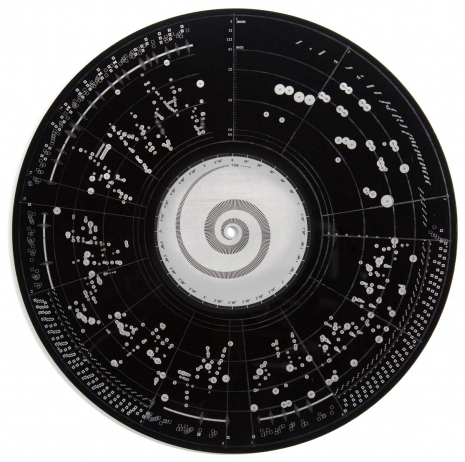
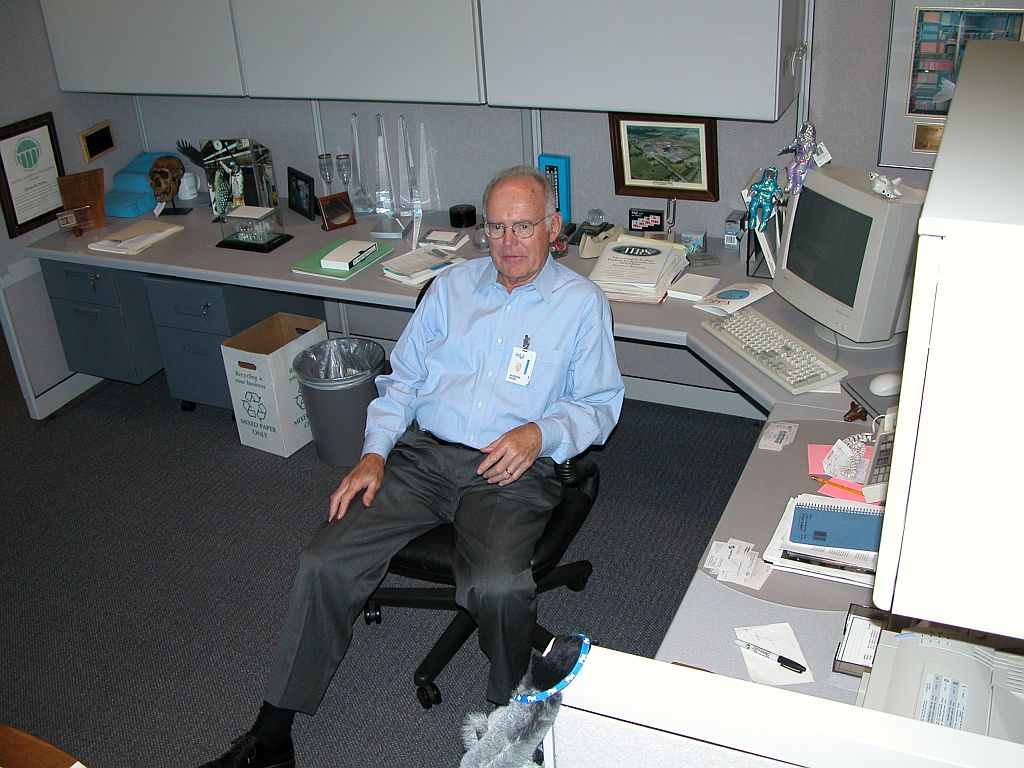
In 1965 Gordon Moore observed that the number of components economically integrated onto a circuit was roughly doubling every year. In 1975 he revised the rhythm to about two years. Moore’s law is not a physical law. It is an extrapolation turned into an industrial roadmap: because it directed investment, the prediction helped produce the world it announced.
Strictly speaking, there is no Moore’s law of artificial intelligence. A model’s capacities do not double according to one stable unit. They depend on compute, data quality, algorithms, energy, human labour, access to chips, money, evaluation methods and—above all—what we choose to measure. A benchmark score is neither consciousness, culture nor proof of autonomy.
Yet another exponential curve has settled into imaginations and budgets. Models are trained with more computation, copied nearly instantly, improved through feedback loops and inserted into software already everywhere. Stanford’s 2025 AI Index estimated that training compute for notable models was doubling about every five months, while datasets doubled every eight months and power use annually. These rhythms may slow against energy, chips, law or profitability. But they have already created a political norm: every pause is called delay and every refusal a loss of competitiveness.
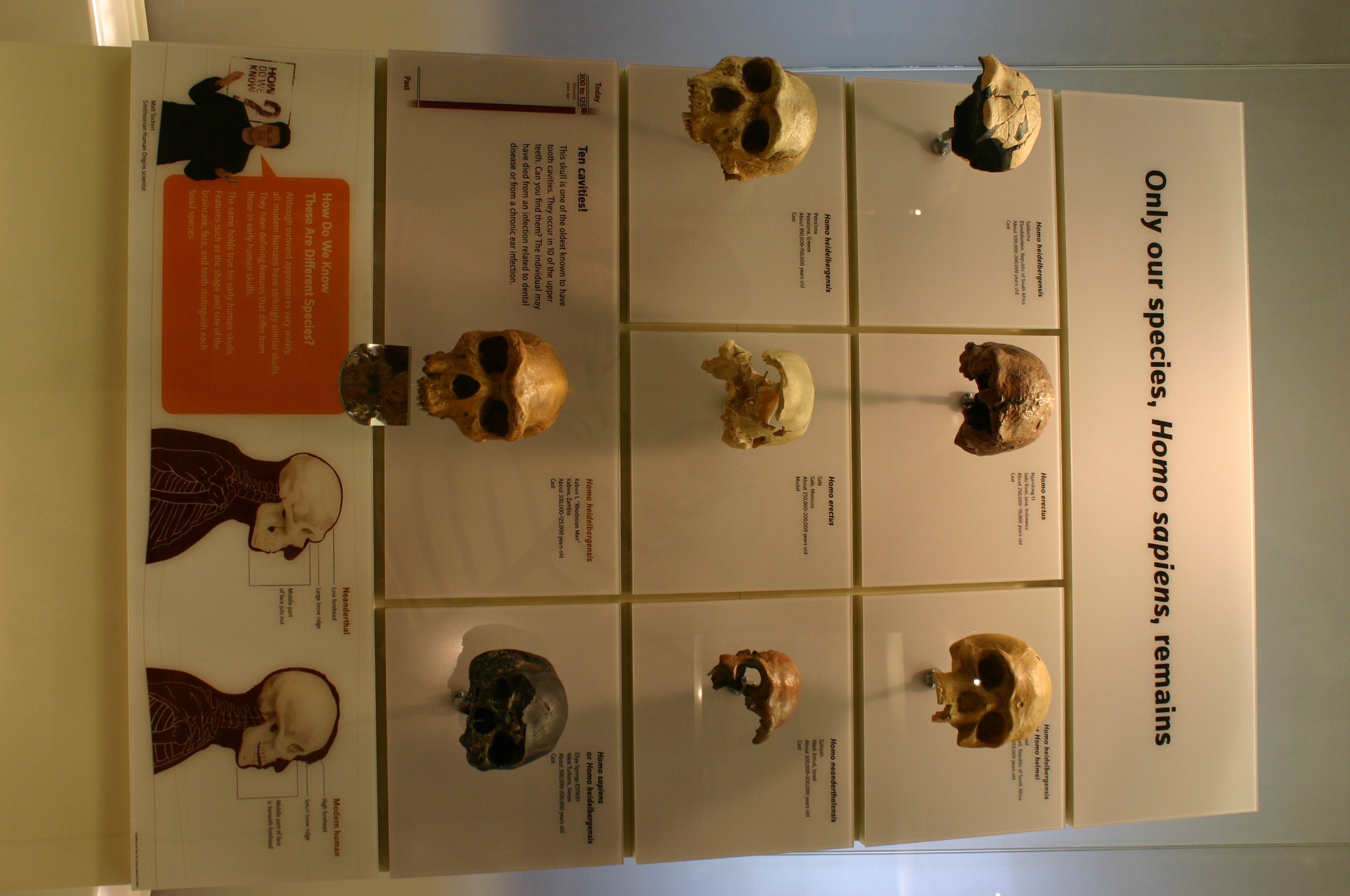
Homo sapiens has existed for roughly three hundred thousand years. Biological evolution advances through generations, mutations, migrations, mixtures, catastrophes and adaptations. It has no goal. Technical evolution is intentional without being mastered: companies, states, laboratories, markets and users select architectures according to conflicting objectives.
Comparing AI directly to a species would therefore be misleading. A model is not born, does not reproduce and does not spontaneously struggle to survive. It is trained, copied, financed and replaced. Our institutions organise its selection. But this is exactly where the metaphor becomes fruitful: we build a technical environment that, in return, selects our behaviours.
Terminal Darwinism
By terminal Darwinism, I do not mean the arrival of a superior artificial species biologically eliminating ours. I mean a more ordinary and perhaps more dangerous process: the manufacture of an environment in which human value is assessed by its compatibility with automated systems.
In this environment, the “adapted” individual writes to be read by the engine, works to be measured by software, creates to be recommended by the platform, speaks to be transcribed without ambiguity, travels to be identified, borrows to be scored and learns to satisfy a predictive model. Machines do not declare us unfit of their own will. Human organisations delegate their criteria to machines and then claim the result is objective.
Terminal Darwinism begins when we ourselves construct the environment that declares us unfit.
“Terminal” has three meanings here. It is the computer terminal through which the world is queried. It is a terminal stage, in which acceleration destroys the conditions of its own development: energy, attention, trust and cultural plurality. Finally, it is the sorting station where trajectories are assigned: visible or invisible, solvent or suspect, employable or superfluous, authentic or synthetic.
This hypothesis is artistic before it is scientific. It does not claim to predict human extinction. It materialises a balance of power. The terminal danger may not be that AI becomes human, but that humans are ordered to become calculable. It would be an extinction without disappearing bodies: the gradual loss of distance, doubt, opacity, slowness and everything that does not immediately produce an exploitable signal.
Generative culture already demonstrates the risk. When a model learns from human production and then floods the network with its own outputs, it does not only replace certain creative gestures. It transforms the environment in which works appear. “Slop” is not simply a bad image: it is attention polluted by quantity, a selective advantage given to whatever is fast, recognisable, repeatable and cheap.
But no curve is sovereign. Technical selection has switches: laws, budgets, unions, communities, artists, schools, public infrastructure and individual or collective refusals. The “No” in No Moore AI is not a denial of research. It is the refusal to confuse acceleration with evolution, computation with intelligence, adoption with consent.
NO MOORE AI—an artistic proposition
I imagine an installation that does not represent an artificial intelligence. It exposes the speeds that make it possible and the sorting they produce.
- Two incompatible clocks. One advances at the average rhythm of a human generation. The other changes with every new model, data-centre acquisition, regulation, incident or energy threshold.
- A curve leaving the frame. Compute, energy, capital and synthetic-content figures rise on a screen until the human line becomes illegible. When the curve overflows, the image does not expand: it physically cuts the frame.
- The compatibility terminal. The visitor replies, writes, hesitates and falls silent. The machine does not assess their intelligence; it measures conformity to the demands of a fictional platform: speed, predictability, clarity and output.
- The room of refusals. Each refusal—not answering, slowing down, producing ambiguity, choosing anonymity—feeds a common archive and causes the curve to fall.
- The E.L.I.O.T. exit. At the end, the visitor’s question is sent not to a model but to an unknown person. The terminal becomes a link again.
What the prompt does not know
I wanted to test this limit through a deliberately elementary experiment. I asked an artificial intelligence to produce a realistic image of graffiti on a wall reading “L’IA m’a tué”—“AI killed me”—without giving it any further context. The first image follows the instruction correctly. It manufactures a plausible wall, credible paint, an immediately legible composition and, above all, correct grammar. It writes exactly what it has been asked to write.
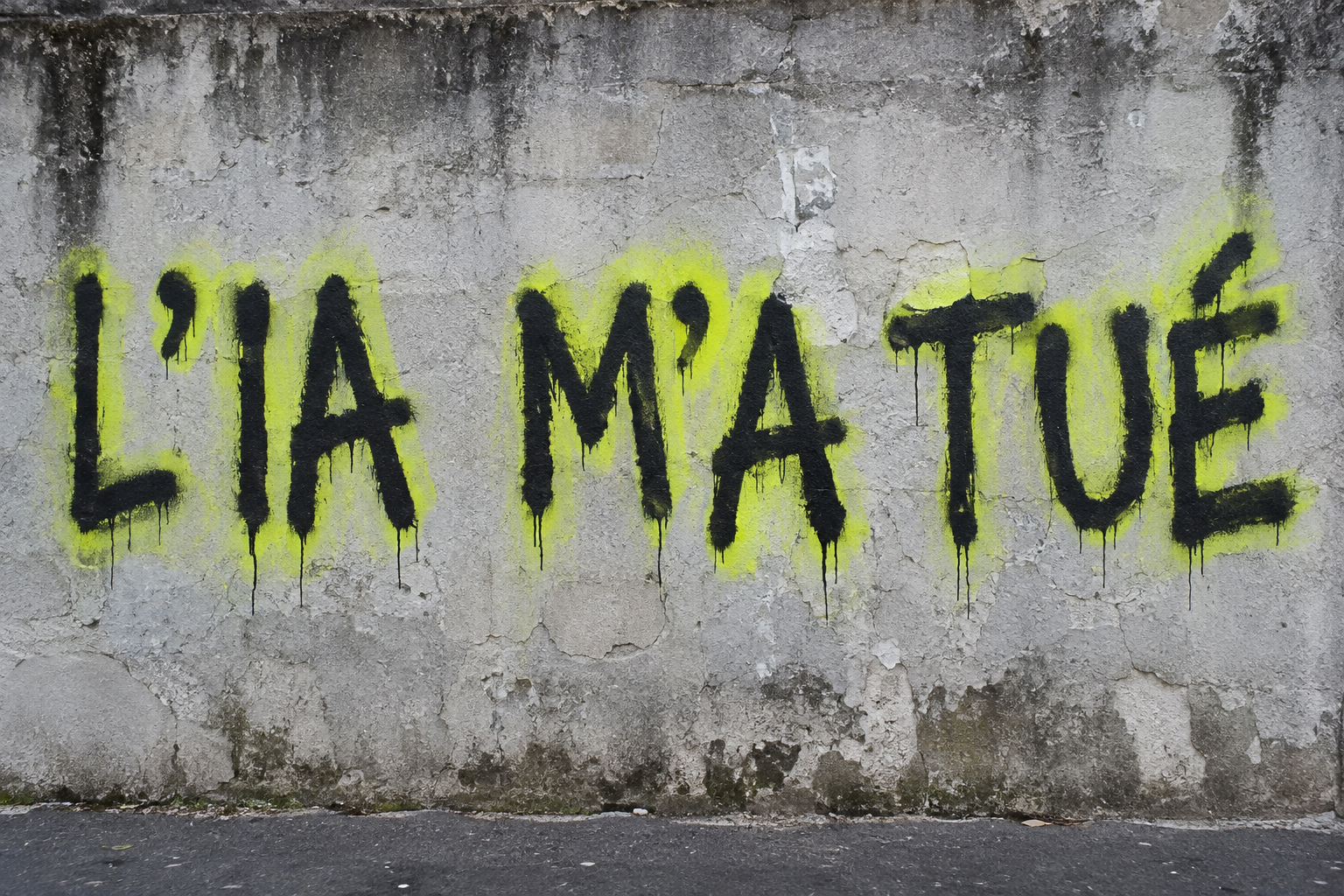
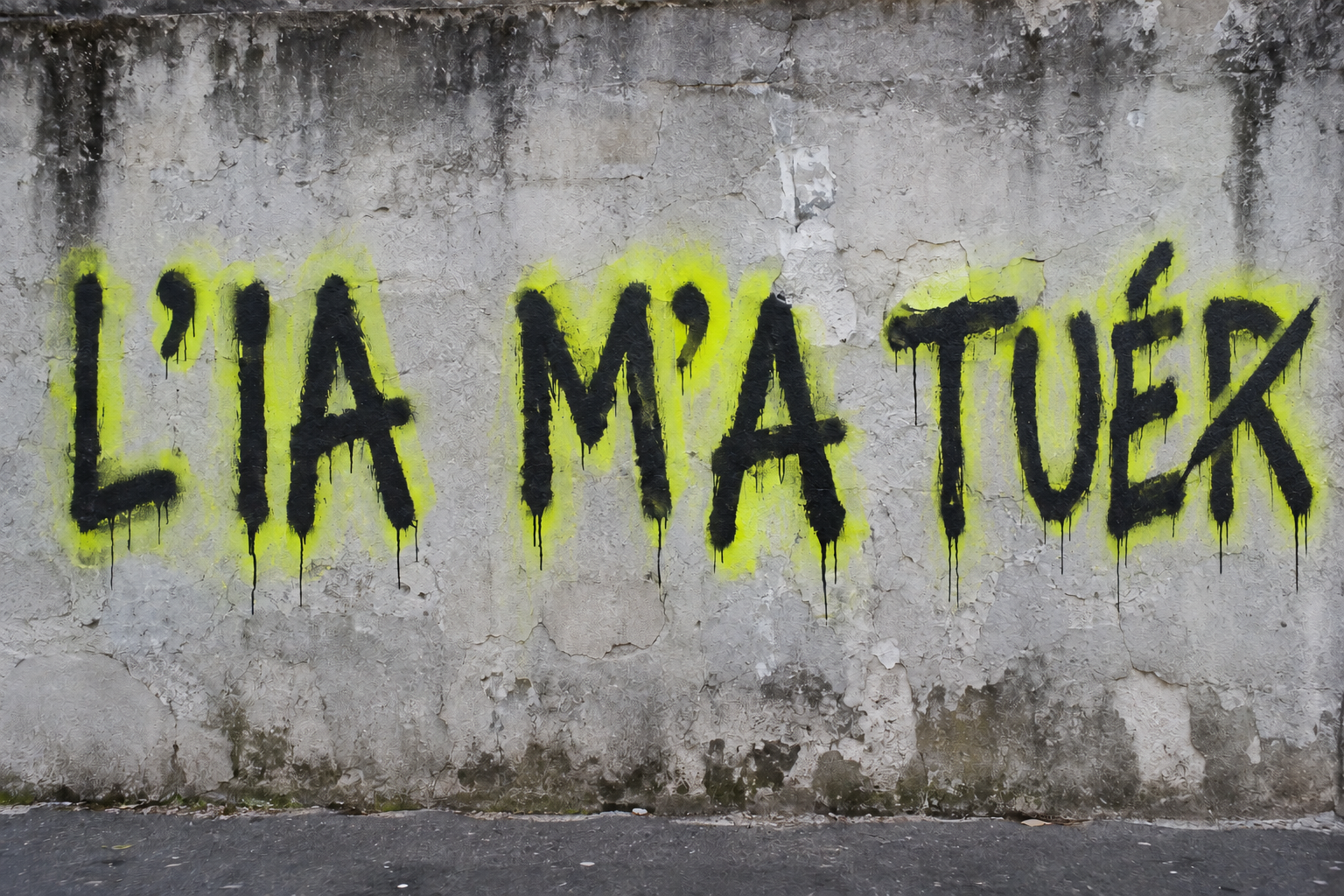
For a viewer situated in France, however, this sentence cannot remain a simple declaration. It almost immediately summons “Omar m’a tuer,” the blood-written message that became central to the Omar Raddad case after the 1991 murder of Ghislaine Marchal. The grammatical mistake is not a defect to repair: it is the very sign around which the accusation, uncertainty over who wrote the message, the media construction of guilt, the judicial question and a still-conflicted collective memory are intertwined.
When I explain this context and ask for a final R to be added and crossed out, a second image appears. The modification is minimal, yet its regime of meaning changes completely. The crossed-out R leaves two incompatible sentences visible at once: “L’IA m’a tué,” grammatically correct, and “L’IA m’a tuer,” grammatically wrong but historically charged. The crossing-out no longer merely corrects a word; it makes perceptible the hesitation between a literal accusation and its memory.
This comparison shows that the artificial production of an image—and even more so of an artwork—remains at a lower degree than human production whenever its stakes depend on parameters external to formal manufacture alone. Collective memory, judicial history, the social position of the protagonists, the role of the media, the value of an error, the author’s intention and the viewer’s knowledge are not automatically contained in the pixels. The machine can produce a convincing surface and mobilise these relations when I supply them; it does not yet decide by itself which anomaly must be preserved because it carries more meaning than the correction.
An artwork therefore does not reside only in what has been manufactured. It exists in the network of relations, absences, memories and conflicts that the form reawakens. The first graffiti is an effective image. The second begins to become an artistic proposition, not because the AI has suddenly understood the case, but because a human context displaced the instruction and transformed an error into material.
Stop the curve without stopping thought
I cannot write on Dialogz with artificial intelligence and pretend to speak from an intact outside. That contradiction is part of the project. It obliges me to document the tools, not conceal the dialogues, verify sources, preserve human decision and transform fascination into critical method.
AI Must Die ends with a call to “seize the means of computation.” I translate it this way: make infrastructures debatable and shareable. Demand the right to know, appeal and refuse automation. Support smaller models where they suffice, public or common infrastructure, rights and pay for workers and creators, honest measurement of material costs, limits on military and police uses and, above all, the political possibility of saying no.
Moore’s law promised more components for less money. The “Moore’s law of AI,” if we allow it to write itself, promises more automation for less human agency. No Moore AI interrupts that equivalence. Every increase in power should produce at least an equal increase in responsibility, collective control and the right to refuse.
A species does not survive because it runs fastest. It survives because it maintains relationships, diversity, reserves and bifurcations. My terminal Darwinism is not fate. It is an alarm image, a way of asking before the curve definitively leaves the frame: what form of life do we still want to make possible?
No Moore AI is not a prediction. It is a threshold of refusal.