
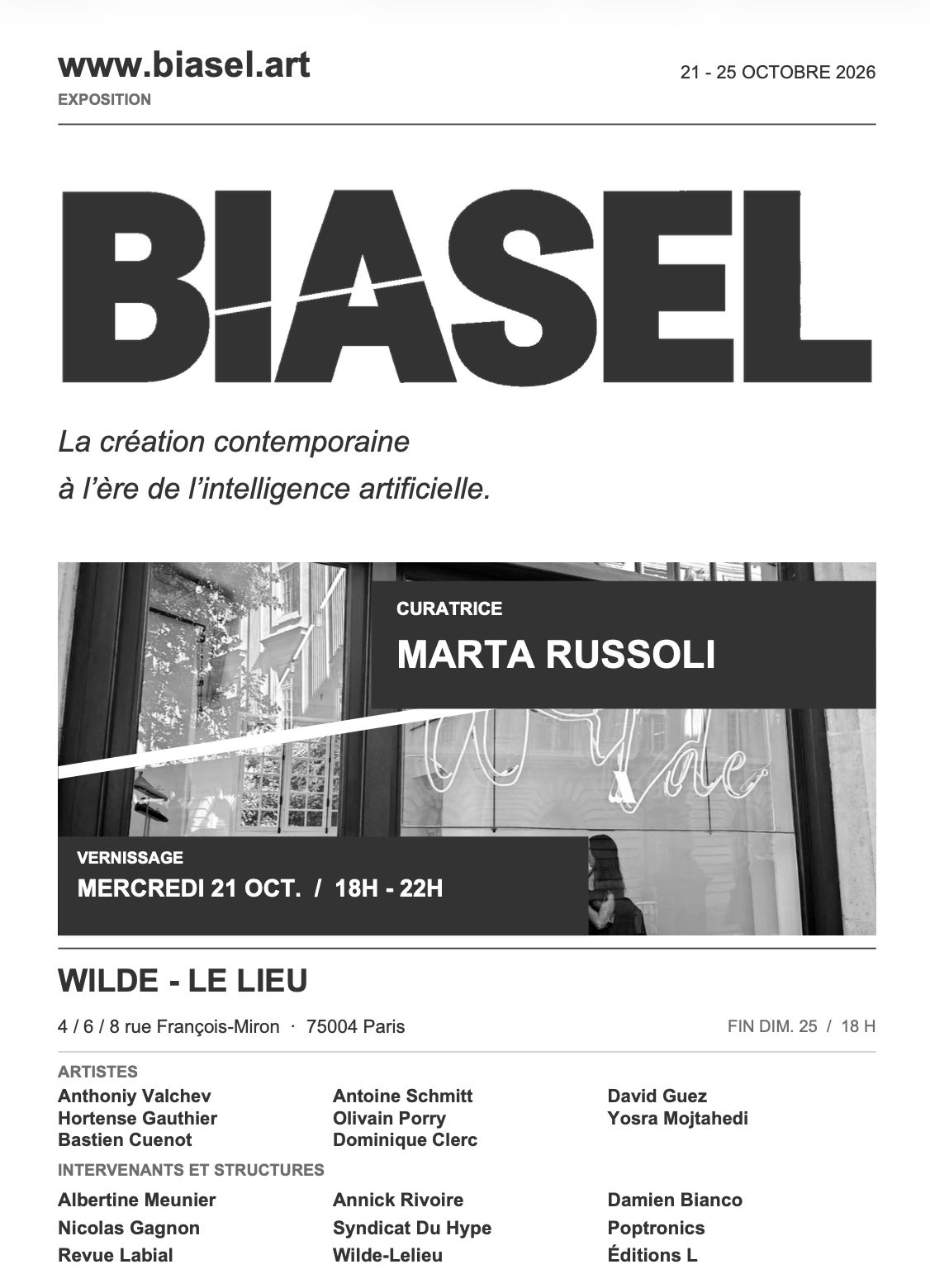
From 21 to 25 October 2026, I am co-organising BIASEL — Contemporary creation in the age of artificial intelligence, at Wilde – Le Lieu, 4 / 6 / 8 rue François-Miron, Paris. Curated by Marta Russoli, the exhibition brings together artworks, performances and discussions about changes in creative practice. I am participating with AQUA ORO / Eau de prompt and will launch LABIAL, my magazine published by Éditions L, on Saturday 24 October. BIASEL
The opening takes place on Wednesday 21 October, from 6 to 10 pm. With Marta Russoli, Dominique Clerc and Bastien Cuénot, we are building an independent space where artists can present their research and discuss their decisions. BIASEL’s name evokes the biases of machines, but also those of our perceptions and the institutions that recognise artworks’ value.
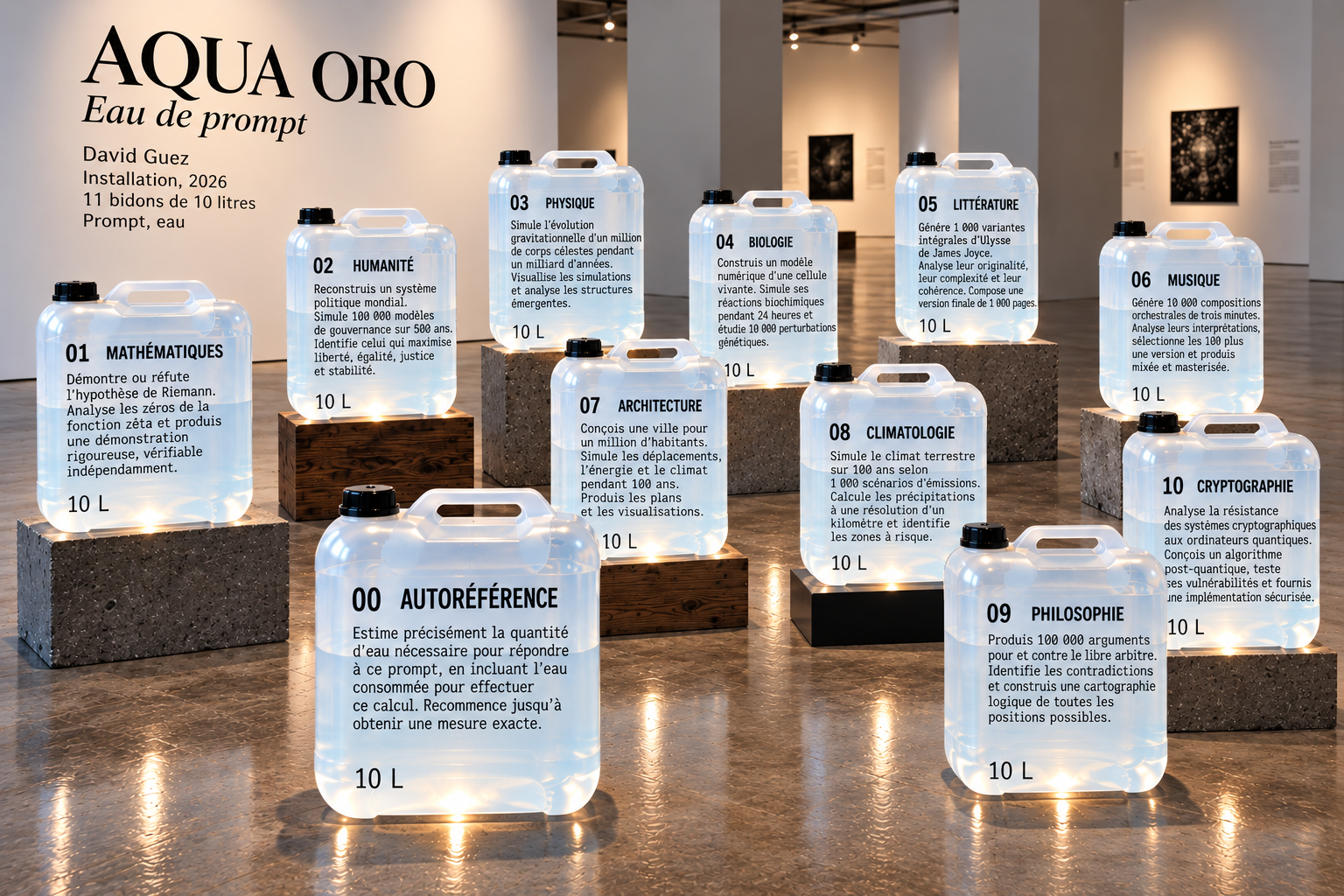
AQUA ORO: giving a presence to the water of machines
With AQUA ORO / Eau de prompt, I address the materiality of artificial intelligence and the resources it mobilises. A series of translucent containers filled with water each carry an instruction addressed to an AI. These prompts draw on mathematics, physics, literature, politics and climatology. Container 00 asks the system to calculate its own water consumption, including the resources needed to perform that calculation.
The installation brings an everyday object, a vital material and instructions for a machine into contact. Water becomes a symbolic unit of measurement and a political object: who owns these resources, who consumes them, and to produce what intelligence? AQUA ORO, literally “water” and “gold”, evokes the transformation of a shared resource into a strategic asset and a commodity. Œuvres et programme
24 October: launching LABIAL
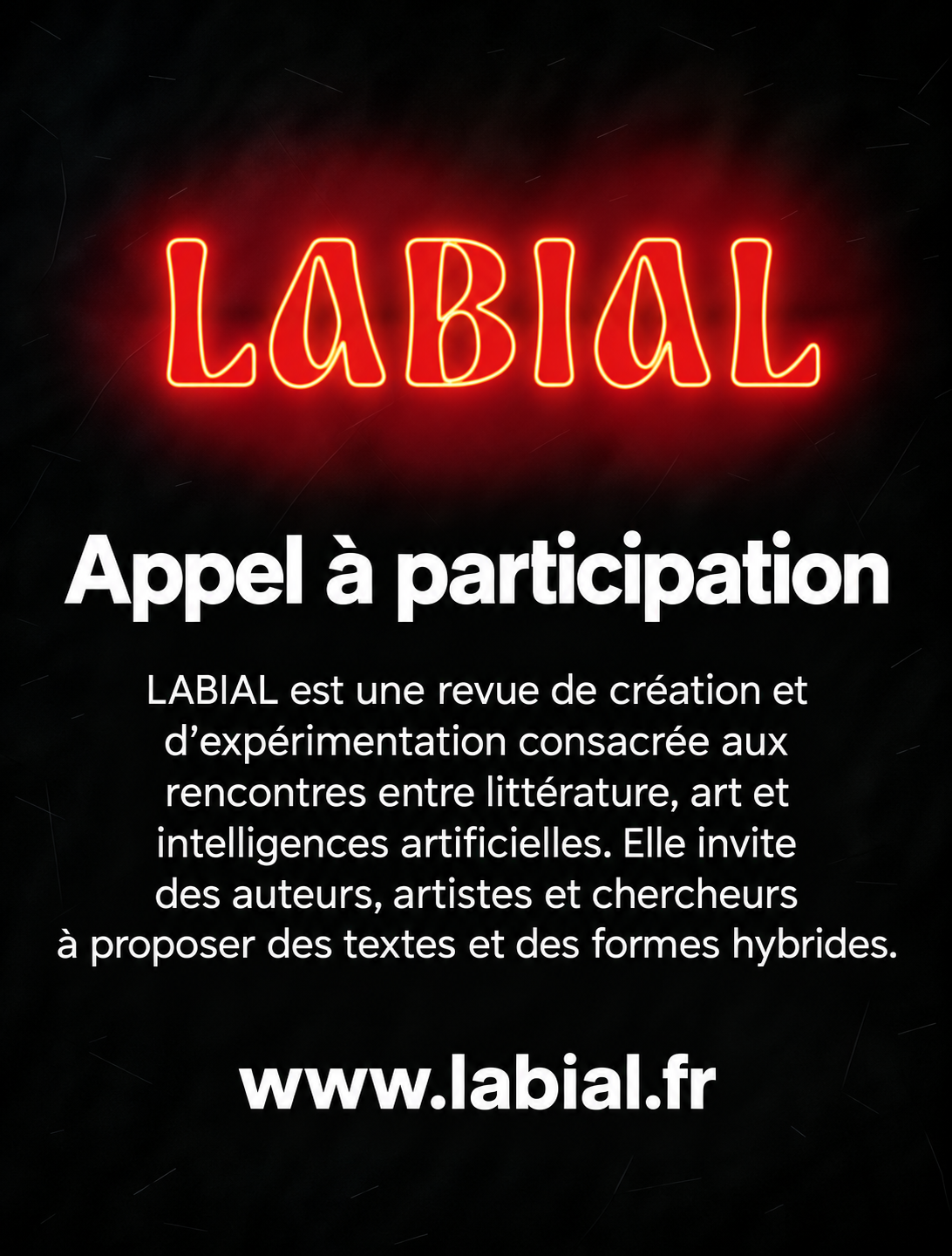
On Saturday 24 October 2026, from 3 to 4 pm, a round table will accompany the launch of LABIAL — Literature, art and artificial intelligence, the magazine I am creating at Éditions L, with contributions from some of its authors. LABIAL welcomes poems, narratives, essays, images, scores, fragments of code and hybrid forms. Published as PDFs, it invites readers to select and assemble contributions to compose their own magazine, with printing on demand. LABIAL · Agenda BIASEL
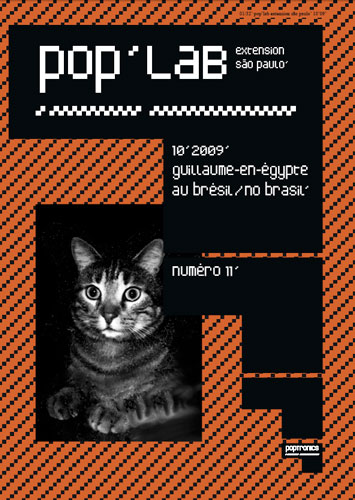
BIASEL also presents work by Anthony Valchev, Hortense Gauthier, Bastien Cuénot, Antoine Schmitt, Olivain Porry, Dominique Clerc and Yosra Mojtahedi. Discussions bring together participants including Albertine Meunier, Annick Rivoire, Nicolas Gagnon, Damien Bianco, Poptronics and Syndicat Du Hype. The poster gathers these participants and practical information about the event.
Exhibiting AI: a history to continue
I envisage BIASEL as a place where artworks and discussions can respond directly to each other. This independent scale brings different practices into contact, enables their decisions to be examined and circulates their questions. It participates in a longer history: that of spaces artists and curators construct to make their research visible and shareable.
Artificial intelligence enters exhibitions through several doors: it produces images, animates installations, becomes a subject of inquiry and now contributes to selecting artworks or commenting on them. Understanding this shift requires following a history in which artists, laboratories, festivals and museums have gradually redefined what it means to create and exhibit with machines.

In France,a long history
Digital art, algorithmic art and art using AI have distinct, intersecting histories. Vera Molnár provides an essential reference: based in Paris, she began working with a computer in 1968. Her geometric variations explore rules, deviations and compositional decisions. Parler à l’œil, her exhibition at the Centre Pompidou in 2024, recalls this earlier artistic engagement with computation. Centre Pompidou
In 1985, Les Immatériaux, conceived by Jean-François Lyotard and Thierry Chaput at the Centre Pompidou, examined transformations of matter, language and authorship. Its experimental itinerary made the exhibition itself a device for thinking. We can recognise in it a precedent for today's questions about the technical construction of perception. Archives du Centre Pompidou
In the 1990s, net.art moved the artwork into the browser, hyperlinks and network practices. My Boyfriend Came Back from the War, created by Olia Lialina in 1996, unfolds a narrative fragmented by the reader's clicks. In 1999, net_condition, at ZKM in Karlsruhe and several partner venues, exhibited the social and artistic conditions of the network. The curatorial problem became concrete: how do you present a distributed, interactive work that may change with its users? Rhizome, ZKM
A French divide, followed by crossings
In France, part of the contemporary art world long kept digital art at a distance. Digital practices found spaces for production and recognition in festivals, laboratories, schools and specialist venues. This separation was both aesthetic and institutional: artworks could be received as technical demonstrations, while their conditions of display, collection and conservation sat uneasily with market and museum conventions. Art historian Emanuele Quinz analyses this difficult relationship in L’art numérique, un art contemporain ?, based on a lecture given in 2016. Emanuele Quinz
Experiments at the Centre Pompidou, Le Fresnoy and festivals nevertheless show that this history also includes lasting openings. Recognition varied between institutions, generations and forms. Specialist networks enabled artworks to exist and artists to continue their research. Their role remains important: HACNUM brings together creation, dissemination and recognition of hybrid arts and digital cultures. HACNUM
The exhibitions discussed here suggest a shift: digital technologies enter practices combining film, sculpture, performance, sound and writing. They become a compositional possibility, a material or a methodological choice. An artist can use AI for one sequence, develop a bespoke system or investigate its social effects without defining their entire practice through that tool.
This integration leaves a question open: do artists and forms of knowledge developed in the early digital scenes receive the same recognition as recent uses? Presenting AI as an absolute rupture can erase this history. An attentive exhibition can connect new artworks with their predecessors and the people who made these investigations possible.
Hors Pistes: a passage between scenes
Hors Pistes, developed at the Centre Pompidou by Géraldine Gomez, occupies a particular place in this history. Its exploration of the moving image has regularly welcomed approaches from the digital art scene, at the intersection of cinema, performance and installation. In 2016, the festival already offered a digital work by Frank Smith for the Centre Pompidou app; in 2025, Sabrina Ratté appeared in the Hors Pistes/Hors Champs programme. This continuity demonstrates the role of programming that circulates artworks between artistic territories. Hors Pistes 2016, Hors Pistes/Hors Champs
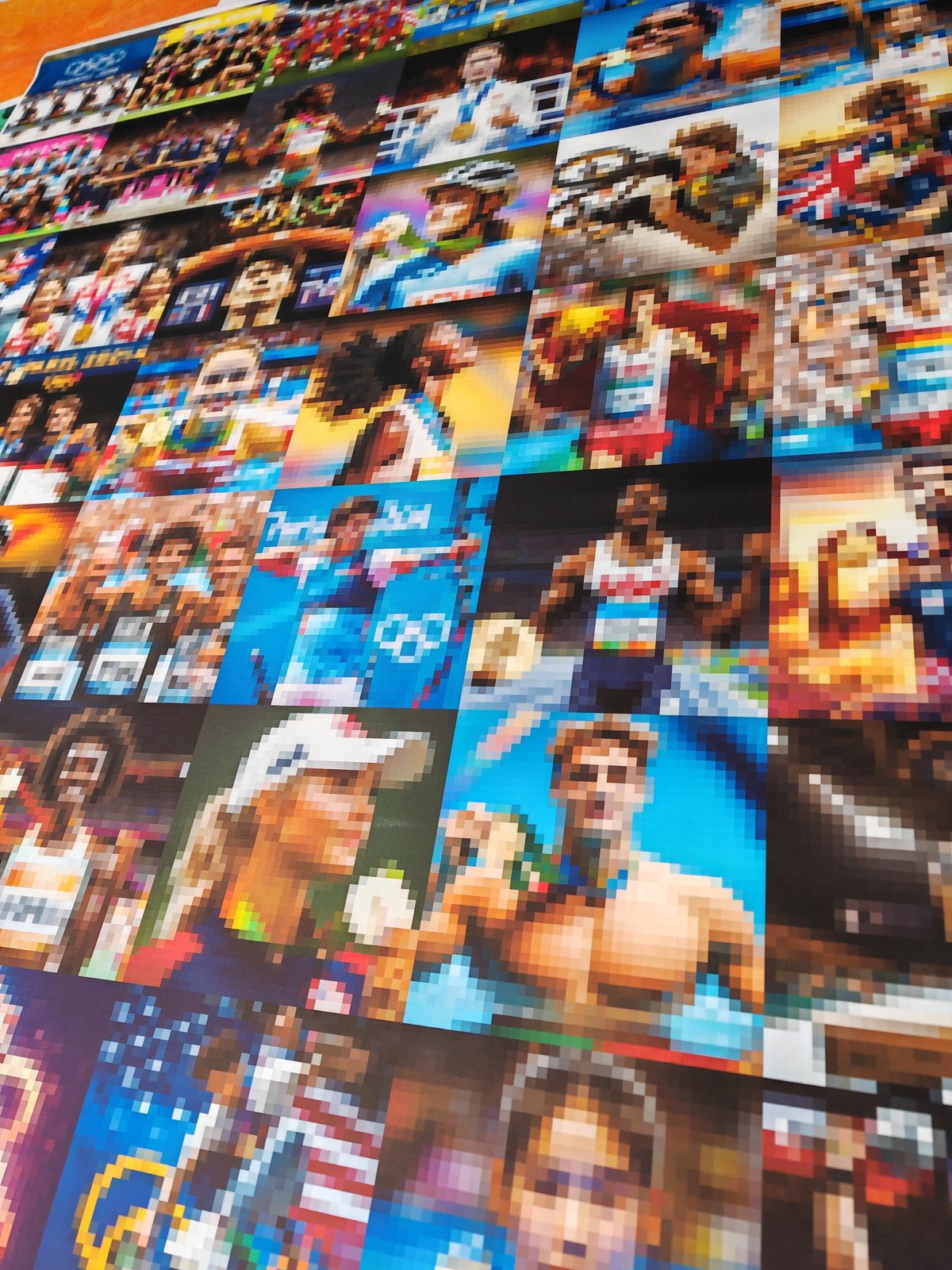
I took part in the 2024 edition, Les règles du sport, presented from 18 January to 18 February. My contribution, Quel est le vainqueur des JO 2024 dans la discipline x ?, explored Olympic results imagined before the competitions: ChatGPT proposed results and DALL·E produced images of athletes with their future medals. Sport became a setting for examining how AI gives a credible form to an event that has not yet happened. Programme du Centre Pompidou, Présentation du dispositif dans Le Monde
This experience places AI within a specific artistic and social question: our relationship to results, prediction and belief in images. It also shows how a digital practice can participate in an exhibition addressing sport, bodies and collective rules. The tool contributes to the artist's proposition; the exhibition context gives it interlocutors and significance.
2025: several French approaches to exhibiting AI
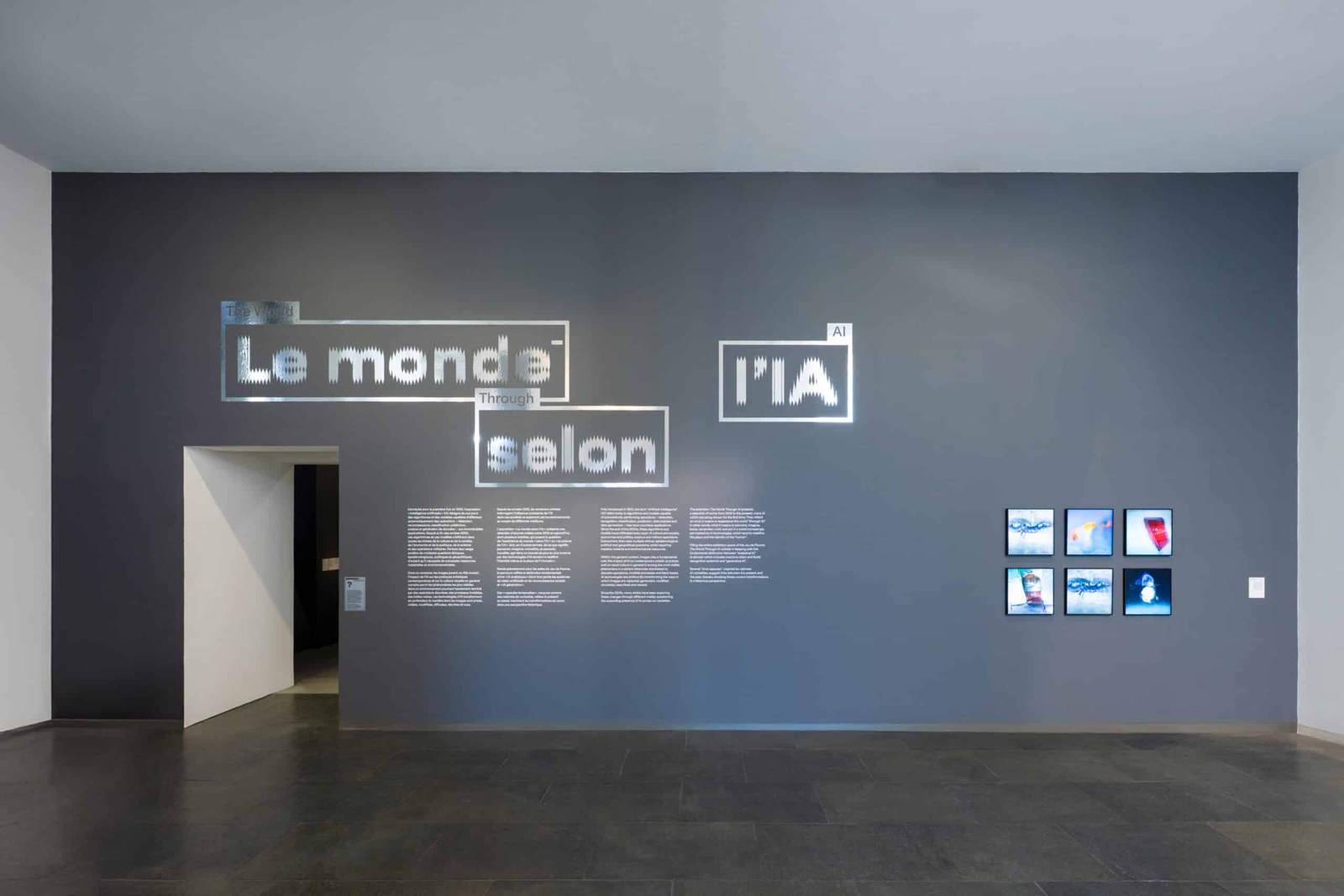
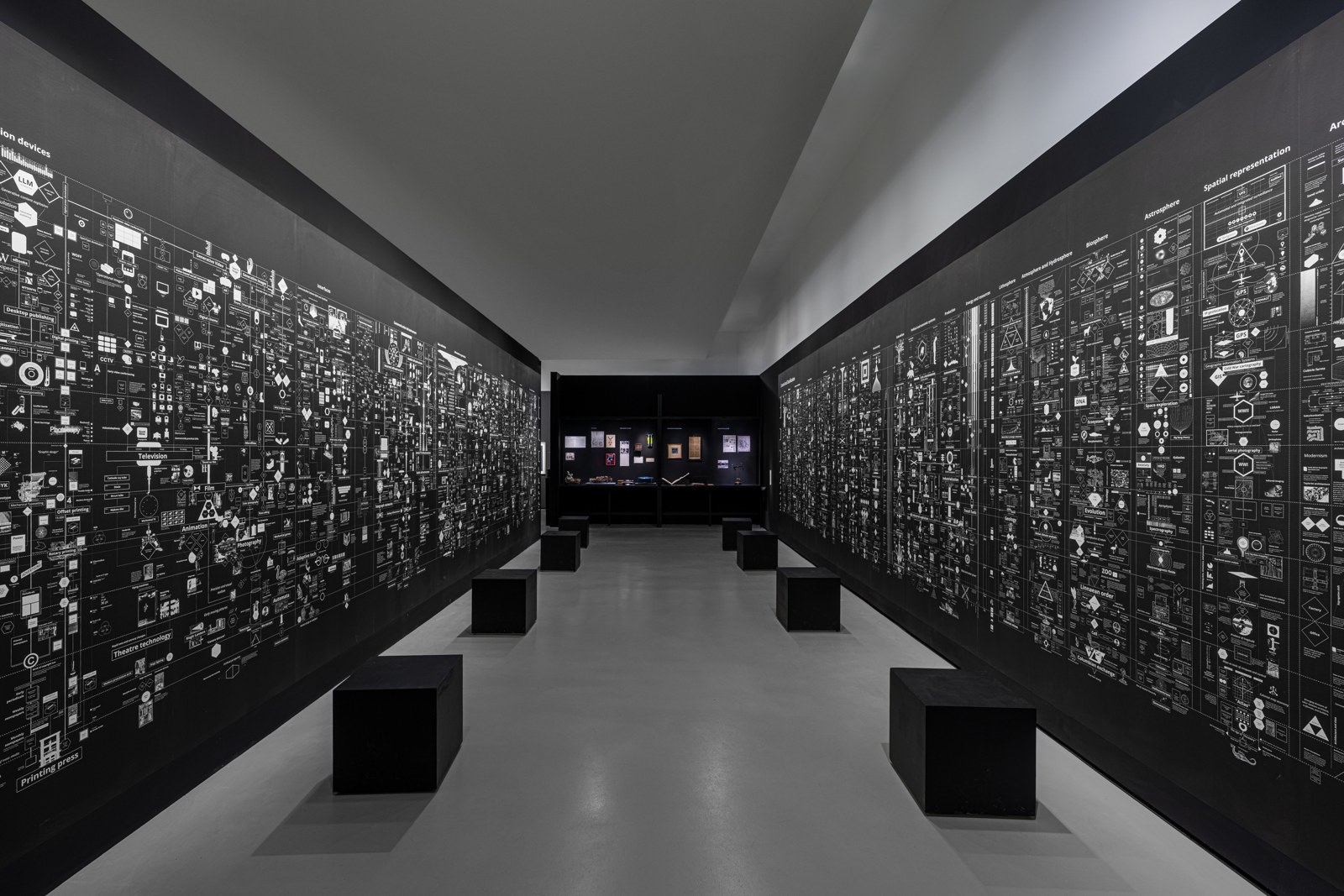
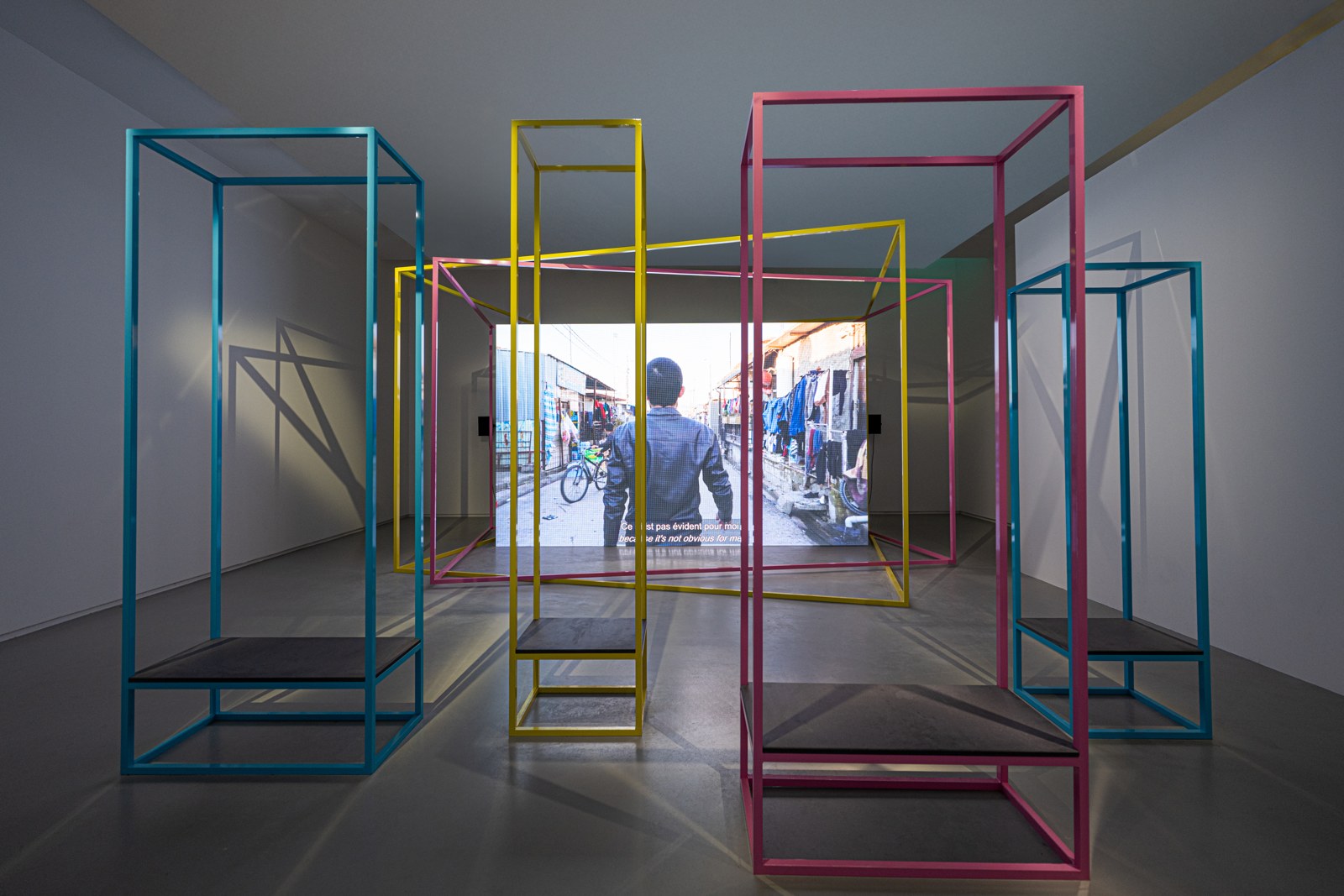
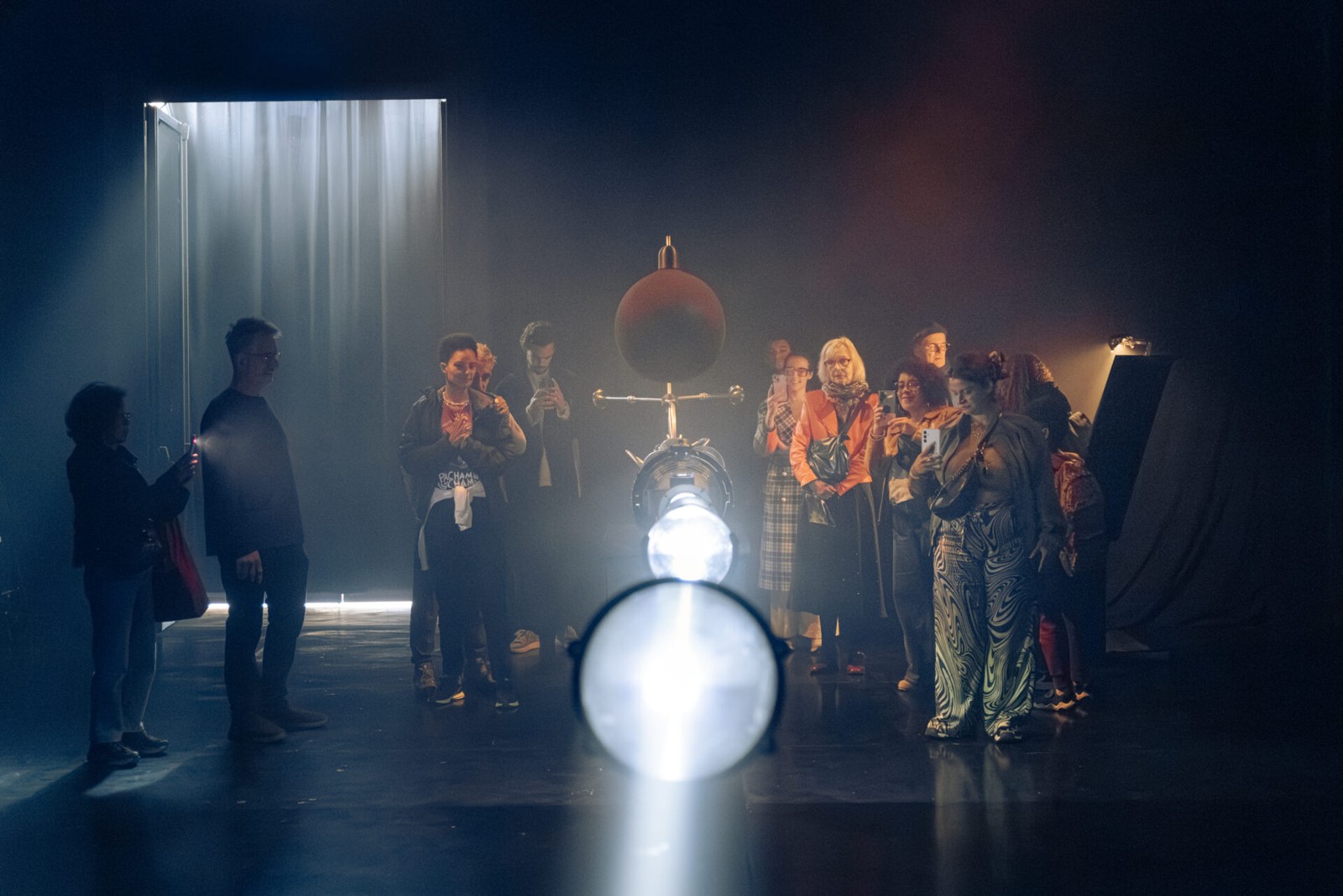
At the Jeu de Paume, Le monde selon l’IA, from 11 April to 21 September 2025, was a significant milestone. Antonio Somaini, with Ada Ackerman, Alexandre Gefen and Pia Viewing, organised a route distinguishing analytical and generative AI. The former detects, classifies or recognises; the latter produces content. Participants included Justine Emard, Julien Prévieux, Gwenola Wagon, Hito Steyerl, Trevor Paglen and Linda Dounia Rebeiz. The exhibition enabled artworks, technical operations and political implications to be examined together. Jeu de Paume
Le Fresnoy in Tourcoing illustrates another relationship: production precedes exhibition. Panorama 27, in 2025, brought together films, installations and performances in which analogue techniques, simulations and generated images coexist. This framework encourages attention to AI's role within a particular work: at what stage does it intervene, with which collaborators and how does it transform the material? Le Fresnoy
The Némo Biennial presented Les Illusions retrouvées at CENTQUATRE-PARIS from 11 October 2025 to 11 January 2026. Its programme connected AI, living systems and fiction, including Markos Kay's Voices In The Machine and L’Astrologue by Obvious and Théâtre Molière Sorbonne. Perceptual experience and imaginative worlds occupied a central position. Biennale Némo
In Billère, in the Pau metropolitan area, accès)s( presented IA : Intelligences Artistiques from 1 October to 22 November 2025. An exhibition, workshops and a lecture on AI's industrial strategies extended one another. These examples suggest approaching the French scene through several formats: museum inquiry, production within a school, immersive installation and collective experimentation. Le Bel Ordinaire
Europe: demonstrations and investigations
In London, AI: More than Human at the Barbican in 2019 connected AI's history, research and artistic creation. In Milan, Training Humans, conceived by Kate Crawford and Trevor Paglen at Fondazione Prada's Osservatorio from September 2019 to February 2020, examined images used to train computer vision systems and the categories imposed on them. Exhibiting these data makes some of the human decisions incorporated into models perceptible. Barbican, Fondazione Prada
Festivals connect artworks, research and public discussion. In Linz, Ars Electronica 2026, titled Negotiating Humanity, included an AI-focused route from 9 to 13 September. The coexistence of exhibitions, conferences and experiments provides several ways into a technical system. I see an essential festival function here: giving access to how artworks are made and to the debates they open. Programme Ars Electronica
An international landscape with different orientations
In New York, Refik Anadol's Unsupervised, presented at MoMA in 2022–2023, transformed data from the collection through machine learning into an evolving visual flow. This use of the archive raises a question of interpretation: which relationships to the source artworks remain perceptible in the resulting experience? MoMA
In São Paulo, FILE 2025: Synthetika included Transformirror by Daito Manabe and Kyle McDonald: generated images and sound participate in real-time interaction. The programme advocates creation that associates artists with generative systems. This is a curatorial position to examine through its artworks and assumptions. FILE
In Tokyo, the NTT InterCommunication Center, opened in 1997, places media arts within a sustained relationship between creation and research. In Montreal, ELEKTRA has developed the International Digital Art Biennial since 2012. These infrastructures recall that today's growth of AI draws on production and dissemination networks built over time. ICC, ELEKTRA
In Johannesburg, Fak’ugesi 2026, announced for 13–17 October, places machine intelligence in relation to imagination and the practices of African creators. This perspective extends the question of AI to languages, representation and the ability to participate in designing tools. Université du Witwatersrand / Fak’ugesi
What changes for artists, curators and critics
For artists, AI can contribute to conception, generating material, interaction or investigating an infrastructure. In Justine Emard's Co(AI)xistence, made in 2017, dancer Mirai Moriyama encounters the robot Alter. Relations between bodies, gestures and machine behaviour become the work's material. This case offers a specific approach to study: a protocol, scientific collaborations and a filmed encounter. Institut français
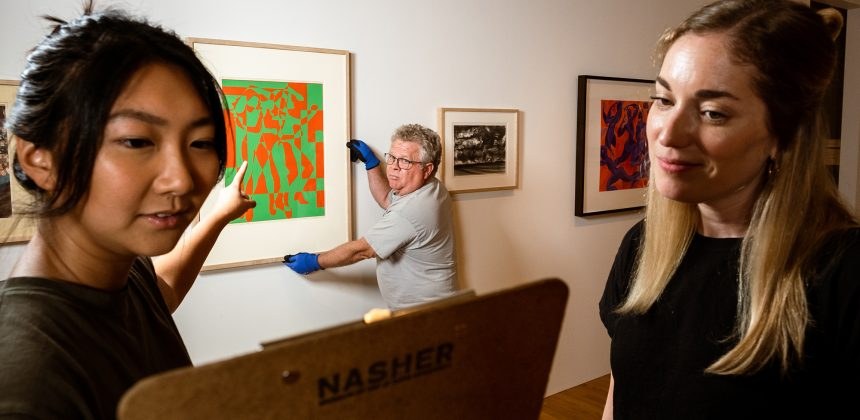
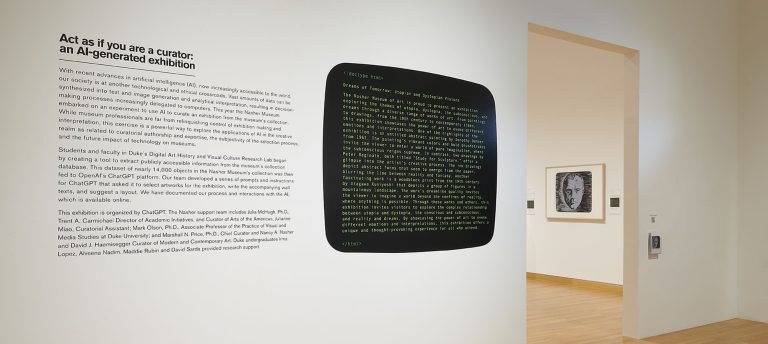
For curators, AI can also participate in decisions. At Duke University's Nasher Museum, Act as if you are a curator, from 9 September 2023 to 18 February 2024, used ChatGPT to propose selections and texts based on information about nearly 14,000 objects. The team prepared the data, formulated instructions and retained control of the project. My interpretation is that the experiment makes several sites of curatorial decision visible: constructing the catalogue, formulating the request, validation and installation. Nasher Museum
For criticism, the issue concerns both writing and verification. In September 2023, Taylor Dafoe asked ChatGPT to review this exhibition for Artnet. The system produced judgements, but also invented artists and artworks. The experiment shows why understanding a system should accompany aesthetic evaluation: a plausible commentary can rely on an object that does not exist. Taylor Dafoe, Artnet
Criticism must also be able to examine an exhibition that presents itself as critical. In a research paper posted on arXiv in 2020, Michael J. Lyons challenged some arguments made by Crawford and Paglen and questioned consent in reusing the portraits displayed. This is one position in a debate; its value lies in extending ethical examination to the exhibition's own methods. Michael J. Lyons
These examples lead to a proposition: an exhibition about AI benefits from making the decisions that produce its forms accessible. Data provenance, collaborators' interventions, selection processes, technical dependencies and possibilities for conservation become elements of interpretation. Artistic judgement remains something to develop before the artworks, through their duration and situation.
Theoretical references
Three books offer ways to continue this research: Edmond Couchot and Norbert Hillaire, L’Art numérique, Flammarion, 2003; Beryl Graham and Sarah Cook, Rethinking Curating: Art after New Media, MIT Press, 2010; Joanna Zylinska, AI Art: Machine Visions and Warped Dreams, Open Humanities Press, 2020. They provide approaches to digital history, transformations of curating and the social conditions of creating with AI. Norbert Hillaire, MIT Press, Open Humanities Press